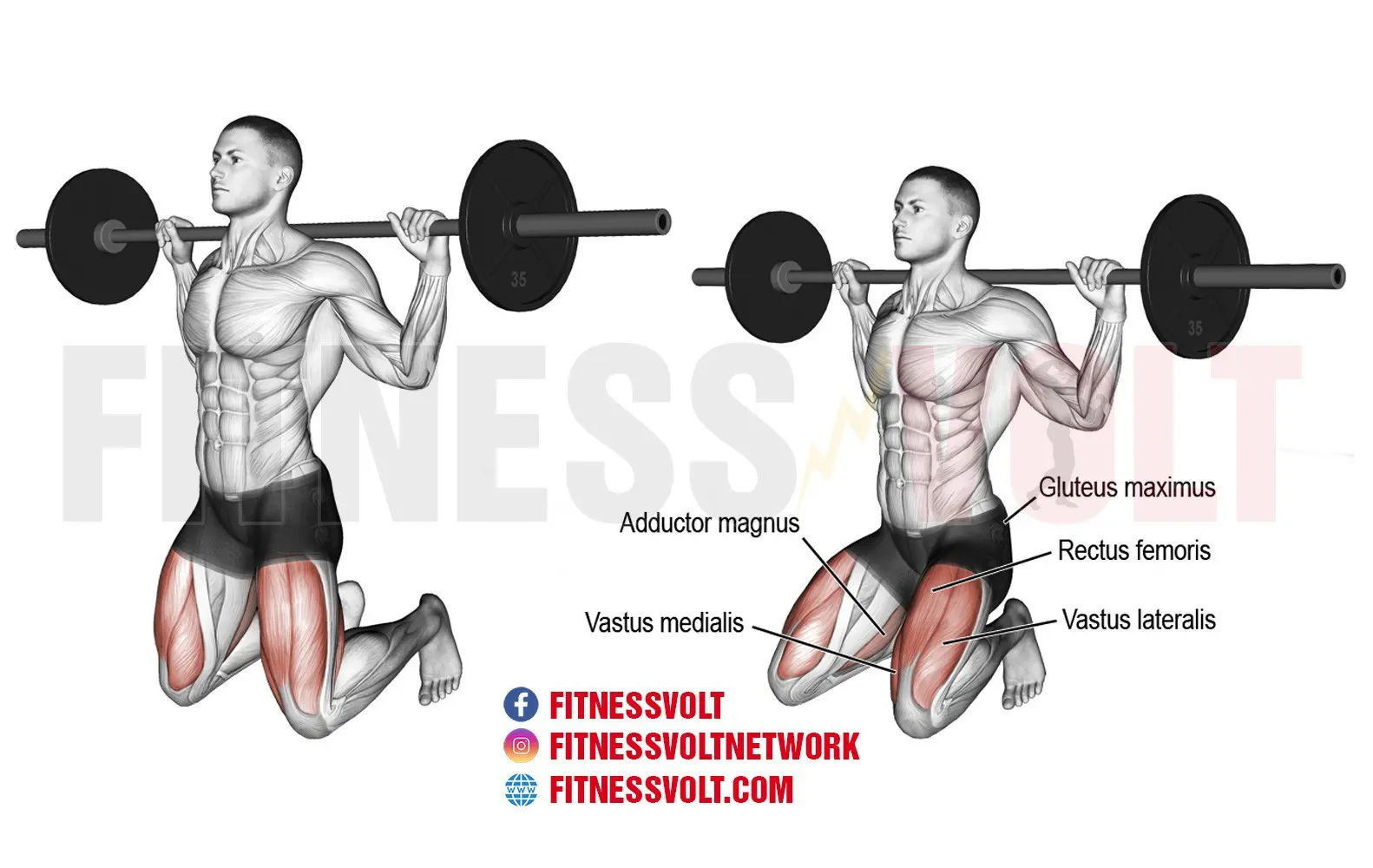
The barbell kneeling squat is an off-kilter leg-focused exercise that could actually be described as a reverse leg extension. Instead of sitting on the machine and extending the legs, the movement is done in a kneeling body position.
When done correctly, it can be an effective exercise for the glutes, quads, and hamstring muscles.
In this guide, we’ve explained what muscles it works, how to do it for best results, some useful tips, benefits of doing this movement, variations, and some ways to effectively include it in your workouts.
Summary
This is an unconventional leg exercise that has its pros and cons but overall, it can certainly build muscle and strength in the muscles of the lower body. Learn about the muscles it works, how to do it, what the benefits are, and more.
Muscles Worked
The barbell kneeling squat works the leg muscles but also the back too. Below we’ve provided descriptions of each muscle involved during this movement.
Gluteus Maximus
This is the largest and most superficial muscle that makes up the majority of the size, shape, and appearance of the butt and hip muscles. It’s also one of the butt muscles that also include the gluteus medius and minimus.
The gluteus maximus is a very important muscle for function and aesthetics. The butt primarily extends and externally rotates the thighs and it plays an important role in helping us to maintain an upright posture.
Quadriceps
The quadriceps or quads for short is the large group of muscles that make up most of your upper leg mass. It has four heads; rectus femoris, vastus lateralis, vastus medialis, and vastus intermedialis.
These muscles help to flex the hips and extend the knees during movements such as squats. They’re also important for posture, walking, and the function of the spine and pelvis.
The quads are heavily activated during the barbell kneeling squat and it is, therefore, a great way to build and strengthen these muscles.
Hamstrings
The hamstrings is a three-headed muscle group consisting of semitendinosus, semimembranosus, and biceps femoris.
This muscle group is located on the back of the upper leg opposite the quads and functions to extend the hips and flex the knees. It’s important to note that the short head of the biceps femoris only crosses the knee joint and not the hip like the other two muscles.
The hamstrings play an important role in standing but also explosive activities such as sprinting and jumping.
Additionally, this three-headed muscle is active during the gait cycle to resist knee extension, plus it stabilizes the knee joints and has other functions too.
Adductor Magnus
The adductor magnus is the largest of the muscles that make up the adductor group of muscles in the medial compartment of the thigh. While it assists during adduction of the thigh (limb moves toward the center of the body), the adductor magnus also helps with hip extension and medial rotation. It has anterior and posterior fibers that help it act on the front and back of the leg.
Erector spinae
The erector spinae are the muscles that span the length of the back on either side of the spine. They function to help us stand up straight and bend backward.
While any squat variation will involve these muscles to a great degree, the kneeling squat will especially challenge these muscles.
Rear deltoids
The rear delts are one of the three shoulder muscles and are, as the name implies, located posteriorly or on the backside of the body. These muscles originate from the shoulder blades (scapula) and insert into the upper arm (humerus). The rear delts help to move your arms backward and outward.
The muscles are engaged by holding the barbell on your upper back.
How To Do The Barbell Kneeling Squat
We recommend using either a shorter fixed barbell or a Smith machine for this exercise. It would be difficult to use a loaded freeweight barbell although some experienced lifters can do it. The advantage if using a fixed freeweight barbell is that you have freer range of movement and may be able to stay more upright.
You may need to try both to see which works better for you.
Here are step-by-step instructions.
- You’ll first need to set up the Smith machine. To do this, move the bar high enough to where you can comfortably reach above your head when in the kneeling position
- Get into the kneeling position on your knees underneath the bar and pull it down on your traps/upper back muscles on either side of your neck. You may need to do a little adjusting to get into a comfortable position. Your knees should be just about directly under the bar.
- Set the bar one notch lower than where it is when you’re in an upright position so that you can unrack the bar.
- Keeping your back straight and core tight, unrack the bar then lower your butt down to your heels.
- Squeeze your glutes as you lift up and then repeat the movement.
Here’s a video example…
Here’s a different angle.
Barbell kneeling squat tips
- For long term health of your knees, avoid using max loads for this movement. It’s more of a compliment to the big compound lifts.
- Keeping your back straight and core tight is very important for protecting the lower back and spine. This exercise has the potential to place the exerciser in a dangerous position if not using proper form throughout.
- We recommend using a shorter fixed barbell if doing the freeweight variation.
Barbell Kneeling Squat Benefits
While not our first choice and we don’t think it’s the most effective leg builder, this exercise does seem to have some benefits and advantages.
Better leg development
While the kneeling squat should not replace conventional squats that you do on your feet, it has its place. You can certainly build muscle in the legs with enough resistance and proper execution of the movement.
Not as taxing on the body but still challenging
Compared to normal squats, the kneeling squat is not as taxing although, make no mistake, it can be very challenging and you’ll feel it. In fact, just try the bodyweight-only variation of this exercise and you’ll understand what we mean.
A good option for when you do not have a leg extension machine
Whether you use a barbell, dumbbells, water jugs, or no additional weight, you can do this exercise in many different ways. It’s actually not a bad option for home training, when equipment is limited or when you only have your body weight to work with.
Easy to do
In general, this is one of the easiest exercises you can do. Simply sit back onto the heels and lift yourself back up. That means almost anyone can do it.
Drawbacks
Here are a few drawbacks of the barbell kneeling squat.
Can be tough on the knees
Like leg extensions, there’s a greater force on the knee joint, especially if using heavy weight. We don’t recommend maxing out on this movement and it may be a better option for higher rep training. This is not a movement we recommend doing a lot but it can provide additional stimulation to the leg muscles.
Can be bad for the lower back
This is not a beginner exercise because it requires a decent understanding of the importance of maintaining good form throughout the movement. Not that a beginner cannot do it properly, but repetition and experience means safer lifting overall.
Having weight on your back without the support of your legs requires more torso, and decently strong core muscles too.
Using Barbell Kneeling Squat Into Your Training Routine
While everyone has their own training regime, we can recommend a few ways to incorporate this exercise into your leg workouts.
Here are a few of our suggestions.
After your primary lifts
Why after your main movements? Because the knee joints are already warmed up as well as the quads. This could be better for the knees and you’ll feel the muscles working a lot better.
Not to mention, you may not need to use much weight to overload the muscles as you’ve already exhausted the quads which could also potentially be better for the knees.
Substitute for leg extensions
You may not have access to a leg extension machine or maybe you want to change things up a little. The barbell kneeling squat is a viable alternative.
Set and reps
There’s no perfect number of sets and reps. However, if we could make a recommendation it would be to do 2-3 sets of this exercise using a challenging weight in the 10-25 rep range.
Of course, your individual workout plan will determine the ideal sets and reps.
Barbell Kneeling Squat Variations
We like training variety which is why we’ve included this section too. Here are some variations that we recommend and that, many times are more ideal or feasible.
Bodyweight only
If you train at home, are in a situation where you are limited by your body weight, or want a simple way to finish off your legs, then you can do this variation.
We recommend using shoes and an exercise mat and you’re ready to roll.
You’ll do the exercise the same by lowering your butt down and then sitting back up.
Dumbbells/weights
Dumbbells, weight plates, a kettlebell and anything that adds resistance without having to place a barbell on your traps is arguably a more comfortable alternative. Your arms are out in front placing the shoulder in a better position and it’s easier to maintain balance too.
Sissy squat
The sissy squat is actually a genius exercise even though it could be tough on the knees and we do not recommend doing it as much as standard squat variations.
But what it does do is provide a great way to overload the leg muscles even more than the kneeling squat which could make it more effective for building leg mass and strength.
Leg extensions
As an alternative to the barbell kneeling squat, you could always just do the machine leg extension. It’s one of the most popular leg exercises that’s been used for decades and when done safely and using reasonable weight, you can help develop amazing quads and minimize long-term knee pain.
Leg Extension Alternatives: 13 Best Alternatives for Quads Size and Strength
Wrapping Up
The barbell kneeling squat can be a great leg exercise along with your other primary movements. It has its advantages and disadvantages and should not be your main lower body exercise but if done safely and correctly, you can expect an improvement in your leg development.
Training at home? Want to change up your routine at the gym? This could be a good option.
Interested in measuring your progress? Check out our strength standards for Hack Squat, Dumbbell Deadlift, Single Leg Squat, and more exercises.