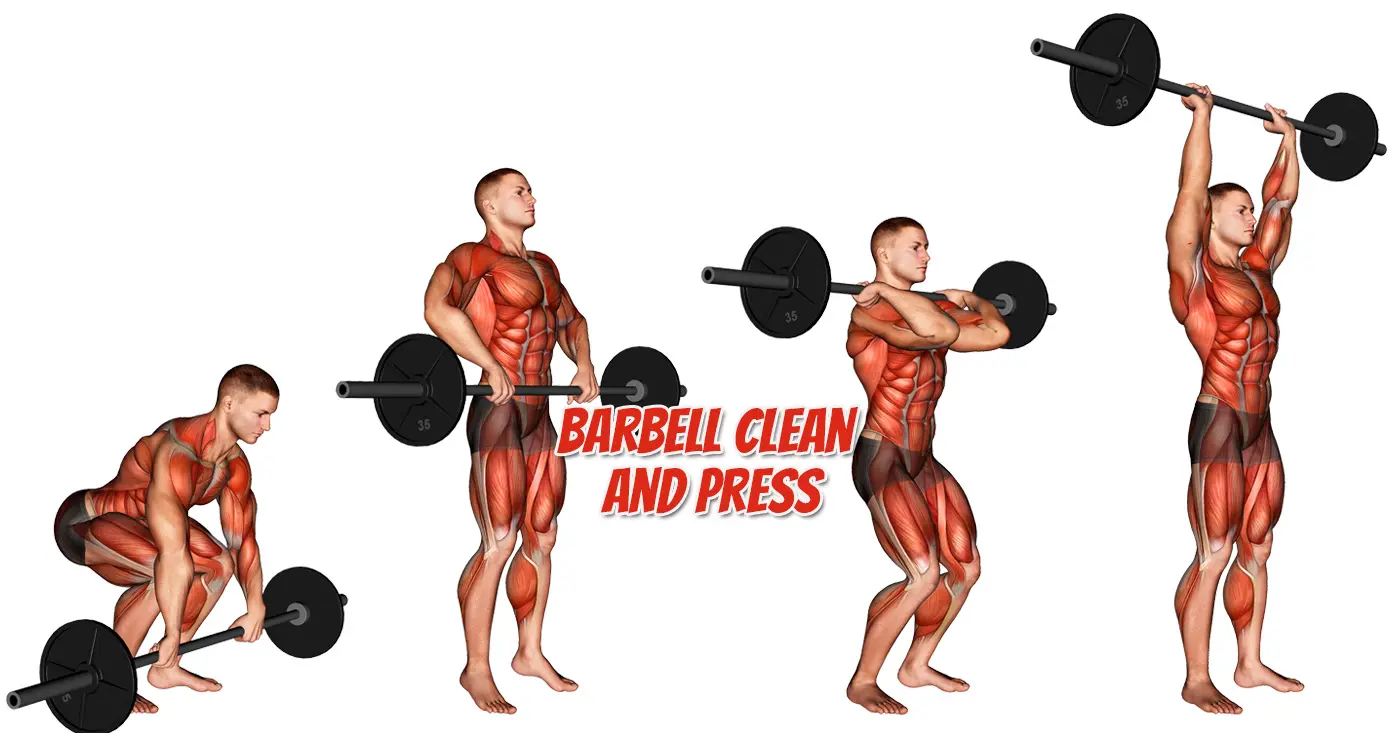
The barbell clean and press combines a clean from the floor with an overhead press. You accelerate the bar with the legs and hips, receive it on the front of the shoulders, stand tall, then press it overhead. The exercise develops clean technique, lower-body power, front-rack control, and overhead strength in one sequence, but its value depends on sound positions rather than how tired it makes you.
This guide uses a power clean, meaning the bar is received above parallel, followed by a strict press. It also covers the clean and push press as a leg-assisted variation. Those finishes are not interchangeable: the strict press uses no knee or hip drive after the clean, while the push press starts with a controlled dip and leg drive.
What Is a Barbell Clean and Press?
The barbell clean and press is a two-part compound lift:
- Clean: Move the bar from the floor to a supported front-rack position across the shoulders.
- Press: Move the bar from the shoulders to a stable overhead lockout without knee or hip drive.
The clean should send force into the bar through the floor. Your arms guide the bar and pull your body underneath it after the lower body has extended. They should not curl the bar from the floor. That distinction fixes one of the most common clean-and-press errors and keeps the bar close to the body.
The movement has a high learning requirement because it links a fast pull, a timed catch, a front-rack recovery, and an overhead press. Learn each component before treating the sequence as one repetition.
Muscles Worked by Phase
No single muscle drives the entire clean and press. The main contributors change as the bar leaves the floor, accelerates, settles into the rack, and travels overhead.
| Phase | Main muscles | Role |
|---|---|---|
| Setup and first pull | Quadriceps, gluteus maximus, hamstrings, spinal erectors, latissimus dorsi, forearm flexors | Extend the knees and hips, hold the trunk position, keep the bar close, and secure the grip. |
| Transition and second pull | Glutes, quadriceps, hamstrings, plantar flexors, upper trapezius | Accelerate the bar through rapid hip and knee extension, ankle extension, and a late shrug. |
| Turnover and catch | Quadriceps, glutes, abdominals, obliques, spinal erectors, upper back, anterior deltoids | Pull the body under the bar, absorb the catch, stabilize the trunk, and support the front rack. |
| Strict press | Anterior and lateral deltoids, triceps, upper pectoralis major | Press the bar overhead while the glutes and trunk resist rib flare and lumbar extension. |
| Push-press finish | Quadriceps, glutes, plantar flexors, deltoids, triceps | Drive the bar from the rack with the legs, transfer force through a braced trunk, and finish with the shoulders and elbows. |
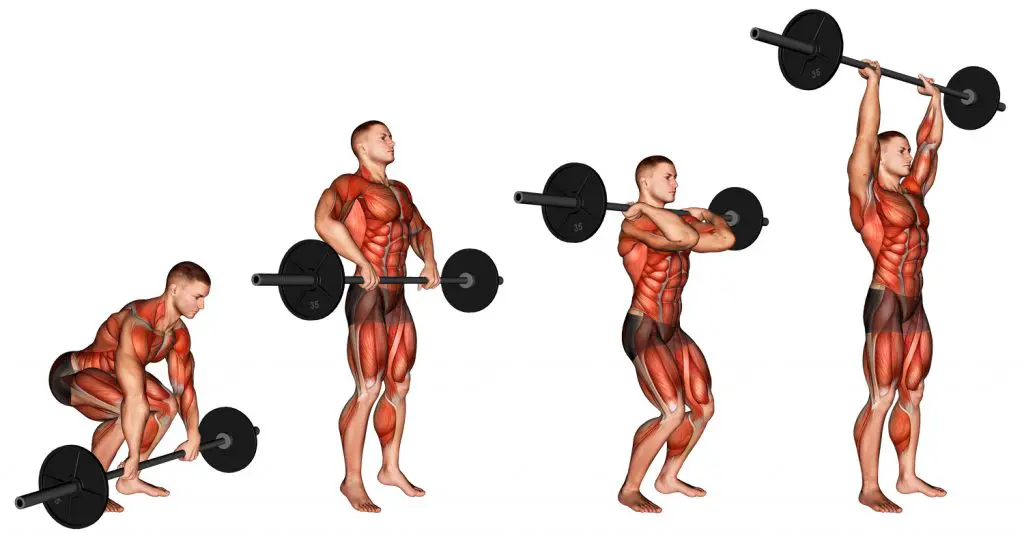
The phase table is a biomechanical overview based on the NSCA technique sources below. It does not rank muscle activation or promise equal training stimulus for every listed muscle.
Setup
Use bumper plates and a lifting platform when possible. Keep a clear drop zone around the platform and learn the facility’s bailout rules with a qualified coach before handling challenging loads.
- Stand with your feet between hip and shoulder width, toes turned out slightly, and the bar over the middle of each foot.
- Take a closed pronated grip just outside your legs, optionally securing the thumb with a hook grip. Your hands will usually sit a little wider than shoulder width.
- Bend the knees and hips until your shins approach the bar. Keep your hips lower than your shoulders and your shoulders slightly in front of the bar.
- Lift your chest without forcing an exaggerated arch. Brace your trunk, keep your elbows straight, and point them out toward the ends of the bar.
- Balance pressure through the whole foot. Pull the slack from the bar before it leaves the floor.
Your limb lengths and mobility will change the exact hip height and torso angle. The non-negotiable positions are a balanced foot, a braced trunk, straight elbows, and a bar path that starts close to the legs.
Clean Sequence
1. First pull
Push the floor away as your knees and hips extend. Keep the shoulders over or slightly ahead of the bar and preserve your torso angle as the bar passes the shins. If the hips shoot up before the shoulders, the lift turns into a rushed back-dominant pull.
2. Transition
Once the bar clears the knees, bring the knees back under it while continuing to keep it close. The bar should reach the lower-to-middle thigh with your balance near midfoot. Do not sweep the bar around the knees or drive the hips forward so hard that the bar bounces away.
3. Second pull
Extend the hips and knees hard, then finish through the ankles as the bar accelerates. Keep the elbows long during that extension. Shrug only after the lower body has driven the bar upward. Once the shoulders reach their highest point, bend the elbows and pull your body under the rising bar.
An early arm bend reduces the contribution of the lower-body extension and can send the bar forward. Keep the elbows straight through extension, then use the arms to guide your body under the rising bar.
4. Turnover and catch
Rotate the elbows around and under the bar, then receive it across the anterior deltoids and clavicles. Let the knees and hips bend to absorb the load. Keep the feet flat, the torso braced, and the bar over your base of support. The hands guide the bar, but the shoulders carry it.
Catch only as low as needed. Receiving the bar above parallel makes it a power clean. Receiving it at or below parallel makes it a full clean and demands more mobility, timing, and recovery strength. The FitnessVolt power clean guide covers the high-catch variation in more detail.
Barbell demonstration
Rack Transition Before the Press
Stand fully from the catch and regain balance before pressing. Bring the feet back to your normal pressing stance if they moved wider during the catch. Take a breath, brace, and make sure the bar rests on the shoulders rather than hanging in the hands.
For the press, lower the elbows from the high clean rack until the forearms are close to vertical beneath the bar. Keep enough shoulder contact to support the load. You may release and reset a hook grip if wrist mobility allows you to do so without losing control. Do not begin the press while still recovering from the catch.
If you cannot establish a secure rack with the wrists comfortable and the elbows in front of the bar, stop and practice the front-rack position separately. Forcing a press from the fingertips usually produces a poor bar path or a lost grip.
Strict Press Finish
A strict clean and press uses no intentional knee or hip drive after the clean.
- Stand tall with the knees extended and still, glutes firm, ribs controlled, and bar supported at the shoulders.
- Press the bar up and slightly back while moving your head out of its path.
- Once the bar clears your forehead, bring your head through so the bar finishes over the shoulders, hips, and midfoot.
- Lock the elbows and elevate the shoulders enough to support the bar overhead. Keep the trunk stacked instead of leaning back.
Use the strict finish when overhead strength and a repeatable press are the priority. The clean often limits how fresh your press feels, so load the combined exercise by the weaker component. For more detail on strict and leg-assisted pressing, see FitnessVolt’s strict press, push press, and push jerk comparison.
Clean and Push Press Finish
The clean and push press uses one dip and drive after the clean to start the bar, followed by an upper-body press. It is not a jerk because you do not re-bend the knees to receive the bar under locked arms.
- From a stable front rack, bend the knees and hips a few inches while keeping the heels down and torso vertical.
- Reverse the dip at once. Drive through the floor and extend the knees and hips so the bar leaves the shoulders.
- Continue pressing as the leg drive fades. Move the head through and lock the bar over midfoot.
- Stand motionless before lowering the bar to the shoulders.
Choose this finish when you want to coordinate lower- and upper-body power or use a load above your strict-press capacity. A dip that tips the torso forward sends the bar away from the body. A slow, deep dip also wastes the elastic transition that makes the push press effective.
Common Clean-and-Press Errors
| Error | Why it causes trouble | Correction |
|---|---|---|
| Curling the bar from the floor | The arms bend before the legs and hips finish driving, reducing bar speed and pulling the bar forward. | Keep the elbows straight through extension. Bend them only as you begin moving under the bar. |
| Hips rising first | The shoulders fall behind the pull and the lower back takes more of the load. | Push the floor away and let the hips and shoulders rise together through the first pull. |
| Bar looping away | Excess hip contact or an early arm pull creates a forward arc and a hard catch. | Keep the bar close with straight arms, then extend up rather than jumping forward. |
| Catching in the hands | The wrists and elbows absorb a load that the shoulders should support. | Turn the elbows through faster and receive the bar on the deltoids. |
| Pressing before balance returns | A rushed transition compounds a poor rack or uneven foot position. | Stand, reset the feet and grip, breathe, then press. |
| Leaning back under the press | Rib flare and lumbar extension replace a clean overhead bar path. | Squeeze the glutes, brace, and finish with the bar stacked over midfoot. |
| Turning every missed strict press into a push press | The exercise no longer matches the planned stimulus. | Choose the finish before the set and stop when that version breaks down. |
Regressions and Learning Progression
Learn from the rack and hang before adding the floor pull. This top-down sequence gives you fewer positions to solve at once.
- Front-rack hold and front squat: Build a supported rack and learn to keep the torso braced.
- Strict press: Establish a controlled overhead path with the bar starting in a rack.
- Push press: Add a vertical dip and drive after the strict press is consistent.
- Clean deadlift and clean pull: Practice the first pull, transition, and full lower-body extension without a catch.
- Hang power clean: Start above the knees to shorten the pull and focus on extension, turnover, and the rack. NSCA identifies this variation as less technically demanding than a power clean from the floor. FitnessVolt’s hang clean guide shows this starting position.
- Power clean from the floor: Add the first pull only after the hang clean stays close and lands in a stable rack.
- Clean plus chosen press: Combine the parts with one clean followed by one strict press or push press.
Lifters who cannot tolerate a barbell front rack can practice a neutral-grip version with dumbbells. The dumbbell clean and press also lets each arm find its own path, although it remains a technical lift.
Kettlebell option
A single-kettlebell clean and press reduces the total load and lets you learn one side at a time. Keep the bell close during the clean and rotate the hand around it so it settles against the forearm instead of crashing onto the wrist.
Hang clean option
The hang clean starts with the bar held above the knees, removing the floor-to-knee portion. It is useful when the first pull adds more complexity than the athlete can manage during the same session.
How to Program the Clean and Press
Place clean-and-press work near the start of a session, after the general warm-up and movement preparation. Fatigue can slow the turnover, change the catch, and pull the press away from its planned form. The table offers sample starting prescriptions, not universal rules. The NSCA clean progression and 2023 NSCA weightlifting position statement support sequential skill development and deliberate changes to exercise variation, load, and volume.
| Goal | Working sets | Reps | Rest and loading |
|---|---|---|---|
| Technique practice | 3 to 5 | 1 to 3 | Rest 2 to 3 minutes. Use a load that leaves every catch and press crisp. |
| Strength and power | 4 to 6 | 1 to 3 | Rest 2 to 4 minutes. Add load only while bar path and timing remain stable. |
| Moderate-load practice | 3 to 4 | 3 to 5 | Rest 2 to 3 minutes. Stop the set before speed or rack quality drops. |
Avoid using 15 to 30 continuous repetitions for this technical combination lift. If bar path, catch timing, or overhead position changes, stop the set and use simpler presses, rows, squats, or cyclical exercise for high-repetition conditioning.
One or two weekly practice sessions can suit a lifter learning the movement when the rest of the program leaves room for recovery. Keep the combined movement low in total repetitions, then add separate front squats, pulls, or presses if you need more strength volume. Track the strict clean and press separately from the clean and push press. Formula-based estimates from FitnessVolt’s one-rep max calculator are rough for a technical explosive combination lift; do not calculate them from fatigued, high-repetition clean-and-press sets.
Who Should Use the Clean and Press?
The exercise suits intermediate lifters who want to combine a clean derivative with overhead strength, field or court athletes whose programs include coached power training, and strength trainees who can already front-rack and press without pain. It can also serve as a compact main lift when training time is limited, provided neither half of the movement gets rushed.
Beginners should earn the movement through the progression above. A qualified weightlifting or strength coach can shorten the learning curve because bar path and catch timing are difficult to judge from inside the lift.
Choose another exercise for now if you cannot hold a front rack, cannot stabilize a light bar overhead, have pain during either phase, or train in a space where a missed bar cannot be released safely. Shoulder, wrist, elbow, back, hip, or knee symptoms need an individual assessment rather than a generic form adjustment from an article.
Clean and Press Compared With Similar Lifts
| Exercise | Starts where? | Ends how? | Key distinction |
|---|---|---|---|
| Clean and press | Floor | Strict press | The bar is cleaned to the shoulders and pressed overhead without knee or hip drive. |
| Clean and push press | Floor | Leg-assisted press | The bar is cleaned to the shoulders, then one dip and drive starts the overhead press. The lifter does not re-bend the knees to receive the bar. |
| Clean and jerk | Floor | Jerk | After the clean, the lifter drives the bar up and moves under it with bent or split legs before standing. The IWF clean-and-jerk explanation defines the competition lift; detailed jerk technique belongs in its own guide. |
| Power clean | Floor or hang | Front rack | The lift ends at the shoulders, with the bar received above parallel. There is no overhead phase. |
| Military press | Shoulders or rack | Strict overhead lockout | There is no clean. The traditional military press uses a strict body position, often with a narrower stance and no leg drive. |
| Push press | Shoulders or rack | Leg-assisted overhead lockout | There is no required clean. One dip and drive starts the bar, and the arms complete the press without re-bending the knees to catch it. |
The name on your training log should match the finish you perform. Write clean and strict press when the knees stay extended and still after the rack, and clean and push press when you use leg drive. That record makes load changes and technical progress easier to interpret.
Sources
- National Strength and Conditioning Association. (2017). Power Clean. Exercise Technique Manual for Resistance Training, Third Edition.
- National Strength and Conditioning Association. (2017). The Power Clean Progression. Foundations of Coaching Lifts.
- National Strength and Conditioning Association. (2022). Power Clean From Hang. Developing Power.
- Waller, M., Bonder, I., Tangeman, M., Shim, A., & Piper, T. (2023). Integration of Clean Variations, Progressions, and Application in Strength and Conditioning Programs. NSCA Coach, 10(1).
- Comfort, P., Haff, G. G., Suchomel, T. J., et al. (2023). National Strength and Conditioning Association Position Statement on Weightlifting for Sports Performance. Journal of Strength and Conditioning Research, 37(6), 1163-1190. PMID: 36952649. DOI: 10.1519/JSC.0000000000004476.
- International Weightlifting Federation. (2025). Knowing One of the Basic Lifts: Clean and Jerk. Accessed July 12, 2026.
Interested in measuring your progress? Check out our strength standards for barbell clean and press, Half Squat, Hang Snatch, and more exercises.