

Assisted Prone Lying Quads Stretch vs Assisted Prone Rectus Femoris Stretch: Complete Comparison Gui
Assisted Prone Lying Quads Stretch vs Assisted Prone Rectus Femoris Stretch — both are beginner-friendly prone stretches that target the front of the thigh, but they load the quad differently. You’ll get clear cues, biomechanics-based differences, equipment needs, progression tips, and practical recommendations for mobility, muscle length, and training transfer. Read on to learn which stretch better targets the rectus femoris versus the whole quadriceps group, how to set up safe 60–90 second holds, and when to pick one for sport, rehab, or daily mobility.
Exercise Comparison
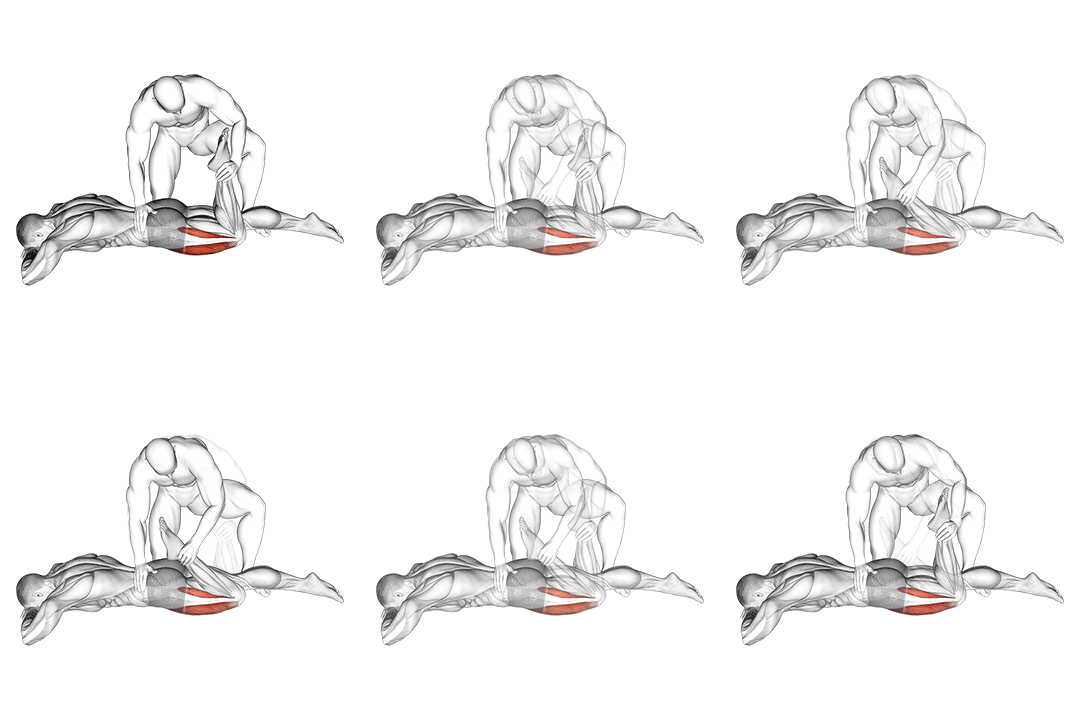
Assisted Prone Lying Quads Stretch
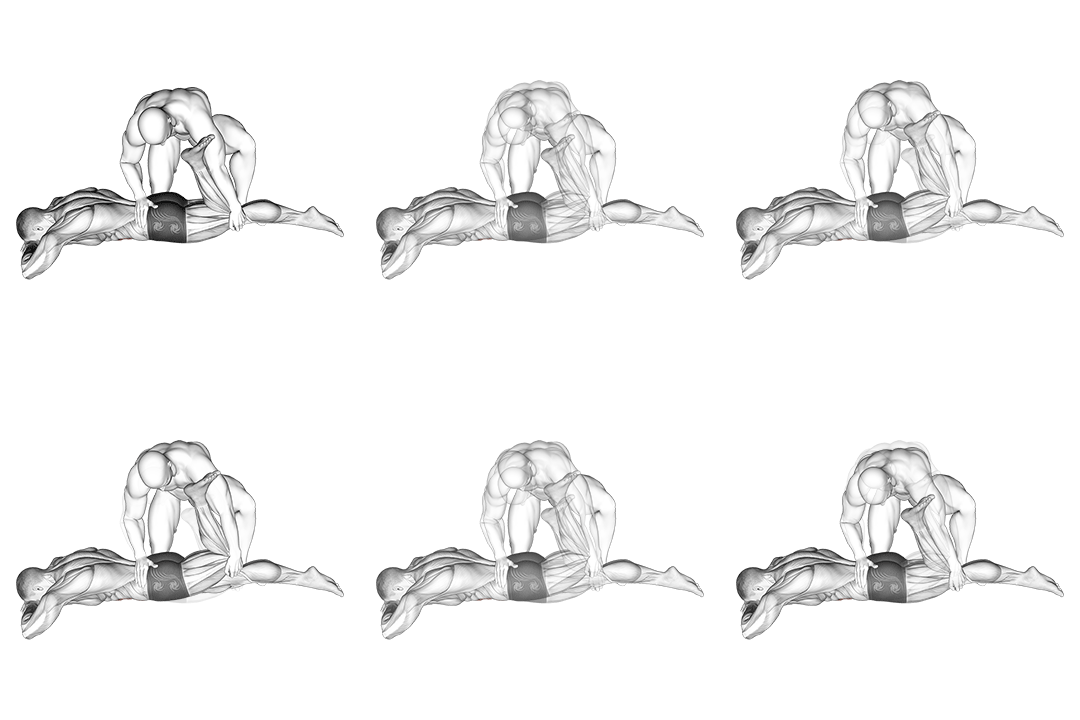
Assisted Prone Rectus Femoris Stretch
Head-to-Head Comparison
| Attribute | Assisted Prone Lying Quads Stretch | Assisted Prone Rectus Femoris Stretch |
|---|---|---|
| Target Muscle |
Quads
|
Quads
|
| Body Part |
Upper-legs
|
Upper-legs
|
| Equipment |
Other
|
Other
|
| Difficulty |
Beginner
|
Beginner
|
| Movement Type |
Isolation
|
Isolation
|
| Secondary Muscles |
2
|
1
|
Secondary Muscles Activated
Assisted Prone Lying Quads Stretch
Assisted Prone Rectus Femoris Stretch
Visual Comparison
Overview
Assisted Prone Lying Quads Stretch vs Assisted Prone Rectus Femoris Stretch — both are beginner-friendly prone stretches that target the front of the thigh, but they load the quad differently. You’ll get clear cues, biomechanics-based differences, equipment needs, progression tips, and practical recommendations for mobility, muscle length, and training transfer. Read on to learn which stretch better targets the rectus femoris versus the whole quadriceps group, how to set up safe 60–90 second holds, and when to pick one for sport, rehab, or daily mobility.
Key Differences
- Both exercises target the Quads using Other. The main differences are in their movement patterns and muscle activation angles.
Pros & Cons
Assisted Prone Lying Quads Stretch
+ Pros
- Simple setup—bench or mat plus strap or towel
- Evenly lengthens the whole quadriceps group
- Low learning curve; good for beginners and rehab
- Easy to perform solo with minimal space
− Cons
- Less specific for rectus femoris, so limited biarticular lengthening
- May not restore hip-extension range as effectively
- If pelvis lifts, lumbar extension can reduce effectiveness
Assisted Prone Rectus Femoris Stretch
+ Pros
- Targets rectus femoris specifically by combining hip extension with knee flexion
- Provides deeper anterior thigh and hip flexor lengthening
- Better for athletes needing improved hip extension during gait or sprinting
- Progression options include greater hip extension angle and active holds
− Cons
- Requires precise pelvic control to avoid lumbar strain
- Slightly harder to set up and perform without a partner or strap
- Can irritate anterior knee if excessive force is applied
When Each Exercise Wins
The rectus femoris stretch exposes the biarticular muscle to longer muscle lengths, increasing time-under-tension at extended sarcomere lengths; aim for 60–120s holds and 3–4 sets to leverage stretch-mediated hypertrophy signaling.
Improving uniform quadriceps length and knee-extension range with the lying quads stretch transfers better to closed-chain lifts (squat, lunge). Use 2–4 sets of 60–90s to increase ROM and allow stronger force production through deeper joint angles.
Its simple alignment and low demand on hip-control make it easier for beginners to perform safely and consistently, producing reliable improvements in anterior thigh flexibility with minimal cueing.
Needs only a towel or strap and minimal space; you can perform it on a mat or bed without a partner, making it the most practical home option.
Frequently Asked Questions
Can I do both Assisted Prone Lying Quads Stretch and Assisted Prone Rectus Femoris Stretch in the same workout?
Yes. Use the lying quads stretch first to broadly reduce quad stiffness (2 sets of 60s), then add 1–2 targeted rectus femoris holds (60–90s) to accentuate biarticular length. Keep total time under 10–12 minutes to avoid over-stretching and include posterior pelvic tilt cues.
Which exercise is better for beginners?
The Assisted Prone Lying Quads Stretch is better for beginners because alignment is simpler and it requires less hip-control. Start with 30–60 second holds, focus on breathing and keeping the pelvis flat, then progress hold time as mobility improves.
How do the muscle activation patterns differ?
The lying quad stretch applies a knee-focused lengthening force, distributing passive tension across all quad heads. The rectus femoris variation adds hip-extension length, increasing passive tension specifically in rectus femoris due to its biarticular nature and shifting the length-tension relationship toward greater sarcomere stretch.
Can Assisted Prone Rectus Femoris Stretch replace Assisted Prone Lying Quads Stretch?
Not entirely. If your goal is general quad flexibility or squat depth, the lying quads stretch is more comprehensive. If you need targeted rectus femoris length for sprinting or hip-extension mobility, the rectus femoris stretch can replace the general stretch in that context—but combine both for broad benefits.
Expert Verdict
Use the Assisted Prone Lying Quads Stretch when you want a reliable, easy-to-teach method to increase overall quadriceps length, improve knee-extension range, and support strength work like squats. Perform 2–4 sets of 60–90 second holds, keep a posterior pelvic tilt, and brace your core to avoid lumbar extension. Choose the Assisted Prone Rectus Femoris Stretch when you need targeted rectus femoris length for athletic sprint mechanics or stretch-mediated muscle remodeling: emphasize hip extension of 10–30°, maintain pelvis contact with the bench, and progress hold time to 60–120 seconds. If you train at home or are new to stretching, pick the lying quads stretch; if you require deeper anterior thigh length and have good core control, prioritize the rectus femoris variation.
Also Compare
More comparisons with Assisted Prone Lying Quads Stretch
More comparisons with Assisted Prone Rectus Femoris Stretch
Compare More Exercises
Use our free comparison tool to analyze any two exercises head-to-head.
Compare Exercises