

Every federation requires a minimum set of equipment to compete. While specific rules vary, the following are universally mandatory:
Singlet: A one-piece, non-supportive garment worn during competition. It must fit properly (not sagging or bunching) and be made of non-elastic material. Most are nylon or polyester. For training, you do not need to wear one - but you must own an approved singlet before your first meet.
Compression shorts or briefs: Worn under the singlet. Must not extend below the singlet hem. Many federations prohibit supportive shorts (tight compression garments) in raw divisions.
T-shirt: Worn under the singlet for the squat and deadlift in most federations. The sleeves must not extend below the elbow. Long-sleeved shirts are prohibited in raw divisions in most federations.
Deadlift socks: Required at many federations to prevent shin abrasions from the bar. Must cover the shins completely during the deadlift. Knee-high socks are the standard choice.
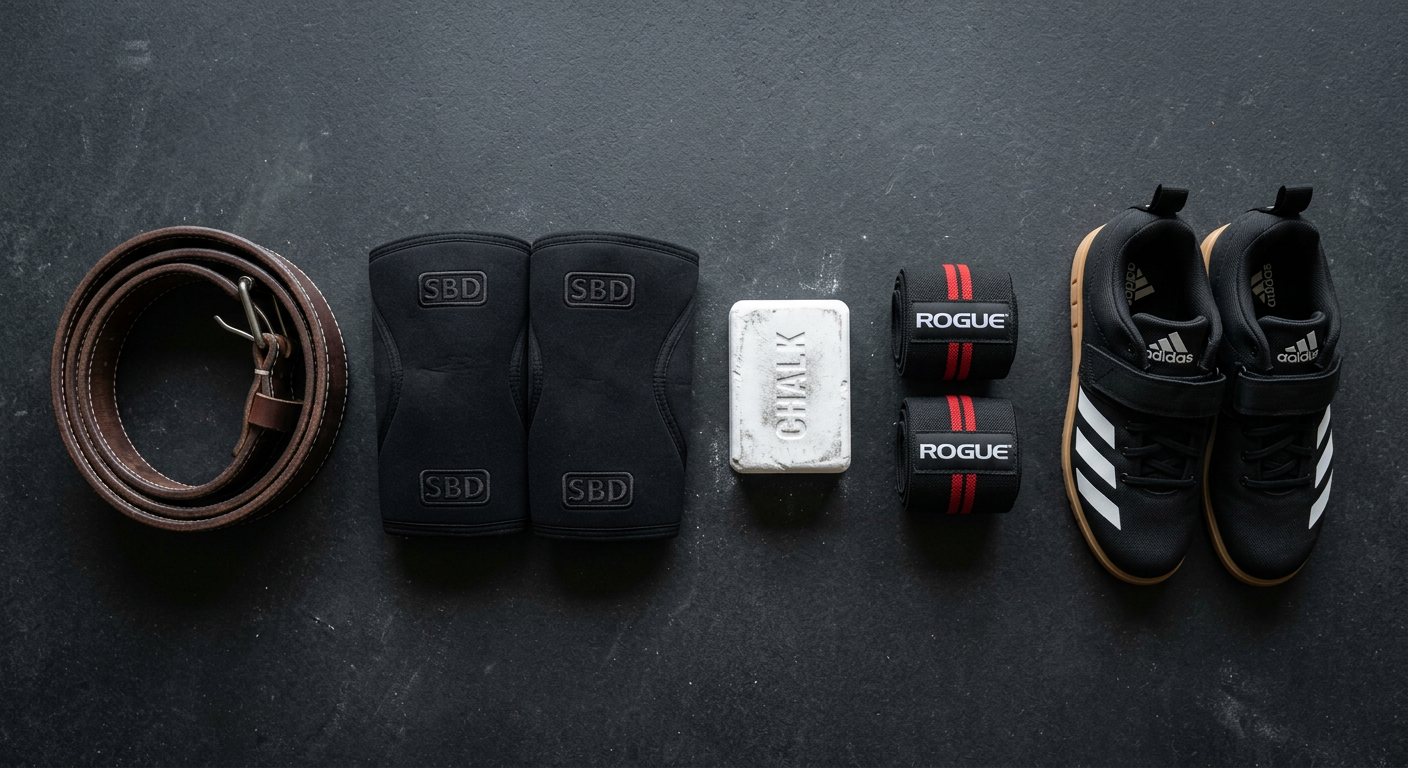
Powerlifting Equipment Guide: What to Buy and Why
A practical breakdown of every piece of equipment used in powerlifting - from mandatory competition gear to performance accessories - with buying advice and federation compliance notes.
Updated March 1, 2024Mandatory Competition Equipment
The Belt
A powerlifting belt is the single most impactful piece of optional equipment for raw lifters. It increases intra-abdominal pressure, stabilising the spine and allowing greater force transfer through the trunk.
Lever vs prong: Lever belts buckle with a metal lever mechanism - fast to put on and take off, fixed circumference. Prong belts use a traditional belt-and-hole system - slightly more adjustable but slower. Both are legal in competition.
Thickness: 10 mm (IPF-legal, good for most lifters) or 13 mm (stiffer, preferred by some advanced lifters, banned in IPF).
Width: 10 cm is the maximum allowed in most federations. Some lifters prefer a 7.5 cm belt that sits more comfortably.
Learning to use a belt: A belt does not work automatically. You must actively brace against it - breathing into the belt, creating tension around the entire midsection. Practise this regularly in training before your first competition.
Knee Sleeves and Knee Wraps
These are not interchangeable - they serve different purposes and are permitted in different divisions.
Knee sleeves (neoprene cylinders): Provide warmth, compression, and a modest rebound effect at the bottom of the squat. Legal in raw/classic divisions at most federations. Common thickness: 5 mm (light support) or 7 mm (more support and rebound). Sleeves should fit tightly - if you can put them on without effort, they are too loose.
Knee wraps (elastic wraps): Wound tightly around the knee, providing significantly more rebound than sleeves. Only legal in equipped or 'wraps' divisions. Wraps require practice to apply correctly - too loose and they do not help; too tight and they restrict movement or cut off circulation.
If you are a beginner: Start with knee sleeves or train without them entirely. Do not use wraps until you are competing in a wraps division.
Wrist Wraps
Wrist wraps stabilise the wrist joint during the bench press and overhead pressing movements. They are particularly useful for lifters with previous wrist injuries or those pressing very heavy loads.
Types: Cotton wraps (more flexibility, lighter support) or stiffer wraps with more elastic content (greater support, less range of motion). For powerlifting, stiffer wraps are more common.
Length: 30 cm (light support, good for most training), 45 cm (moderate support), or 60 cm (maximum support, IPF limit is 100 cm). Most federation rules specify a maximum wrap length.
Application: Wrap firmly around the wrist joint (not up the forearm). The thumb loop holds the wrap in position but should be removed before the lift in some federations - check the rules.
Footwear
Footwear affects squat mechanics significantly. Deadlift footwear is less complex.
Squat shoes (weightlifting shoes): Feature a raised heel (typically 0.75 to 1 inch), a very firm sole, and a secure upper. The heel elevation shifts the torso upright, improving depth and reducing forward lean. Ideal for high-bar squatters and lifters with limited ankle mobility.
Flat shoes (powerlifting shoes or canvas shoes): A very flat, thin sole that puts the foot close to the ground. Preferred by low-bar squatters and most deadlifters. Chuck Taylors are a classic choice. Many dedicated powerlifting shoes have an even thinner sole.
Deadlift: Most lifters pull in flat shoes to minimise the distance the bar travels. Some lifters pull in socks (deadlift slippers) to get the bar as close to the legs as possible - check federation rules on this.
Buying advice: If you can only buy one pair, flat shoes are more versatile across all three lifts.
Chalk
Chalk (magnesium carbonate) dries the hands and improves grip on the bar. It is the most used and least expensive performance aid in powerlifting.
Chalk vs liquid chalk: Block chalk is messier but more effective. Liquid chalk dries on the hands and is allowed in commercial gyms where loose chalk is banned. Both are legal in competition.
Application: Apply chalk to the palms and fingers, then rub your hands together to distribute it. Re-apply between attempts. Many lifters also chalk the upper back for squatting to prevent bar slippage.
Federation rules: Most federations allow chalk at competition. Some require you to use chalk provided by the meet rather than bring your own - check in advance.
Equipped Lifting Gear
Equipped divisions allow supportive gear that stores elastic energy and assists the lift. This gear is separate from raw/classic equipment and requires significant practice to use effectively.
Squat suit: A tight, single-ply or multi-ply suit made from polyester (single-ply) or denim/canvas (multi-ply). Provides support at the bottom of the squat and significant rebound assistance.
Bench shirt: A very tight shirt made from polyester or canvas. The material stretches when the bar descends, storing energy that assists the press. Touch weight (the minimum weight needed to touch the chest) can be very high in bench shirts.
Deadlift suit: Similar to a squat suit but with a looser cut. The support is primarily at the hips and bottom of the pull.
Getting started with equipment: Find an experienced equipped lifter or coach to help you learn the gear. Breaking into equipped lifting without guidance is difficult - the gear is hard to put on, moves the lifting mechanics significantly, and requires a learning curve of several training cycles.
What to Buy First
For a lifter preparing for their first meet, prioritise in this order:
1. Singlet - required to compete, buy this first
2. Belt - the biggest performance gain for the money
3. Deadlift socks - cheap and often required
4. Knee sleeves - if you squat and want extra support/warmth
5. Chalk - inexpensive and effective
6. Wrist wraps - useful if bench pressing heavy
7. Lifting shoes - meaningful investment, but flat-soled sneakers work fine to start
Spend money on quality for items that touch your body (belt, sleeves). Brand matters less for chalk and socks.