

Injuries are common in powerlifting. A large survey of competitive powerlifters found that roughly 50-65% experience a training-related injury each year significant enough to affect training. This does not mean powerlifting is uniquely dangerous - injury rates are comparable to other strength sports and lower than many team sports - but it does mean most serious lifters will deal with injury at some point.
The most commonly injured areas are, in order: the shoulder, lower back, knee, and hip. Many of these injuries are overuse injuries from accumulated training stress rather than acute traumatic events. Understanding this changes how you respond - rest alone is rarely the answer.
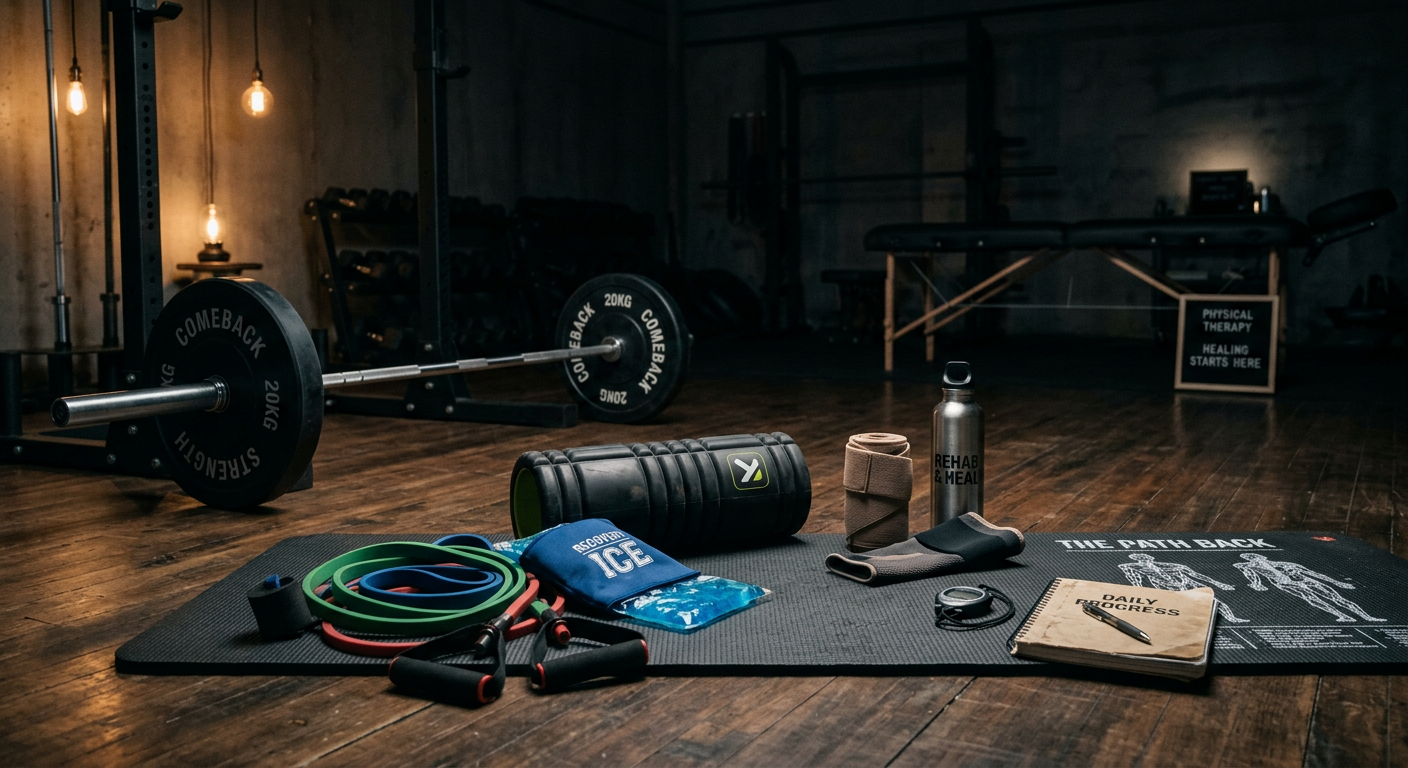
Injury Recovery and Prevention for Powerlifters
How to manage common powerlifting injuries, train around pain without losing progress, return to competition after time off, and build resilient programming that reduces injury risk over the long term.
Updated March 15, 2024The Reality of Injury in Powerlifting
Acute vs Overuse Injuries
Acute injuries happen suddenly - a pec tear during a heavy bench press, a bicep pop at the top of a deadlift, a knee pop during a squat. These require immediate medical evaluation and potentially imaging. Training must stop until you have professional guidance.
Overuse injuries develop gradually from repetitive stress exceeding tissue recovery capacity. Patellar tendinopathy, lower back pain, shoulder impingement, and hip flexor tightness are typical examples. These are far more common than acute injuries.
Key distinction: Overuse injuries rarely require complete rest. In most cases, the prescription is load management - reducing the volume and intensity that aggravates the tissue while maintaining as much training as possible.
Common Injuries and How to Manage Them
Lower back pain: The most common complaint in powerlifters. Distinguish between muscular soreness (diffuse, improves with movement) and disc-related pain (sharp, radiating into the leg). For muscular issues, reduce deadlift volume temporarily, add back extensions and core work, and address technique. Disc issues require professional assessment.
Patellar tendinopathy: Pain below the kneecap, often worsened by squatting. Heavy slow resistance (HSR) protocol - slow, heavy knee extensions - has strong evidence for tendon remodelling. Reduce squat depth temporarily; avoid complete rest.
Shoulder impingement: Often caused by bench pressing with a wide grip or excessive shoulder external rotation demands. Temporarily reduce training load, work on shoulder mobility and rotator cuff strengthening, and adjust grip width or technique.
Bicep tendinopathy: Pain at the front of the shoulder, aggravated by curls and sometimes deadlifts. Often a supination grip issue in deadlift. Consider switching to double overhand or mixed grip; add heavy slow resistance for bicep tendons.
Training Around Injuries
The goal when injured is to maintain as much training stimulus as possible while allowing the injured tissue to recover. Stopping all training is rarely necessary and usually counterproductive.
The traffic light framework:
- Green (0-3/10 pain): Train normally, monitor closely
- Yellow (3-5/10 pain): Reduce load and range of motion; substitute exercises that do not provoke symptoms
- Red (5+/10 pain, or sharp/catching pain): Stop the aggravating movement; see a professional
Substitution strategies:
- Lower back injury: Replace deadlifts with trap bar deadlifts, leg press, or RDLs in a pain-free range
- Knee injury: Replace squats with box squats (reduced depth), leg press, or split squats
- Shoulder injury: Replace bench press with floor press, dumbbell press, or close-grip press
Returning to Lifting After Time Off
Returning from injury or extended time off requires a planned approach. Strength detrains more slowly than cardiorespiratory fitness - you will not lose as much as you fear in 4-8 weeks - but rushing the return is the most common way to re-injure.
Return-to-training framework:
1. Pain-free range of motion first: Before adding load, confirm you can move through the full range of motion without pain.
2. Start at 50-60% of previous working weights: Your muscles may remember the movement, but tendons and connective tissue adapt more slowly.
3. Progress 5-10% per week: More conservative than standard LP. Let the connective tissue catch up to muscular adaptation.
4. Monitor for symptom flare-ups: Some post-injury soreness is normal; sharp pain, swelling, or pain that worsens with each session is a signal to slow down.
5. Expect 4-8 weeks to return to previous performance: Most lifters who have been out 2-6 weeks return to previous levels within 6-8 weeks.
Injury Prevention: Programming Principles
Most overuse injuries are preventable with good programming practice.
Avoid large volume spikes: Do not increase total training volume by more than 10-15% week to week. Rapid volume increases are the primary cause of overuse injury in powerlifters.
Include planned deloads: A deload (reduced volume and intensity week) every 4-8 weeks allows accumulated tissue stress to dissipate before it becomes an injury. This is not optional for intermediate and advanced lifters.
Address weak points proactively: Many powerlifting injuries originate from muscular imbalances. Rotator cuff weakness leads to shoulder injury; weak glutes contribute to lower back problems. Accessory work that addresses these imbalances is injury prevention.
Respect fatigue: Training while significantly sleep-deprived, ill, or under extreme life stress dramatically increases injury risk. Reduce load in these conditions.
When to See a Professional
See a sports medicine physician, physiotherapist, or sports chiropractor if:
- Pain is sharp, severe, or radiates into limbs
- You heard or felt a pop
- There is visible swelling, bruising, or deformity
- Pain does not improve or worsens after 2-3 weeks of load reduction
- You are unsure whether the movement is safe to continue
Seek someone with experience treating strength athletes. A physiotherapist who says 'stop lifting' without an assessment is not the right choice. Look for professionals who work with powerlifters or competitive athletes and understand that your goal is to return to competition.