

A 300 kg total in the 59 kg weight class is a different achievement from a 300 kg total in the 120 kg class. Heavier lifters can generally lift more in absolute terms because larger bodies have more muscle mass. Scoring formulas apply a mathematical coefficient to a lifter's total to produce a bodyweight-adjusted score, allowing fair comparison across weight classes and sex.
These scores are used for 'best lifter' awards at meets, cross-federation comparisons, all-time rankings, and informal internet bragging rights. They do not affect who wins their weight class - that is always decided by the highest raw total.
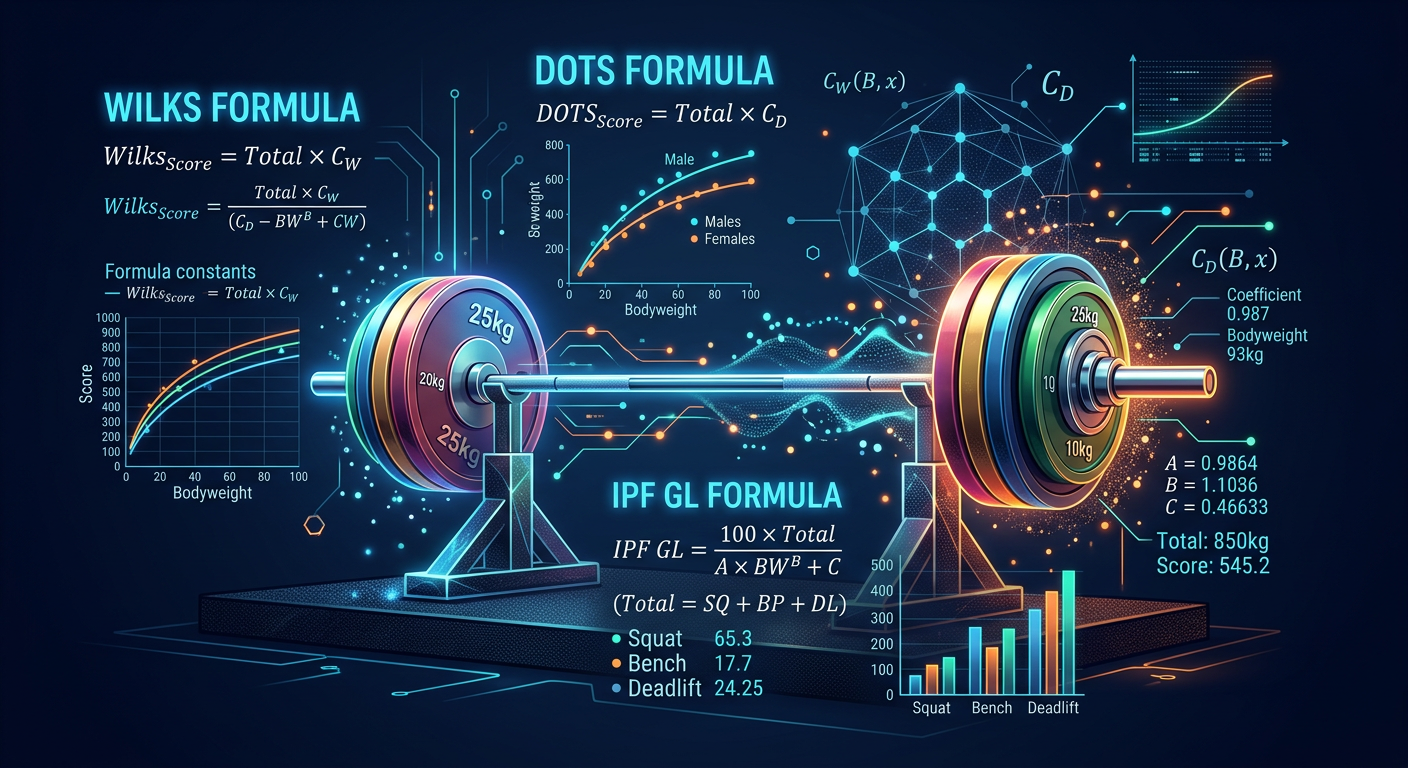
Powerlifting Scoring Explained: Wilks, DOTS, and IPF GL Points
A clear explanation of how Wilks, DOTS, and IPF GL Points work, why they exist, and which formula is used where. Includes worked examples and a comparison of how they rank different lifters.
Updated March 1, 2024Why Scoring Formulas Exist
Wilks Score
The Wilks formula was developed by Robert Wilks of Powerlifting Australia and introduced in the 1990s. It dominated the sport for roughly two decades and is still the most widely recognised coefficient outside the IPF.
How it works: Wilks uses a 5th-degree polynomial fitted to world record data at the time of its creation. The formula produces a coefficient that you multiply by your total (in kg) to get your Wilks score. Higher is better. Scores above 400 are solid; above 500 is elite.
Limitations: Critics pointed out that Wilks favoured heavier lifters - the polynomial fit was less accurate at the extremes of the bodyweight range. Studies showed that lighter lifters (under 60 kg) and very heavy lifters (over 120 kg) received systematically lower scores than lifters in the middle weight classes.
DOTS Score
DOTS (Dots Points) was developed to address Wilks's weaknesses and was adopted by the IPF as its standard scoring formula in 2019, replacing IPF Points.
How it works: Like Wilks, DOTS applies a polynomial coefficient to your total. The key difference is that the DOTS polynomial was fitted to the full range of bodyweights with explicit attention to fairness at the extremes. The result is a more consistent relationship between bodyweight and score across the full competitive range.
Why it matters: A 500 DOTS score should require roughly the same relative strength achievement whether you weigh 59 kg or 120 kg. Wilks scores do not have this property. DOTS makes it genuinely meaningful to compare a 52 kg lifter's score to a 93 kg lifter's score.
Where it is used: IPF and all affiliated national federations (including USAPL, CPU, and most major tested federations worldwide) now use DOTS as the primary ranking formula.
IPF Goodlift (GL) Points
IPF Goodlift Points are a further refinement developed by the IPF, used specifically at IPF-sanctioned competitions for official rankings and best lifter calculations.
How it works: IPF GL uses a different mathematical approach from DOTS, calculating points based on the ratio of your total to the world record total for your weight class and sex. The formula is updated periodically as world records are broken, which means scores are not directly comparable across different years.
Practical implication: You may score higher or lower on IPF GL versus DOTS depending on your bodyweight. Neither formula is strictly better - they measure slightly different things. DOTS is stable over time; IPF GL is calibrated to current world records.
Where it is used: IPF world championships and major IPF-affiliated competitions use GL points for official rankings. USAPL nationals, CPU nationals, and similar elite meets use IPF GL for best lifter awards.
Comparing the Three Formulas
Example: Same total, different bodyweights
Consider three male lifters all totalling 500 kg raw:
- 66 kg lifter: Wilks ~337, DOTS ~340
- 93 kg lifter: Wilks ~318, DOTS ~305
- 120 kg lifter: Wilks ~295, DOTS ~288
In this example, all three formulas agree that the 66 kg lifter's total represents a greater relative achievement, but the degree of difference varies. DOTS produces slightly more compressed scores at the heavier end, reflecting its revised polynomial fit.
Which should you use? If you compete in an IPF-affiliated federation, DOTS or IPF GL is what your federation uses officially. If you compete in a non-IPF federation (WRPF, APF, USPA, etc.), Wilks is often still the default for rankings, though many have adopted DOTS. For your own tracking, DOTS is recommended because it is the most theoretically sound and time-stable formula.
Glossary of Key Terms
Total: The sum of your best squat, bench press, and deadlift. The primary competition result.
Coefficient: The number multiplied by your total to produce a formula score. Heavier lifters have lower coefficients (their total is divided down more).
Best Lifter: An award given to the lifter with the highest formula score regardless of weight class. At many meets, separate best lifter awards exist for men and women, and for raw vs equipped.
Sinclair / Wilks / DOTS / IPF GL: All bodyweight-adjusted scoring formulas. Sinclair is used in Olympic weightlifting. The others are specific to powerlifting.
IPF: International Powerlifting Federation - the largest and most prestigious powerlifting federation, with affiliated national bodies in most countries. Uses DOTS and IPF GL Points.