

Strength standards are benchmarks that classify a lifter's performance relative to the broader competitive population. They answer the question: 'How does my squat/bench/deadlift/total compare to other powerlifters of my weight and sex?'
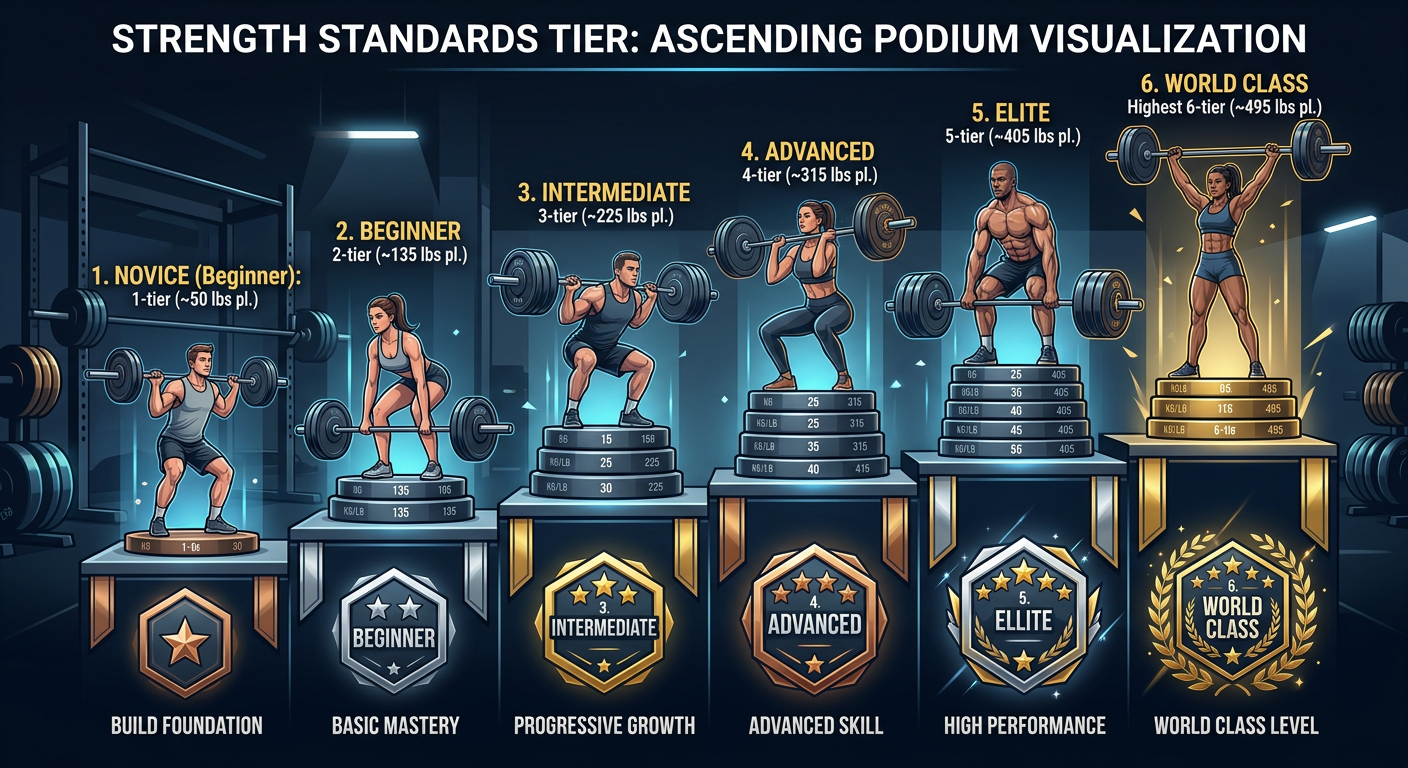
Standards are typically expressed as classification tiers - for example, Beginner, Novice, Intermediate, Advanced, Elite - each corresponding to a specific total or single-lift weight at each bodyweight class. They are derived from analysis of actual competition results across thousands of athletes.
Strength standards are not arbitrary targets set by coaches or personal trainers. They are statistical descriptions of what competitive powerlifters actually achieve at various stages of development.
Understanding Powerlifting Strength Standards
What strength standards are, how they are calculated, what the classifications mean, and how to use them to set realistic competition goals and track your progress over time.
Updated March 15, 2024What Are Strength Standards?
Classification Systems
Several classification systems are used in powerlifting, and they differ in methodology and purpose:
IPF Classification Points: The IPF uses its own GL (Good Lift) Points formula to award classification levels (Class I through Class V, plus Elite) based on performance relative to world records. These apply within IPF-affiliated meets.
Wilks-based classifications: Some federations and coaches use Wilks score thresholds to define levels. Because Wilks adjusts for bodyweight, a single threshold applies across all weight classes.
Percentile-based standards: This site's strength standards show where a given total or single-lift performance falls within the actual competitive population - for example, 'top 25%' or '75th percentile.' This is arguably the most intuitive measure of competitive standing.
Total-based tables: Simple tables showing minimum totals for each classification at each bodyweight. Easy to use but do not account for bodyweight differences within a class.
What the Levels Mean
Common classification labels and their approximate competitive meaning:
Beginner: Just starting out. Have competed at most once or twice. Total reflects early-stage training.
Novice: 6-18 months of consistent training. Technique is developing. Making rapid progress with linear or simple programming.
Intermediate: 2-4 years of training. Technique is established. Progress requires more structured periodization. Competitive at local and regional meets.
Advanced: 4+ years of focused training. Nationally competitive in many federations. Making progress in months rather than weeks.
Elite: National and international level. Top 5-10% of competitive lifters. Progress is hard-won and requires highly individualized programming.
These descriptions are approximations. Training age, consistency, coaching quality, and individual factors all influence where a given lifter falls.
How Standards Are Calculated on This Site
The strength standards on this site are derived from the OpenPowerlifting database, which contains results from hundreds of thousands of competitive powerlifters worldwide. For a given sex, weight class, and division:
1. All recorded totals and single-lift bests are compiled.
2. The distribution is calculated to identify percentile thresholds.
3. Percentile cutoffs (10th, 25th, 50th, 75th, 90th) are mapped to classification labels.
This means the standards reflect real competition results, not theoretical ideals. If this site says your total is at the 75th percentile for your weight class, it means approximately 75% of competitors who have entered a meet in that weight class have recorded a lower total.
Important caveat: the database includes all competitive results, from first-time competitors to national champions. This tends to make lower tiers very accessible and upper tiers genuinely challenging.
Using Standards to Set Goals
Strength standards are most useful as goal-setting tools when used correctly:
Set realistic time horizons: Moving from Novice to Intermediate typically takes 1-2 years of consistent training. Moving from Intermediate to Advanced may take 3-5 years. Do not set short-term goals based on multiple classification jumps.
Focus on total, not individual lifts: You compete on your total. A lifter with a balanced squat, bench, and deadlift will almost always outscore a lifter with one elite lift and two weak ones.
Compare within your division: Raw totals cannot be meaningfully compared to equipped totals. Use standards specific to your division (raw vs equipped) and federation type (tested vs untested).
Use standards for motivation, not self-criticism: The point is to understand where you are and where you are going - not to feel inadequate. Every elite lifter was once a beginner.
Bodyweight-Adjusted Scoring
Because heavier lifters can generally lift more absolute weight than lighter lifters, comparing raw totals across weight classes is unfair. Several formulas attempt to adjust for bodyweight:
Wilks score: The original and most historically recognized formula. Uses a polynomial equation to produce a score that theoretically levels the playing field across bodyweights. Still widely used in records and rankings.
DOTS (IPF standard): Replaced Wilks as the official IPF formula in 2019. Designed to produce a flatter distribution of scores across the bodyweight range, particularly addressing the over-representation of heavier weight classes in Wilks.
IPF GL Points: Used specifically within IPF competitions for live scoring and classification. Formula is updated periodically.
No formula is perfect. All represent a mathematical approximation of 'best lifter' across bodyweights. Use them as a relative comparison tool rather than an absolute measure of worth.
Practical Application
How to use the strength standards and percentile calculator on this site:
1. Find your percentile: Enter your total and bodyweight in the percentile calculator to see where you stand relative to the competitive population.
2. Identify your weakest lift: The individual lift standards show which of the three lifts is furthest below your overall level. This points to your biggest opportunity for total improvement.
3. Set a competition goal: Identify the next classification threshold above your current performance and calculate the total needed to reach it. Work backward to set targets for each lift.
4. Track progress over time: Record your standards at each meet. A consistent upward trend is the signal that your training is working, regardless of absolute classification level.
5. Compare across weight classes: If you are considering moving up or down a weight class, the Wilks or DOTS calculator lets you see how your total would compare at a different bodyweight.