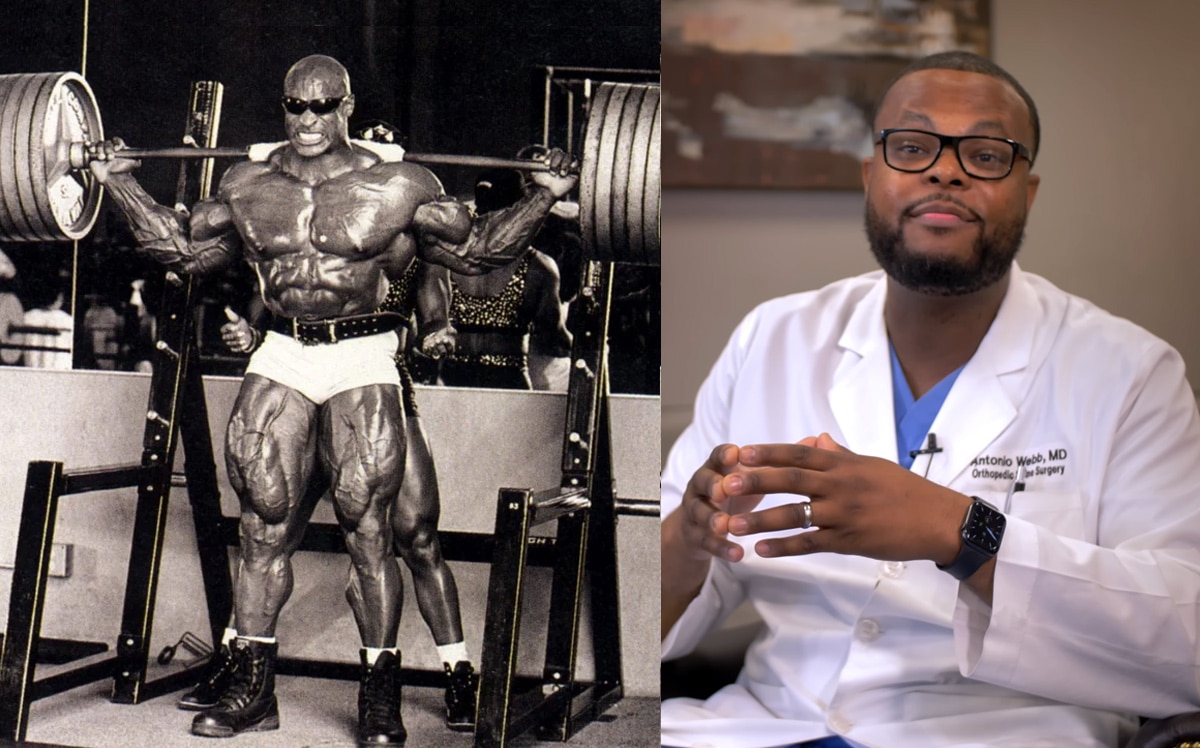
Ronnie Coleman understood the sacrifices it would take in the training room to make his dreams come true on stage. Regarded as one of the strongest bodybuilders of all time, Coleman led a historic career but suffered a number of injuries. In a recent YouTube video, orthopedic spine surgeon Dr. Antonio Webb reacted to Coleman’s 13 back surgeries and underlined the dangers of squatting.
“13 spine surgeries… that’s how many surgeries that Ronnie Coleman, Mr. eight-time Mr. Olympia has underwent. In this video, we’re going to talk about that,” Dr. Antonio Webb shared.
In 1998, Ronnie Coleman shocked the world when he defeated a prime Flex Wheeler to take home his first Mr. Olympia title. Showcasing a blend of muscle mass, conditioning, and freak factor, Coleman would prove to be near unstoppable on his way to tying Lee Haney‘s record of eight Sandow trophies.
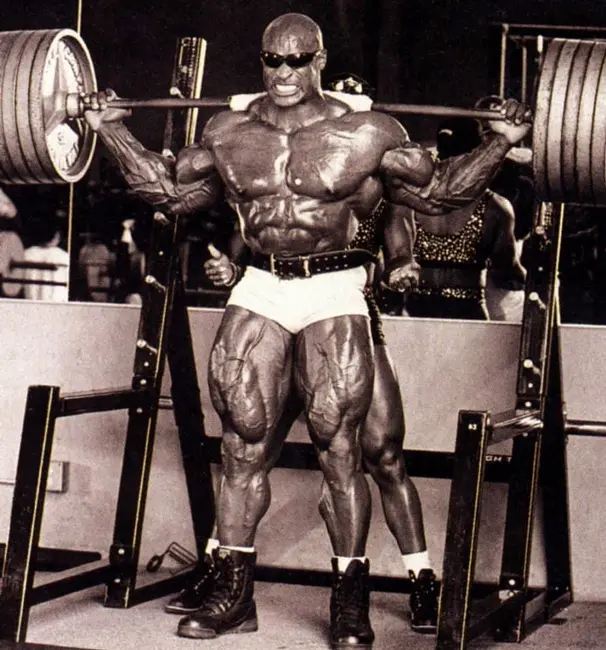
Aside from the massive physique he carved out of hard work and dedication, Coleman was revered for his jarring strength. En route to building his legacy, Coleman recorded epic feats of power like when he pushed 2,300 pounds on the leg press and squatted/deadlifted 800 pounds for reps.
While he retired years ago, Coleman hasn’t stopped training. He’s been open about his health since stepping away from the stage. Speaking with podcast host Joe Rogan, Coleman went over all 13 of his back surgeries. Even today, the bodybuilding legend admits he still has problems with mobility.
Spine Surgeon Dr. Webb Talks Ronnie Coleman’s Back Degeneration, Squatting, and Recovery
According to Dr. Webb, he tells all of his patients to avoid squatting weight because of its potential for causing back injuries.
“Despite undergoing multiple surgeries and having all of these back degenerative and traumatic conditions, he still lifts weights and goes to the gym. And I’m going to give my reaction, let’s jump right into it.”
“It’s crazy how big and massive Ronnie Coleman is, he’s a freak of nature. I mean, his bicep is bigger than my thigh,” said Coleman. “One of the biggest things that I try to stress to my patients and try to harp on is that to avoid squatting. Squatting does a lot of, it can cause a lot of injury to your back and to the discs or the cushions in your back. The cushions are the shock absorbers of your back.”
Next, Dr. Webb explained disc injuries and mentioned that they often cause leg pain. He added that once discs are compromised, there’s no way to reverse the damage.
“If they are injured, this can lead to a collapse of that level and then your spinal canal has less space and less room for the nerves. It can cause back pain and also leg pain. So that process is irreversible. Once you lose and damage your disc, that is irreversible. That is all you have. That’s why I stress to all my patients to avoid squatting.”
“The cushions between your bones or the intervertebral disc, it’s made up of an outer ring called the angulus fibrosis, that’s on the outside. On the inside, you have your jelly portion called your nucleus pulposus. When people have herniations, it’s the jelly portion that spits out.
If you imagine a donut and it has the jelly on the inside, that jelly portion spits out, and then it pushes on the nerve or the spinal canal. This can cause pain that’s either down the leg in the back. If it’s very severe, it can cause a condition called Kata Aquinas syndrome which is suppresion of those nerve roots at the end of your spinal cord,” Dr. Webb shared.
The orthopedic surgeon believes recovery techniques are critical for muscle growth. In addition, Dr. Webb highlighted that any time there is weight on the spine, it adds an ‘additional four pounds of pressure and force.’
“To grow, your body needs to recover. The problem with a lot of weight lifters and people that go to the gym to lift, they don’t give their bodies time to recover. Then, your body sustains injury to those muscles, to the ligaments, to the tendons, then they are more likely to tear or to undergo degeneration. So that’s why it’s important – it’s okay to train, but you have to give your body time to recover. If you don’t, that’s when the injuries ensue.”
“The amount of pounds that you place upon your spine, it adds an additional four pounds of pressure and force. So, 400 pounds, you’re looking at 16,000 pounds of force across that disc, which is not good for your spine.”
“I’ve recommended and instructed Ronnie Coleman to stop lifting weights, ‘Hey, you’re damaging your body.’ He loves it so much that he still does it which is pretty crazy.”
Given that Coleman had problems with screws in his back, Dr. Webb explained why the body sometimes rejects medical ‘hardware.’
“It does happen. The hardware can cause irritation. The hardware is sometimes very close to important structures. What we’ll do is we’ll send the patient for what’s called a spinal block or a hardware block, inject medication around that screw. If it releases pain we can be rest assured that that hardware may be causing their discomfort.”
Even though he’s shocked Coleman still trains today, he understands that there’s a price to pay when you desire to be the best at what you do.
“Despite multiple surgeries, complications, if someone wants something really bad, they’re going to go for it. And he’s a perfect example of that.”
“The greatest bodybuilder of all time… the price to pay. The price for success. This is one of the things – one of the conversations we have with patients all the time, their injuries, and the degenerative nature of their spines.”
Coleman has been forthcoming about his health lately. He’s offered fans an inside look into many of his recent stem cell therapy updates. Having undergone the treatment for months now, Coleman can say with confidence that his pain levels have dropped. However, in a Muscular Development interview with Ron Harris, Coleman expressed that he’s still struggling to walk without assistance.
Having built his name off intense training and grit, Coleman remains one of the most beloved figures of the sport. While the cost of greatness comes at a hefty price, Coleman has zero regrets about his career.
RELATED: Ronnie Coleman’s Training Partner on Working Out w/ ‘The King’: ‘His Lifts Were Amazing’