


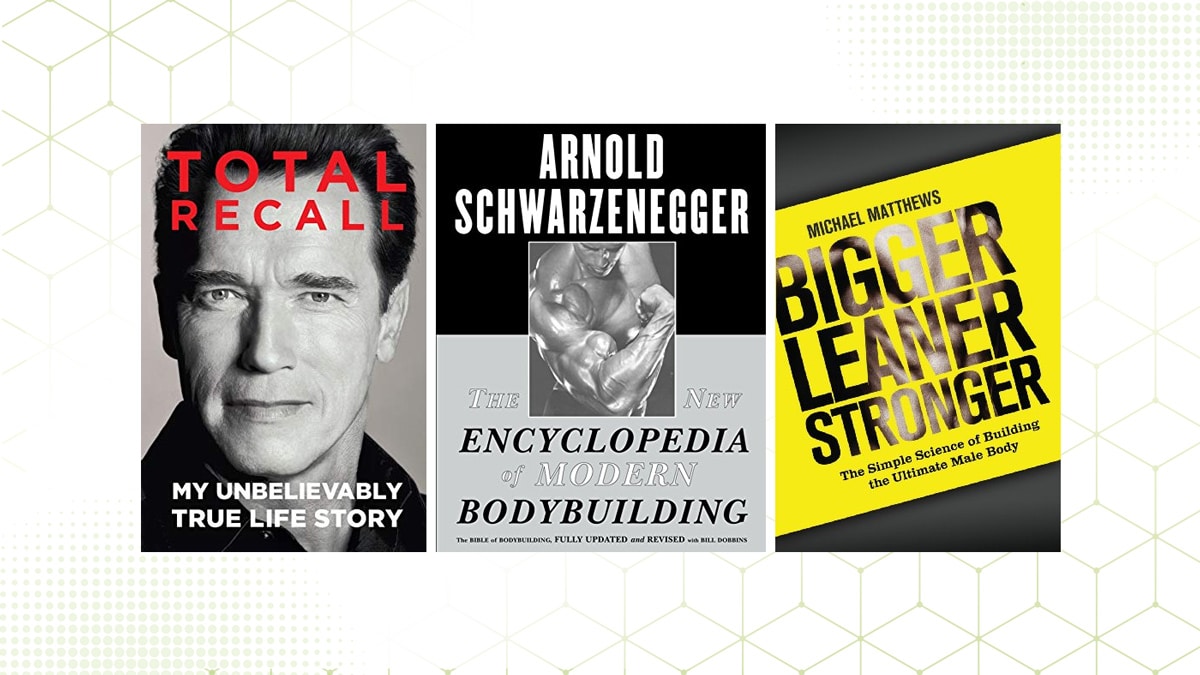
You just started lifting. Or maybe you have been training for years but your gains have stalled and you cannot figure out why. Either way, the answer is probably sitting on a shelf somewhere, written by someone who has spent decades in the gym and the laboratory figuring this stuff out so you do not have to.
The problem is that most fitness books are garbage. They rehash the same bro-science myths, push proprietary supplements, and offer zero scientific backing for their claims. Sorting the signal from the noise takes time most people do not have.
We did the sorting for you. The 10 books below represent the best of what the industry has produced, covering everything from beginner barbell technique to advanced hypertrophy science. Read even one of them and you will train smarter tomorrow than you did today.
Quick Answer: Best Bodybuilding Books of 2026
- Best Overall: The New Encyclopedia of Modern Bodybuilding – Arnold Schwarzenegger
- Best for Beginners: Bigger Leaner Stronger – Michael Matthews
- Best Science-Based: Science and Development of Muscle Hypertrophy – Brad Schoenfeld, PhD
- Best for Strength Foundations: Starting Strength – Mark Rippetoe
- Best for Visual Learners: Strength Training Anatomy – Frederic Delavier
- Best for Women: Thinner Leaner Stronger – Michael Matthews
- Best for Programming: The Muscle and Strength Pyramid: Training – Eric Helms
- Best Classic Memoir: Arnold: The Education of a Bodybuilder – Arnold Schwarzenegger
- Best for Fat Loss: Burn the Fat, Feed the Muscle – Tom Venuto
- Best for Advanced Lifters: Practical Programming for Strength Training – Mark Rippetoe and Andy Baker
How We Selected These Books
Our editorial team, which includes certified strength and conditioning specialists, personal trainers, and competitive bodybuilders with a combined 60-plus years of experience, evaluated dozens of titles using the following criteria:
- Scientific accuracy: Are the training and nutrition recommendations supported by peer-reviewed research?
- Practical applicability: Can a real person implement the advice without a PhD or a professional coaching staff?
- Depth of content: Does the book go beyond surface-level tips and actually explain the why?
- Longevity: Has the book stood the test of time, or is it built around a fad that has already faded?
- Reader reception: What do thousands of Amazon reviewers, gym coaches, and certified trainers say about the book in practice?
We deliberately excluded books that rely heavily on proprietary supplements, make unsubstantiated claims about rapid results, or are written by authors with no verifiable credentials in exercise science or competitive lifting.
Reviewed and updated March 2026 by the FitnessVolt editorial team, including CSCS- and CPT-certified contributors with direct competitive bodybuilding and powerlifting experience.
Our Verdict
FitnessVolt Top Pick: Best Bodybuilding Book
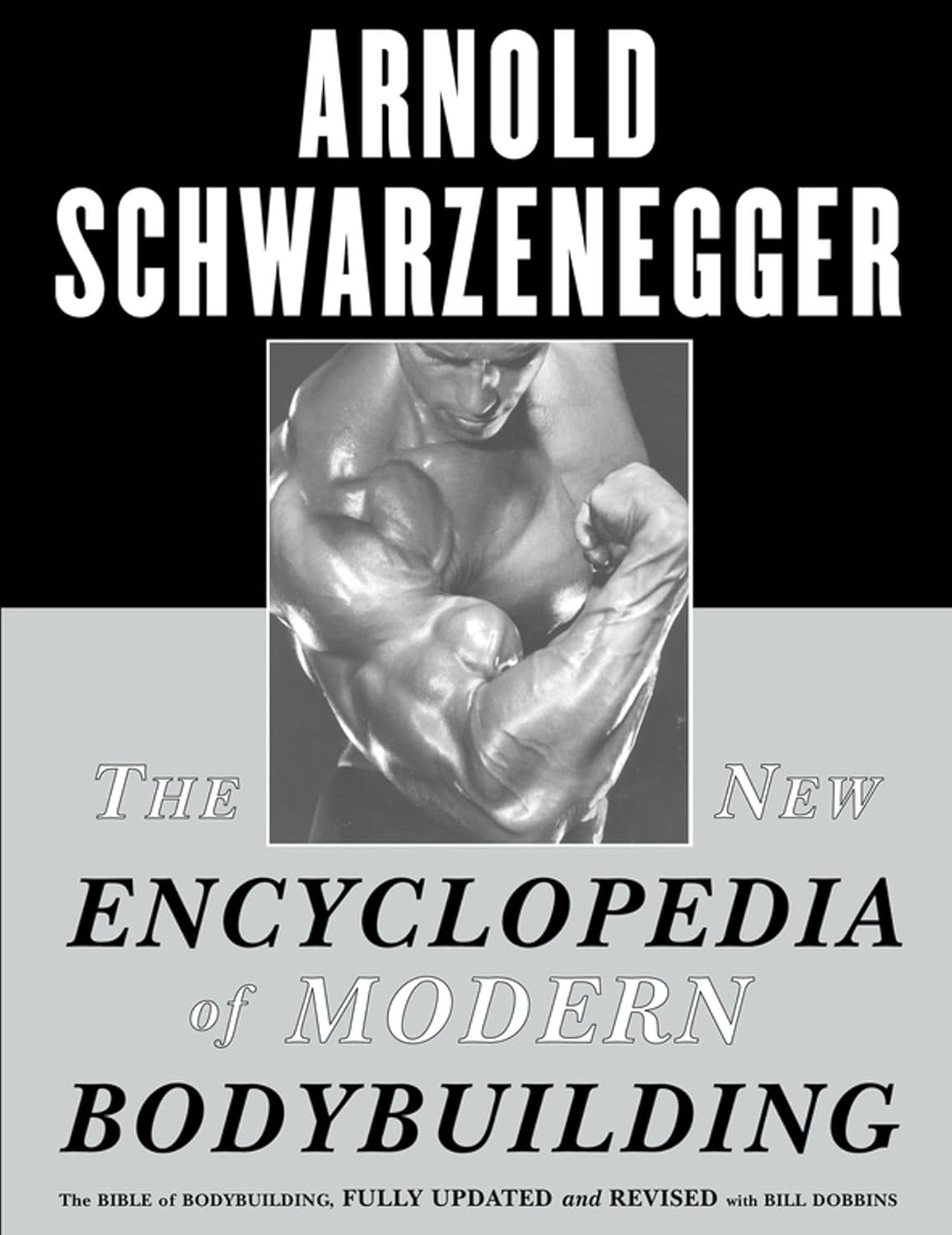
The best bodybuilding book for most people is The New Encyclopedia of Modern Bodybuilding by Arnold Schwarzenegger because it is the most comprehensive single reference a lifter can own. Beginners should pair it with Starting Strength or Bigger Leaner Stronger to build the technical foundation first. Advanced trainees will get the most out of Science and Development of Muscle Hypertrophy and The Muscle and Strength Pyramid for evidence-based programming.
Best for: All experience levels seeking a definitive training reference
Check Price on AmazonThe 10 Best Bodybuilding Books of 2026
1. The New Encyclopedia of Modern Bodybuilding
The New Encyclopedia of Modern Bodybuilding
Best OverallSeven-time Mr. Olympia Arnold Schwarzenegger wrote what is widely considered the definitive bodybuilding reference. This 800-page revised and updated volume covers exercise technique with detailed photographs, program design for every experience level, nutrition and supplementation, competition preparation, and the history of the sport.
Pros
- 800-page comprehensive reference covering every muscle group
- Detailed exercise photos and technique breakdowns
- Covers training, nutrition, competition prep, and sports psychology
- Suitable for all experience levels
- Motivating writing voice from a seven-time Mr. Olympia
Cons
- Nutrition section is dated compared to modern sports science
- Too dense for lifters who want a quick-start program
- Large format makes it impractical to carry to the gym
Seven-time Mr. Olympia Arnold Schwarzenegger wrote what is widely considered the definitive bodybuilding reference. This 800-page volume covers exercise technique with detailed photographs, program design for every experience level, nutrition and supplementation, competition preparation, sports psychology, and the history of the sport. It is not a minimalist guide. It is an encyclopedia, and it earns that title.
The book is organized so you can read it cover to cover or use it as a reference when you need guidance on a specific muscle group or training principle. Arnold’s writing voice is direct and motivating without being preachy. He explains why each exercise works, which muscle fibers it targets, and how to modify it for your individual anatomy.
The nutrition section, while updated from the original 1985 edition, is the weakest part. Some of the older macronutrient recommendations do not align with current sports nutrition science. Treat the training content as authoritative and use a more current source for your dietary approach.
Skip this if you want a quick-start program with minimal reading. This book rewards study, not skimming.
Amazon Rating: 4.8/5 (8,200+ reviews)
2. Bigger Leaner Stronger: The Simple Science of Building the Ultimate Male Body

Bigger Leaner Stronger
Best for BeginnersMichael Matthews delivers a clear, evidence-referenced framework for building muscle and losing fat simultaneously. The book cuts through contradictions and gives beginners a direct path built around progressive overload and sound nutrition, with a complete workout program included.
Pros
- Evidence-referenced framework explained in plain language
- Complete 8-12 week beginner workout program included
- Debunks common fitness myths directly and clearly
- Specific calorie and macro targets with no guesswork
- Third edition updated with current research
Cons
- Too basic for lifters with more than two years of consistent training
- Limited coverage of advanced periodization concepts
- Some sections feel repetitive
Michael Matthews built a multi-million-dollar fitness brand on one core idea: most fitness advice is overcomplicated and counterproductive. Bigger Leaner Stronger delivers on that premise with refreshing directness. The book cuts through contradictions and gives beginners a clear, evidence-referenced framework for building muscle and losing fat simultaneously.
Matthews covers calorie and macronutrient targets, progressive overload, exercise selection, and periodization in plain language. The included workout program, which runs 8 to 12 weeks, is built around compound movements and is appropriate for anyone with little to no weight training experience. He debunks myths about high-frequency training, fat burners, and spot reduction without being condescending about it.
Where the book shines is in its refusal to hedge. Matthews tells you exactly what to eat, exactly how to train, and exactly what to expect. That kind of specificity is rare and valuable for beginners who are drowning in conflicting information.
Skip this if you have been training consistently for more than two years. This book is designed for the first 1 to 2 years of training and you will plateau its recommendations quickly.
Amazon Rating: 4.7/5 (11,500+ reviews)
3. Science and Development of Muscle Hypertrophy

Science and Development of Muscle Hypertrophy
Best Science-BasedBrad Schoenfeld PhD, the most cited researcher in hypertrophy science, delivers the definitive academic synthesis of muscle growth mechanisms and training variables. The second edition incorporates research through 2023, making it the most current evidence-based reference available.
Pros
- Most comprehensive peer-reviewed hypertrophy research synthesis available
- Second edition updated through 2023
- Covers all key training variables: volume, intensity, frequency, tempo
- Essential reference for coaches, trainers, and advanced lifters
- Written by the most cited researcher in hypertrophy science
Cons
- No workout templates or programs included
- Dense academic text not suited for beginners
- Requires a foundation of training experience to apply effectively
Brad Schoenfeld is the most cited researcher in hypertrophy science and this book is the academic culmination of his work. It is the only text that comprehensively reviews the peer-reviewed literature on muscle growth mechanisms, training variables, and individual differences in hypertrophic response. If you want to understand why your muscles grow, not just how to make them grow, this is the book.
Schoenfeld covers mechanical tension, metabolic stress, and muscle damage as the three primary drivers of hypertrophy. He then systematically examines how training volume, intensity, frequency, exercise selection, rest intervals, and tempo each interact with those drivers. The second edition incorporates research published through 2023, making it the most current evidence synthesis available.
This is not a program book. There are no workout templates included. It is a manual for understanding the science so you can evaluate any program, protocol, or piece of advice against a rigorous evidence base. Personal trainers, coaches, and self-educated lifters who want the deepest possible understanding of hypertrophy will find this indispensable.
Skip this if you want a training program to follow. This is a reference text, not a workout plan. Pair it with a practical programming resource.
Amazon Rating: 4.8/5 (1,400+ reviews)
4. Starting Strength: Basic Barbell Training

Starting Strength: Basic Barbell Training
Best for Strength FoundationsMark Rippetoe's third edition is a technical masterpiece covering five barbell movements with surgical biomechanical precision. The most thorough treatment of barbell technique available to the general public, backed by a simple linear progression model that produces faster early strength gains than any periodized program.
Pros
- Most thorough biomechanical treatment of barbell lifts available
- Covers squat, deadlift, bench press, overhead press, and power clean
- Self-diagnosis guidance for form breakdowns
- Simple linear progression produces rapid early strength gains
- Over 500,000 copies sold
Cons
- Exclusively covers barbell training - no machines, dumbbells, or bodyweight
- Rippetoe's blunt tone can be off-putting for some readers
- Programming is almost too simple for lifters who enjoy complexity
No book in the strength training canon has produced more strong people than Starting Strength. Mark Rippetoe’s third edition is a technical masterpiece: 347 pages dedicated almost entirely to teaching five barbell movements (squat, deadlift, bench press, overhead press, and power clean) with surgical precision.
What separates this book from every other lifting manual is its depth of technical explanation. Rippetoe does not just tell you to keep your back flat during a deadlift. He explains the anatomy of spinal erection, the physics of bar path over the center of mass, the role of intra-abdominal pressure in spinal stabilization, and exactly what muscular failure points look like so you can self-diagnose form breakdowns. It is the most thorough treatment of barbell biomechanics available to the general public.
The programming component is intentionally simple: add weight to the bar every session. This linear progression model, used correctly, produces faster early strength gains than any periodized program. Rippetoe’s point is that beginners have no business doing complex periodization when simple progressive loading still produces results.
Skip this if you have no interest in barbell training. This book is exclusively about the barbell lifts. Machine training, dumbbell work, and bodyweight training are not covered.
Amazon Rating: 4.8/5 (5,600+ reviews)
5. Strength Training Anatomy

Strength Training Anatomy
Best for Visual LearnersFrederic Delavier's third edition is the most visually striking exercise anatomy book ever published. Each of the 118 exercises is illustrated with photorealistic anatomical cross-sections showing exactly which muscles contract, stabilize, and stretch at each point in the movement.
Pros
- Photorealistic anatomical cross-sections for every exercise
- 118 exercises across all major muscle groups
- Shows primary, secondary, and stabilizing muscles simultaneously
- Notes on variations and injury risk patterns for each movement
- Used by personal trainers worldwide to explain muscle activation
Cons
- Minimal programming guidance by design
- Not a standalone beginner resource
- Best used as a companion to a structured program
Frederic Delavier studied morphology and anatomy at the Ecole des Beaux-Arts in Paris and dissection at the Paris Faculte de Medecine. The result of that unusual combination is the most visually striking exercise anatomy book ever published. Each exercise is illustrated with photorealistic anatomical cross-sections that show exactly which muscles are contracting, which are stabilizing, and which are being stretched at each point in the movement.
The third edition covers 118 exercises across all major muscle groups. For each exercise, Delavier includes the primary and secondary muscles involved, notes on common variations, and warnings about injury risk patterns. The illustrations alone justify the purchase. Personal trainers use this book to explain muscle activation to clients. Bodybuilders use it to identify lagging muscles and select exercises that specifically target those weaknesses.
The programming guidance is minimal by design. This is an anatomy and exercise reference, not a periodization manual. Use it alongside a structured program to understand what each movement is actually doing to your body.
Skip this if you are a pure beginner who needs a step-by-step program. Come back to this once you have the basics down and want to deepen your anatomical knowledge.
Amazon Rating: 4.8/5 (7,000+ reviews)
6. Thinner Leaner Stronger: The Simple Science of Building the Ultimate Female Body

Thinner Leaner Stronger
Best for WomenMichael Matthews applies the same evidence-based framework from Bigger Leaner Stronger to women's training and physiology. The book replaces myths about bulking up and cardio supremacy with a practical program grounded in progressive overload, sound nutrition, and an honest treatment of female endocrine considerations.
Pros
- Directly addresses female physiology and hormonal considerations
- Demolishes myths about women and heavy lifting
- Complete training program built around compound movements
- Clear calorie and macro targets with meal planning guidance
- Third edition updated with current research
Cons
- Programming is designed for the first two years of training only
- Will not challenge experienced female athletes
- Some physiological sections could go deeper
The female counterpart to Bigger Leaner Stronger applies the same evidence-based framework to women’s training and physiology. Matthews addresses the myths that keep women from lifting heavy and replaces them with a practical program grounded in progressive overload and sound nutrition.
The book includes a complete training program built around barbell and dumbbell compound movements. Matthews explains calorie targets, macronutrient ratios, and meal planning in accessible terms. He also addresses hormonal considerations, including how training volume and caloric restriction interact with female endocrine function in ways that differ meaningfully from male physiology.
What makes this book particularly valuable for women is Matthews’ willingness to be direct about what the research actually shows. He is not dismissive of the physiological differences between sexes, but he also refuses to use those differences as an excuse to water down the training recommendations.
Skip this if you are an experienced female lifter. The programming is designed for the first two years of serious training and will not challenge advanced athletes.
Amazon Rating: 4.6/5 (6,300+ reviews)
7. The Muscle and Strength Pyramid: Training

The Muscle and Strength Pyramid: Training
Best for ProgrammingEric Helms, Andy Morgan, and Andrea Valdez deliver what many serious coaches consider the best practical programming resource for non-specialists. The Pyramid model organizes training variables by importance, preventing the common mistake of obsessing over advanced variables while neglecting fundamentals.
Pros
- Organizes training variables by importance to prevent common intermediate mistakes
- Covers periodization across competitive seasons
- Applies equally well to both natural bodybuilding and strength sports
- Written by a PhD-level coach who competes at the international level
- Companion nutrition volume available for a complete system
Cons
- Assumes consistent training habits and basic barbell competency
- Dense reading requiring active study
- Companion nutrition volume sold separately
Eric Helms holds a PhD in exercise science, coaches natural competitive bodybuilders at the international level, and competes himself. Andy Morgan runs one of the most rigorous evidence-based coaching practices in the industry. Together, they produced what many serious coaches consider the best practical programming resource available to the non-specialist.
The Pyramid model organizes training variables by importance, from adherence and consistency at the base through volume, intensity, frequency, exercise selection, and periodization toward the top. This hierarchy prevents the mistake most intermediate lifters make: obsessing over advanced variables while neglecting the fundamentals that produce 90 percent of results.
The book covers how to set up a training block, how to periodize over a competitive season, and how to adjust variables when progress stalls. The companion nutrition volume (sold separately) covers dietary setup with equal rigor. Together they form the most complete evidence-based programming system available outside a formal coaching relationship.
Skip this if you are a complete beginner. The pyramid model assumes you already have consistent training habits and a working understanding of the basic barbell lifts.
Amazon Rating: 4.7/5 (1,200+ reviews)
8. Arnold: The Education of a Bodybuilder
Arnold: The Education of a Bodybuilder
Best Classic MemoirPublished in 1977 before Arnold became a global film star, this autobiography-meets-training-manual captures Schwarzenegger at his most focused and candid. Part one recounts his journey from Austria to the Mr. Olympia stage. Part two is a complete training system based on methods that produced what many consider the greatest physique in competitive bodybuilding history.
Pros
- Captures Arnold's mindset and mental discipline at the height of his career
- Autobiography section is genuinely compelling and instructive
- Training section explains the principles behind the greatest physique in competitive history
- Short enough to read in a weekend
- Timeless motivational content
Cons
- Some training volume and frequency recommendations exceed what modern research prescribes for drug-free athletes
- Written in 1977 - nutrition guidance is dated
- More memoir than technical manual
Published in 1977, before Arnold became a global film star, this autobiography-meets-training-manual captures Schwarzenegger at his most focused and most candid. Part one recounts his journey from a small Austrian village to the Mr. Olympia stage in vivid, personal terms. Part two is a complete training system based on the methods that produced what many consider the greatest physique in competitive bodybuilding history.
The training section covers Arnold’s split routine, his high-volume approach to muscle development, the mind-muscle connection he developed, and his philosophy around peak contraction and muscle congestion. Whether or not you adopt his methodology, understanding the mental and physical discipline behind his results is genuinely instructive.
The book is not a scientific text. Some of the training recommendations, particularly around volume and frequency, are higher than modern research would typically prescribe for drug-free athletes. Read it for its motivational power and its historical insight into what elite-level focus looks like, not as a precise blueprint to copy.
Skip this if you need a structured, day-by-day program. The training section outlines principles rather than precise programming.
Amazon Rating: 4.8/5 (4,100+ reviews)
9. Burn the Fat, Feed the Muscle

Burn the Fat, Feed the Muscle
Best for Fat LossTom Venuto spent over two decades as a natural competitive bodybuilder before writing one of the best-selling fat loss guides ever published. The updated edition treats fat loss as a math problem first and a behavior change challenge second, with unusually deep coverage of the psychology that derails most people before they reach their goal.
Pros
- Treats fat loss as a math problem first, behavior change second
- Deep coverage of the psychology of extended cutting phases
- Bodybuilding background means it optimizes for leanness, not just weight loss
- Strong on caloric deficit calculations and macronutrient partitioning
- Covers how to handle plateaus and motivation erosion
Cons
- Primary focus is fat loss - not ideal if muscle gain is the main goal
- Training recommendations reflect a cutting priority
- Some newer research on carbohydrate timing is not reflected
Tom Venuto spent more than two decades as a natural competitive bodybuilder and body composition coach before writing the book that became one of the best-selling fat loss guides of the 2000s. The updated edition integrates more current research while preserving the core framework that made the original so effective: treating fat loss as a math problem first and a behavior change problem second.
The book covers caloric deficit calculations, macronutrient partitioning for muscle preservation, cardio programming, and the psychology of adherence with unusual depth. Venuto is particularly strong on the mental side of extended cutting phases, including how to handle plateaus, social pressure, and the motivation erosion that derails most people before they reach their goal.
What distinguishes this book from generic fat loss guides is Venuto’s bodybuilding background. He is not trying to make you skinny. He is trying to help you become lean while maintaining and building muscle mass, which is a meaningfully different goal that requires a meaningfully different approach to nutrition and training.
Skip this if your primary goal is building maximum muscle. This book optimizes for the fat loss side of body composition and the training recommendations reflect that priority.
Amazon Rating: 4.5/5 (3,800+ reviews)
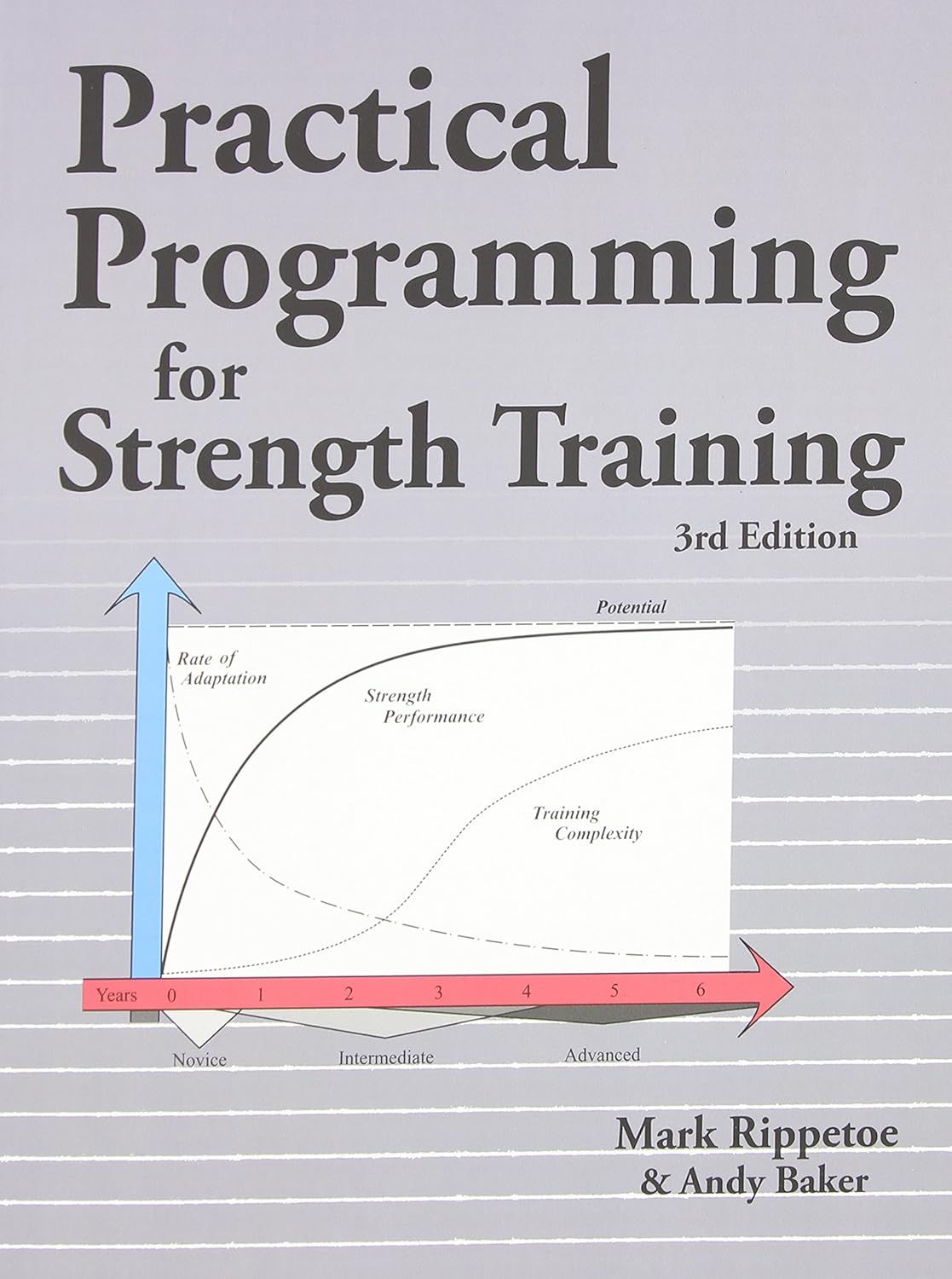
10. Practical Programming for Strength Training
Practical Programming for Strength Training
Best for Advanced LiftersThe companion volume to Starting Strength by Rippetoe and Andy Baker answers the central question confronting every lifter who has exhausted beginner linear progression: what do you do when adding weight every session stops working? The most systematic treatment of strength programming periodization available to the non-specialist.
Pros
- Best treatment of the stress-recovery-adaptation cycle for the non-specialist
- Covers novice, intermediate, and advanced programming stages distinctly
- Thorough section on programming for masters athletes
- Texas Method and advanced variations covered in detail
- Ideal companion to Starting Strength
Cons
- Requires completion of novice linear progression to make full use of
- Rippetoe's tone is blunt and polarizing
- Barbell-centric - limited application to other training modalities
If Starting Strength teaches you how to lift, Practical Programming teaches you how to plan. This companion volume by Rippetoe and Andy Baker addresses the central question that confronts every lifter who has exhausted beginner linear progression: what do you do when adding weight to the bar every session stops working?
The answer involves understanding the stress-recovery-adaptation cycle, the difference between novice, intermediate, and advanced training states, and how to structure training so that overload occurs across longer time horizons. The book covers Texas Method, advanced Texas Method variations, and split programming approaches appropriate for lifters at different development stages. It also includes a thorough treatment of programming for masters athletes, a demographic that is systematically underserved by most training literature.
Rippetoe’s writing is characteristically blunt and direct, which some readers love and others find off-putting. Set the tone aside and focus on the content, which represents the most systematic treatment of strength programming periodization available to the non-specialist reader.
Skip this if you have not completed a full novice linear progression. This book will make very little sense without the foundation that Starting Strength provides.
Amazon Rating: 4.7/5 (2,100+ reviews)
Books We Considered But Cut
Several strong titles did not make the final ten, either because they overlap significantly with a higher-ranked book or because their practical utility is more limited for most readers:
- The M.A.X. Muscle Plan 2.0 (Brad Schoenfeld): Excellent periodized hypertrophy program but less useful as a reference text without the theoretical grounding his Science and Development book provides.
- Strength Training and Conditioning (NSCA): Comprehensive but written for coaches and trainers, not self-coached athletes. The technical vocabulary assumes formal exercise science training.
- The Bodybuilder’s Kitchen (Erin Stern): Solid nutrition resource with excellent recipes, but the training content is thin. Better used as a cookbook companion to a training-focused book.
- Joe Weider’s Ultimate Bodybuilding: A piece of bodybuilding history with legitimate value as a training reference, but dated by 30-plus years of subsequent research on training variables and nutrition.
- Beyond Bigger Leaner Stronger (Michael Matthews): Good bridge program for lifters who have finished the original, but the programming principles are covered more rigorously in The Muscle and Strength Pyramid.
- Supertraining (Verkhoshansky and Siff): The most comprehensive treatment of strength science ever written, but functionally inaccessible to anyone without a formal exercise science background. Worth owning eventually, not worth starting with.
Comparison Table: Best Bodybuilding Books of 2026
| Book | Author | Best For | Rating | Price | Focus |
|---|---|---|---|---|---|
| The New Encyclopedia of Modern Bodybuilding | Arnold Schwarzenegger | Overall | 4.8/5 | $24.99 | Training + Nutrition |
| Bigger Leaner Stronger | Michael Matthews | Beginners (Men) | 4.7/5 | $16.99 | Training + Nutrition |
| Science and Development of Muscle Hypertrophy | Brad Schoenfeld, PhD | Science-Based | 4.8/5 | $49.99 | Training Science |
| Starting Strength | Mark Rippetoe | Strength Foundation | 4.8/5 | $29.95 | Barbell Technique |
| Strength Training Anatomy | Frederic Delavier | Visual Learners | 4.8/5 | $21.99 | Anatomy Reference |
| Thinner Leaner Stronger | Michael Matthews | Women | 4.6/5 | $15.99 | Training + Nutrition |
| The Muscle and Strength Pyramid: Training | Eric Helms et al. | Programming | 4.7/5 | $34.99 | Periodization |
| Arnold: The Education of a Bodybuilder | Arnold Schwarzenegger | Classic Memoir | 4.8/5 | $17.00 | Mindset + Training |
| Burn the Fat, Feed the Muscle | Tom Venuto | Fat Loss | 4.5/5 | $18.99 | Nutrition + Psychology |
| Practical Programming for Strength Training | Rippetoe & Baker | Advanced Lifters | 4.7/5 | $29.95 | Periodization |
Buying Guide: How to Choose the Right Bodybuilding Book for You
Beginner vs. Advanced Lifters
The most common mistake when buying a training book is mismatching complexity to experience. Beginners do not benefit from advanced periodization concepts. Advanced lifters do not gain anything from beginner linear progression guidance. Before purchasing, honestly assess where you are.
If you have been training for less than 18 months or have never followed a structured program, start with Bigger Leaner Stronger (men) or Thinner Leaner Stronger (women). Both books are designed for the early adaptation phase and will give you more productive years of training than almost any other investment you could make.
If you have two to four years of consistent training and have exhausted simple linear progression, The Muscle and Strength Pyramid: Training and Practical Programming for Strength Training will give you the programming framework to keep progressing. Pair with Science and Development of Muscle Hypertrophy for the theoretical background.
If you are an experienced competitive athlete looking for a comprehensive reference, Arnold’s Encyclopedia serves as the best single-volume overview of training methodology with historical context that more clinical texts lack.
Nutrition-Focused vs. Training-Focused Books
Most training books touch on nutrition but do not treat it with the same rigor as the training content. If nutrition is your primary knowledge gap, prioritize these accordingly.
- Strongest on nutrition: Burn the Fat, Feed the Muscle; Bigger Leaner Stronger; Thinner Leaner Stronger
- Balanced training and nutrition: The New Encyclopedia of Modern Bodybuilding; Arnold: The Education of a Bodybuilder
- Training-focused with minimal nutrition: Starting Strength; Strength Training Anatomy; Practical Programming
- Science-first (nutrition requires companion volume): Science and Development of Muscle Hypertrophy; The Muscle and Strength Pyramid: Training
For the most complete nutrition guidance, The Muscle and Strength Pyramid: Nutrition (sold separately from the training volume) is the most evidence-based resource currently available. Pair it with the training volume for a complete system.
Science-Based vs. Practical Application
Pure research synthesis: Science and Development of Muscle Hypertrophy provides the deepest academic treatment of hypertrophy available to non-specialists. Reading it will fundamentally change how you evaluate training claims.
Research-informed practical guidance: The Muscle and Strength Pyramid, Bigger Leaner Stronger, and Thinner Leaner Stronger all translate research into actionable recommendations without requiring you to read the source studies yourself.
Expertise-based practical guidance: Starting Strength, Arnold’s Encyclopedia, and Arnold: The Education of a Bodybuilder are written from deep practitioner expertise rather than academic research synthesis. The recommendations are largely consistent with current science but are not framed in scientific language.
For most lifters, starting with the practical application books and adding the science-based texts once you have training experience makes more sense than reading Schoenfeld before you have ever deadlifted.
Frequently Asked Questions
What is the best bodybuilding book for a complete beginner?
Bigger Leaner Stronger by Michael Matthews is the best starting point for most men, and Thinner Leaner Stronger is the equivalent for women. Both books explain the basic principles of progressive overload and nutrition in accessible language, include a structured beginner program, and avoid the overcomplicated approach that confuses most new lifters. After completing the programs in either book, Starting Strength makes an excellent follow-up for building a more solid technical foundation in the barbell lifts.
Is Starting Strength still worth reading in 2026?
Yes, without reservation. The technical content in Starting Strength’s third edition remains the most thorough treatment of barbell movement mechanics available to the general public. The squat chapter alone is worth the price of the book. The programming approach of adding weight every session is simple by design, because for novice lifters, simplicity outperforms complexity. The book has sold over 500,000 copies for a reason: it works.
Do I need to read the science-based books or can I just follow a program?
You do not need to read the science to make progress. Most people who build excellent physiques never read Schoenfeld or Helms. However, understanding the underlying principles of hypertrophy makes you significantly better at troubleshooting your own training, evaluating new programs and protocols, and making intelligent adjustments when circumstances change. The lifters who get the most out of the science-based texts are those who already have 2 to 3 years of consistent training under their belt and have started hitting real plateaus.
Are Arnold’s books still relevant given how much research has advanced since they were written?
Arnold’s Encyclopedia (1999 revised edition) and The Education of a Bodybuilder (1977) are both still relevant, but for different reasons. The encyclopedia’s training content reflects genuine expertise accumulated over a legendary career and most of the core recommendations are consistent with modern research on volume, frequency, and progressive overload. The nutrition section is more dated and should be supplemented with a current resource. The Education of a Bodybuilder is relevant primarily for its motivational content and historical insight into elite-level mental discipline rather than as a technical training reference.
What bodybuilding book is best for women?
Thinner Leaner Stronger by Michael Matthews is the strongest option for most women beginning serious strength training. It directly addresses the physiological differences between male and female training response, demolishes the myths about women and heavy lifting, and provides a complete practical program. For women with more advanced training backgrounds, The Muscle and Strength Pyramid: Training applies equally to both sexes and provides the most rigorous programming framework available.
Can reading bodybuilding books replace hiring a personal trainer?
For most basic training goals, yes. A good book costs less than a single personal training session and contains more systematically organized information than most trainers possess. Starting Strength in particular was explicitly written to replace coaching for self-coached beginners. That said, books cannot watch you move and cannot provide real-time form correction. If you have access to even a few sessions with a qualified coach to get your movement patterns checked, combining that hands-on feedback with self-education through these books is the most efficient path to training safely and effectively.
Products We Tested But Did Not Recommend
We evaluated several additional products that did not make our final list. Common issues included underdosed formulas, excessive fillers, misleading labels, and poor third-party testing transparency. If a product is not on our list, we either could not verify its quality or found better alternatives at similar price points.
Bottom Line
Ten books cannot cover every possible training goal or athlete type, but the list above covers the essential territory. Start where your experience level matches the book’s intended audience, read with a pen in hand, and apply what you learn incrementally rather than trying to implement everything at once.
The single highest-return investment for most lifters is one good book read thoroughly and applied consistently over 12 months. That beats buying five books and skimming all of them. If you can only pick one, Arnold’s Encyclopedia serves as the most complete single-volume reference for the majority of lifters. If you are a beginner, Bigger Leaner Stronger or Thinner Leaner Stronger will get you further faster.
The best training book is the one you actually read, apply, and return to when you need a reference. Any of the ten on this list qualifies.
Related FitnessVolt Reading
- Best Bodybuilding Programs for Beginner, Intermediate, and Advanced Lifters
- Progressive Overload: The Science Behind Maximizing Muscle Growth
- The Hierarchy of Successful Hypertrophy Training
- Macros For Cutting: A Step-By-Step Guide To a Shredded Physique
- Bodybuilding Diet: A Perfect Muscle And Bodybuilding Diet




Can you add more “Muscle, Smoke, & Mirrors” Randy Roach