

Powerlifting is often described as a purely physical sport, but experienced competitors know that mental preparation separates lifters who peak on meet day from those who underperform relative to their training. The ability to perform a maximum effort in a loud, unfamiliar environment under time pressure and competitive scrutiny requires specific psychological skills.
The good news is that mental skills are trainable. Confidence, focus, arousal regulation, and resilience under pressure all respond to deliberate practice - just like physical strength.
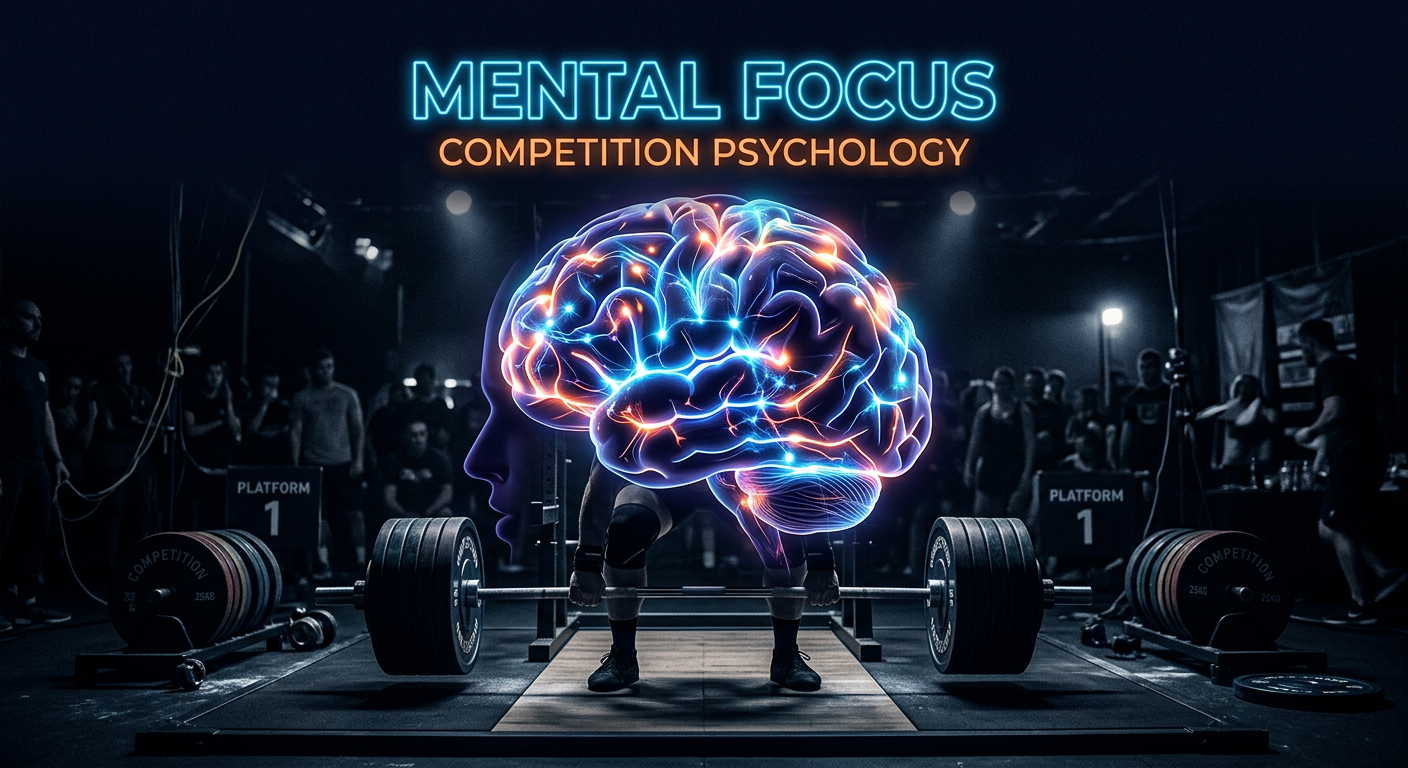
Competition Psychology: The Mental Side of Powerlifting
Mental preparation strategies for powerlifting competition - managing nerves, building confidence, developing pre-lift routines, handling missed lifts, and performing under pressure when it counts most.
Updated March 15, 2024Why the Mental Game Matters
Understanding Competition Nerves
Pre-competition anxiety is universal and physiologically identical to excitement. The elevated heart rate, heightened awareness, and physical tension you feel before a heavy attempt are your sympathetic nervous system preparing you for maximal effort.
The key insight from sports psychology research: anxiety is not the enemy. The problem is how you interpret it. Lifters who label pre-competition arousal as 'excitement' rather than 'nerves' perform significantly better than those who try to suppress or eliminate it.
Reframing technique: When you feel pre-meet anxiety, tell yourself 'I am excited' rather than trying to calm down. This reappraisal is more effective than suppression and requires no special training to implement.
Building Pre-Lift Routines
A consistent pre-lift routine serves two purposes: it focuses attention on task-relevant cues and blocks out distractions, and it anchors arousal to a familiar pattern that the nervous system associates with performance.
Elements of an effective routine:
- Fixed duration (15-60 seconds is typical)
- Physical component (chalk application, belt tightening, a specific stretch)
- Attentional cue (one or two technical focus points, not a checklist)
- Activation cue (a breath pattern, a word, a physical action that signals 'ready')
Developing your routine: Build it in training, not competition. Perform the same routine before every heavy single in training so that by meet day, it is fully automated. A routine you invent at your first meet will not be effective.
Handling Missed Lifts
Every competitive powerlifter fails lifts. How you respond in the minutes after a miss largely determines what happens on your next attempt.
The two-minute rule: After a missed lift, allow yourself two minutes to feel whatever you feel. Then make a deliberate decision to move your attention forward. Dwelling on a miss during warm-ups for the next lift is one of the most common and most costly mental mistakes.
Process focus: When a lift fails, direct your attention to the correctable technical error, not the outcome. 'I lost tension at the bottom' is actionable. 'I am not good enough' is not.
Red light errors: If judges give you red lights for a technical error (soft lockout, depth, commands), see it as information. Many lifters successfully repeat the same weight with a correction. Treat red lights as coaching feedback.
Concentration and Attentional Focus
Peak performance requires narrow, internal focus during the lift itself. The goal is to reduce the number of conscious thoughts to one or two technical cues while the rest of the movement is automatic.
Over-thinking on the platform: Beginners often have a ten-item mental checklist running during the squat. Advanced lifters reduce this to one cue - often a feeling rather than a mechanical instruction. Develop this by gradually narrowing your focus cues during training.
External distractions: Crowd noise, other lifters' attempts, scoreboard watching, and what competitors are doing are all attentional traps. Building a strong pre-lift routine creates a mental 'bubble' that filters these out.
Between-attempt focus: Actively direct your attention between attempts. Watch the platform, think about your warm-up feedback, discuss your next attempt with your handler. Passive waiting allows anxiety to build and attentional focus to scatter.
Confidence and Self-Talk
Self-talk - the internal monologue during training and competition - significantly influences performance. Negative self-talk ('I can't do this', 'this is too heavy') activates threat responses that impair motor performance. Instructional self-talk ('tight, push the floor away') maintains attention on technique.
Self-efficacy (confidence in your ability to perform a specific task) is built through mastery experiences. The more times you successfully complete heavy attempts in training, the stronger your competition confidence. This is why aggressive training that results in frequent misses is counterproductive - not just physically, but psychologically.
The training-to-competition confidence gap: Many lifters feel confident in training but anxious at meets. This gap typically closes with competition experience. Your first meet is the hardest mentally. By your third or fourth, the environment is familiar and the confidence transfers more reliably.
Goal Setting for Competition
Effective competition goals have three layers:
Outcome goals (place on the podium, win the weight class) are motivating but depend partly on others' performance and are outside your direct control. Use them for motivation, not as the primary performance standard.
Performance goals (total a specific weight, hit a personal record in each lift) depend only on your performance. These are your primary competition targets.
Process goals (execute my pre-lift routine on every attempt, stay focused between lifts, make conservative attempt adjustments) are entirely within your control and are the most powerful goals on competition day.
Before your meet: Write down your performance goal (target total or PR), one process goal for the warm-up room, and one process goal for the platform. Review them the morning of the meet.