

Beginners have one enormous advantage over experienced lifters: they respond to almost any reasonable training stimulus with rapid strength gains. This phase - sometimes called 'newbie gains' or the linear progression window - is characterized by strength improvements session to session or week to week.
During your first 6-18 months of consistent training, the primary driver of progress is neuromuscular adaptation: your nervous system learns to recruit muscle fibers more efficiently, coordinate the movement pattern, and produce force in the specific direction the lift requires. This happens quickly with consistent practice.
The implication: do not over-complicate your first year of training. Almost any well-structured beginner program will produce excellent results. The main variables that matter are consistency, progressive overload, and technique quality.
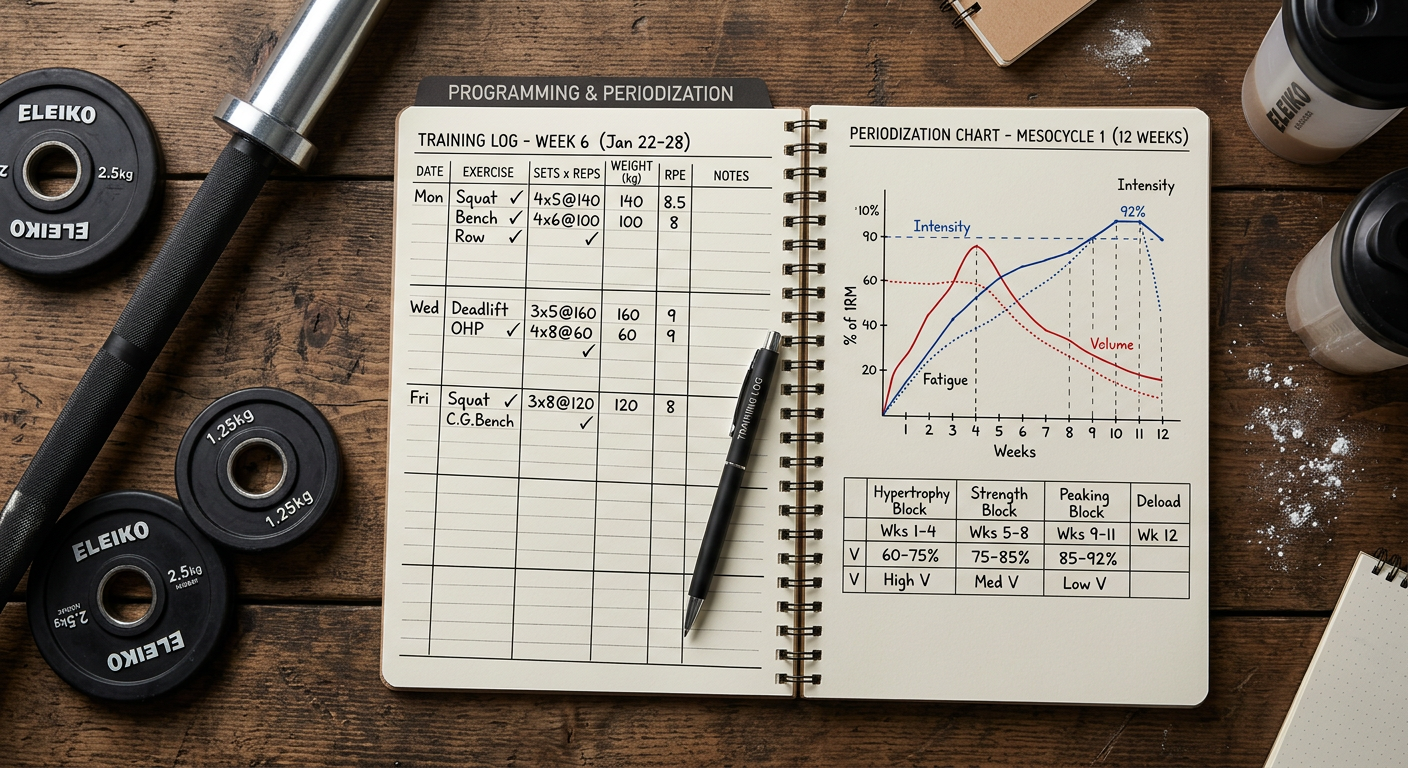
Powerlifting Training for Beginners: Your First Year
A practical guide to training in your first year of powerlifting - choosing a program, understanding progression, building technique, and preparing for your first competition.
Updated March 15, 2024The Beginner Advantage
Choosing Your First Program
The powerlifting community has produced many proven beginner programs. The most important criterion is not which program is theoretically optimal - it is which program you will follow consistently for 6+ months.
Starting Strength: Three days per week, focusing on squat, deadlift, bench press, and overhead press. Add weight every session. Very simple to follow. The coaching cues have specific idiosyncrasies (notably a very hip-dominant, low-bar squat style) that suit some lifters and not others.
StrongLifts 5x5: Similar structure to Starting Strength but uses 5 sets of 5 rather than 3 sets of 5. Slightly more volume. Equally simple progression.
GZCLP: Three-tier system (T1: main lifts 5x3, T2: secondary lifts 4x6, T3: accessories). More volume and variety than Starting Strength. Good for lifters who want slightly more programming complexity.
Candito Linear Progression: 4-day program with dedicated upper/lower split. Good introduction to more structured periodization for lifters who adapt quickly to three-day programs.
Key principle: Run a program as written for at least 3 months before modifying it. Resist the urge to add exercises, change rep schemes, or 'optimize' based on what you read online. Consistency with a proven program beats constantly modified training.
Understanding Linear Progression
Most beginner programs use linear progression: add a small amount of weight every session or every week. This works because beginners can recover from session to session and adapt faster than they can recover.
Typical increments:
- Squat and deadlift: 2.5-5 kg per session
- Bench press and overhead press: 1.25-2.5 kg per session
These increments seem small but compound quickly. Adding 2.5 kg per session to your squat three times per week means 7.5 kg per week - over 300 kg of progress in a year if the progression held uninterrupted (it will not, but you get the idea).
When progression stalls: Linear progression always stalls eventually. The correct response depends on the program you are running:
- Deload: Reduce weight by 10-15% and rebuild to your stall point.
- Program transition: After multiple deloads fail to restore progress, it is likely time to move to an intermediate program (Texas Method, 5/3/1, etc.).
Do not rush to intermediate programming. Linear progression can last longer than most beginners expect when technique is prioritized and recovery is adequate.
Technical Development
Technique in the squat, bench press, and deadlift is more important for long-term progress than any program detail. Poor technique limits how heavy you can safely train and increases injury risk.
Priorities for technical development:
1. Safety first: Learn the movements without ego. Use weights that allow you to focus on form.
2. Consistency before load: Establish a consistent movement pattern before prioritizing weight on the bar. A shaky squat at 100 kg will be a more shaky squat at 150 kg.
3. Video yourself: Recording your lifts from the side and rear allows you to see what you cannot feel. Compare your form to coaching cues and make incremental adjustments.
4. Get coaching: Even one or two sessions with an experienced powerlifting coach can save months of developing compensatory patterns. Many gyms with powerlifting communities offer form checks.
Common beginner technical errors:
- Squat: insufficient depth, knees caving inward, forward lean leading with the hips
- Bench: bouncing the bar off the chest, uneven ascent, not retracting shoulder blades
- Deadlift: rounding the lower back under load, jerking the bar off the floor, hyperextending the lockout
Training Frequency and Volume
For beginners, 3 days per week of full-body training (squat, bench, and deadlift at every session) is well-supported by evidence and tradition. This provides high practice frequency for the main movements while allowing adequate recovery.
Why frequency matters for beginners: Learning the squat, bench press, and deadlift is primarily a neurological task. More practice sessions per week means more opportunities to groove the movement pattern. A beginner who squats three times per week develops technique faster than one who squats once.
Volume management: Beginner programs typically use lower volume (3 sets of 5) than intermediate programs. This is intentional - the intensity of adding weight every session provides sufficient stimulus without excessive fatigue accumulation.
Rest days: At least one day between training sessions. Rest is when adaptation occurs. Training tired defeats the purpose of progressive overload.
Sleep: 7-9 hours per night. Growth hormone release, muscle protein synthesis, and neural recovery all peak during sleep. Training hard without sleeping is the fastest path to stalled progress and injury.
Nutrition Basics for New Powerlifters
You do not need a complicated diet to make excellent progress as a beginner. The fundamentals:
Calories: Strength training requires energy. Eating in a slight caloric surplus (200-300 kcal above maintenance) maximizes muscle protein synthesis and strength adaptation. Significant caloric restriction during heavy training impairs recovery and slows progress.
Protein: The most important macronutrient for powerlifters. Target 1.8-2.2 g of protein per kg of bodyweight per day. Distribute protein across 3-4 meals rather than consuming it all in one sitting.
Carbohydrates: The primary fuel for intense strength training. Do not fear carbohydrates. Adequate carbohydrate intake replenishes muscle glycogen and supports training performance.
Hydration: Even mild dehydration (2% bodyweight) reduces strength performance. Drink water consistently throughout the day, not just during training.
Supplements worth considering: Creatine monohydrate (3-5 g/day) has the strongest evidence base of any sports supplement for strength performance. It is inexpensive, safe, and effective. Protein powder is a convenient way to hit protein targets, not a necessity.
Your First Competition
Competing in your first powerlifting meet before you feel 'ready' is one of the best decisions you can make as a new lifter. There is no minimum strength standard to enter. The community is welcoming to beginners. And nothing teaches you more about powerlifting than standing on the platform.
When to enter your first meet: After 3-6 months of consistent training, you know the movements well enough to demonstrate them safely under competition conditions. That is enough.
What to expect: You will be nervous. The warm-up room will be louder and more chaotic than your gym. Your attempts will feel different under competition conditions. This is normal and universal. Almost every experienced powerlifter remembers how surreal their first meet felt.
Attempt strategy for your first meet: Open at 85-90% of your gym training max. Your goal is simply to total - get a successful lift in each of the three disciplines. Do not chase PRs on your first meet. Treat it as a learning experience.
After the meet: Use your competition results to recalibrate your training. A competition total gives you accurate data on your current strength level that pure training numbers sometimes obscure. Use it to set realistic goals for your next training block.