
The 5:2 diet calculator plans a week of five normal days and two low-calorie fast days. It works out your calories for both kinds of day, a protein, carbohydrate and fat split for the fast days, and the weekly and monthly loss that pattern may give. The numbers are planning estimates. If you have diabetes or take medication that lowers blood sugar, ask a clinician before you start.
Last verified 6 Oct 2026 against the revised Harris-Benedict equation (Roza and Shizgal, 1984), the 3,500-calories-per-pound rule (Wishnofsky, 1958), the calculator’s own fast-day settings and Harvie and colleagues’ 2011 trial of two-day-a-week energy restriction.
5:2 Diet Calculator
Calculate your fast day and normal day calories for the 5:2 diet
Related Calculators
Medical Disclaimer: This calculator provides estimates for educational purposes only and does not constitute medical advice. Intermittent fasting is not appropriate for everyone. Do not fast if you are pregnant or breastfeeding, under 18 years of age, have a history of eating disorders, or have been diagnosed with Type 1 diabetes. If you take medications (especially insulin or blood pressure medication), have any chronic health conditions, or are recovering from surgery, consult your physician before beginning any fasting protocol. If you experience chest pain, fainting, persistent dizziness, or heart palpitations during a fast, stop immediately and seek medical attention.
How your result is worked out
The calculator works in four steps. The fast-day share and the macro split are its own settings.
1. Calories at rest (BMR)
Your weight, height, age and sex go into the revised Harris-Benedict equation, which estimates the calories you burn at complete rest.
Men: 88.362 + (13.397 x weight in kg) + (4.799 x height in cm) – (5.677 x age)
Women: 447.593 + (9.247 x weight in kg) + (3.098 x height in cm) – (4.330 x age)
Roza and Shizgal found the equation estimates resting energy use to within about 14%, so your real needs can differ.
2. Normal days and fast days
The calculator multiplies your BMR by 1.2 for Sedentary, 1.375 for Light, 1.55 for Moderate or 1.725 for Very Active to estimate your daily energy use (TDEE). Your five normal days are set at your TDEE. Your two fast days are set at 25% of your TDEE.
| Fast-day macro | Share of fast-day calories |
|---|---|
| Protein | 40%, at 4 calories per gram |
| Fat | 35%, at 9 calories per gram |
| Carbohydrate | 25%, at 4 calories per gram |
3. Weekly deficit
Your weekly deficit is seven days at your TDEE minus what the plan gives you: five days at TDEE plus two days at 25% of it. That works out to one and a half days of TDEE each week.
4. Weekly and monthly loss
Weekly loss is the weekly deficit divided by 3,500 calories per pound. Monthly loss is the weekly figure times 4.33. The 3,500-calorie rule ignores the way your energy use falls as you lose weight (Hall and colleagues, 2011), so read the monthly figure as an estimate for the first months, and recalculate as your weight changes.
Worked example: the default inputs
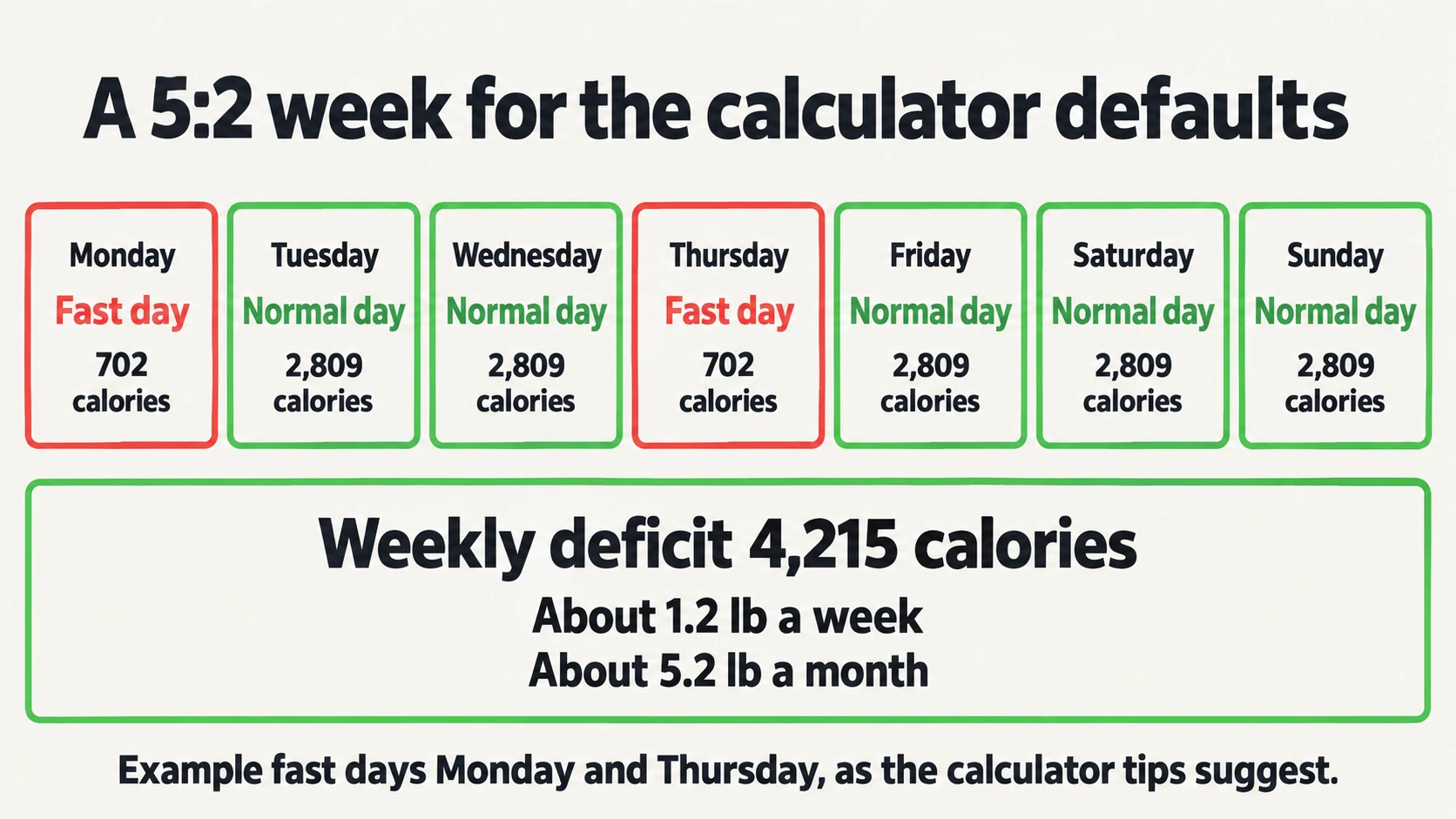
The calculator starts with a 35-year-old man, 180 lb, 5 ft 8 in and Moderate activity. These are the numbers it shows before you change anything.
| Step | Result |
|---|---|
| BMR | 1,812 calories a day |
| Normal day calories (TDEE, x 1.55) | 2,809 calories |
| Fast day calories (25% of 2,809) | 702 calories |
| Fast day protein (40%) | 70 g |
| Fast day fat (35%) | 27 g |
| Fast day carbohydrate (25%) | 44 g |
| Weekly deficit | 4,215 calories |
| Weekly loss (4,215 / 3,500) | 1.2 lb |
| Monthly loss (x 4.33) | 5.2 lb |
5:2 diet questions
Does 5:2 work as well as cutting calories every day?
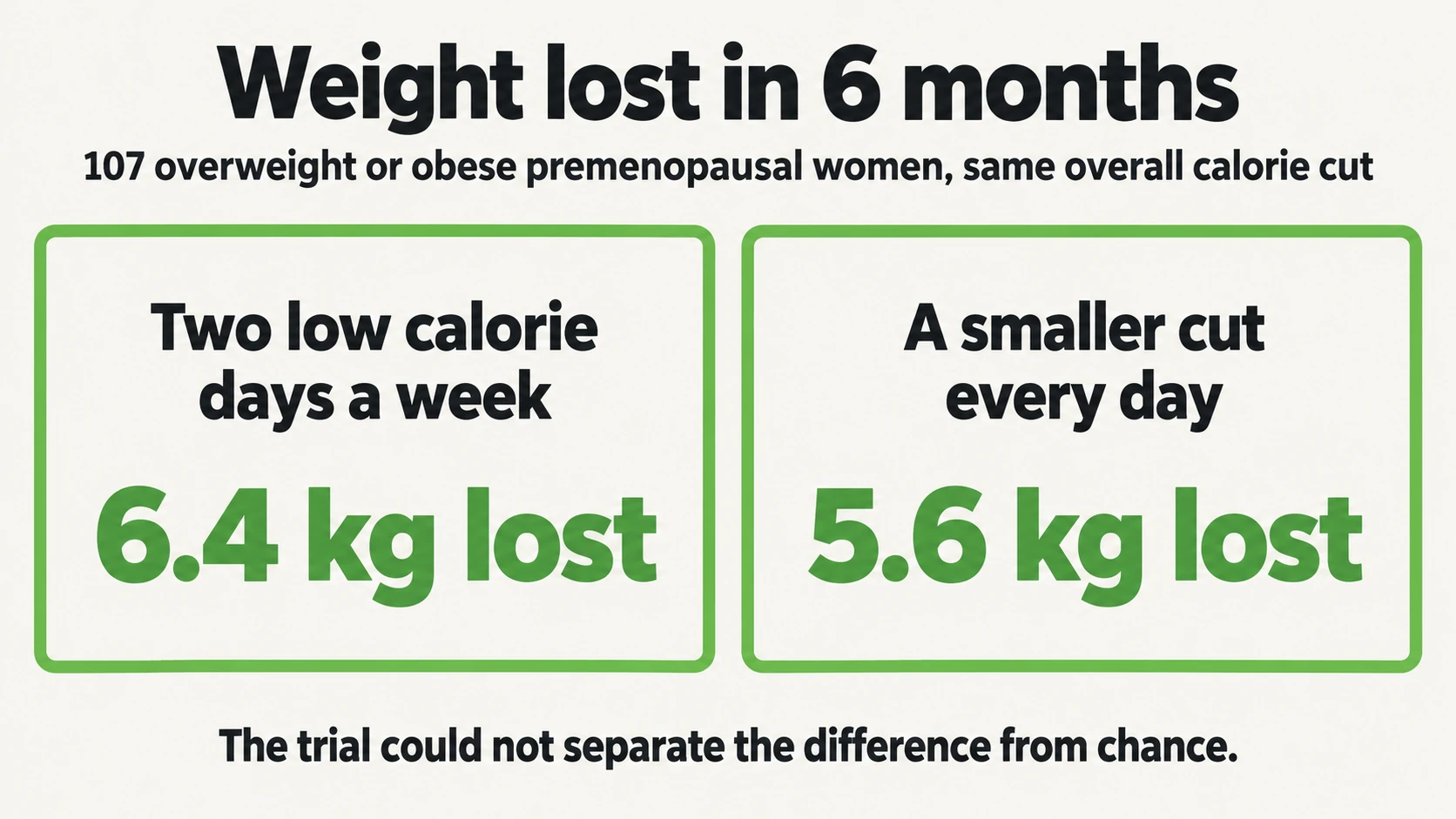
In a 6-month trial, Harvie and colleagues randomized 107 overweight or obese premenopausal women to the same overall 25% calorie cut, taken either on 2 days a week or every day. Weight loss was similar: 6.4 kg on the two-day plan and 5.6 kg on the daily plan, a difference the trial could not separate from chance. Both groups improved cholesterol and blood pressure by similar amounts, and the two-day group had a slightly larger drop in fasting insulin and insulin resistance. The trial included only women.
Why is my fast-day target not 500 or 600 calories?
The calculator sets each fast day at 25% of your TDEE, so the number follows your size and activity: 702 calories at the defaults. A smaller or less active person gets a lower figure. In Harvie’s trial, the fast-day intake was about 2,710 kJ, roughly 650 calories.
Can I choose any two days for fasting?
The calculator’s tips suggest two non-consecutive days, such as Monday and Thursday. Its numbers come out the same whichever two days you pick.
How is the 5:2 diet different from alternate-day fasting?
The 5:2 diet restricts calories on two days a week. Alternate-day fasting restricts every other day, so 3 or 4 days a week. This calculator plans 5:2 only.
Sources
- The effects of intermittent or continuous energy restriction on weight loss and metabolic disease risk markers: a randomized trial in young overweight women. Harvie MN, Pegington M, Mattson MP, Frystyk J, et al. International Journal of Obesity, 2011; 35: 714-727.
- The Harris Benedict equation reevaluated: resting energy requirements and the body cell mass. Roza AM, Shizgal HM. American Journal of Clinical Nutrition, 1984; 40: 168-182.
- Caloric equivalents of gained or lost weight. Wishnofsky M. American Journal of Clinical Nutrition, 1958; 6: 542-546.
- Quantification of the effect of energy imbalance on bodyweight. Hall KD, Sacks G, Chandramohan D, Chow CC, et al. The Lancet, 2011; 378: 826-837.
More fasting tools
- Fasting schedule generator: set daily eating and fasting times for your normal days.
- Fasting weight loss calculator: estimate how many weeks your fasting plan takes to reach a goal weight.
- OMAD calculator: calories and macros for one meal a day.
- All fasting calculators: every fasting calculator in one list.