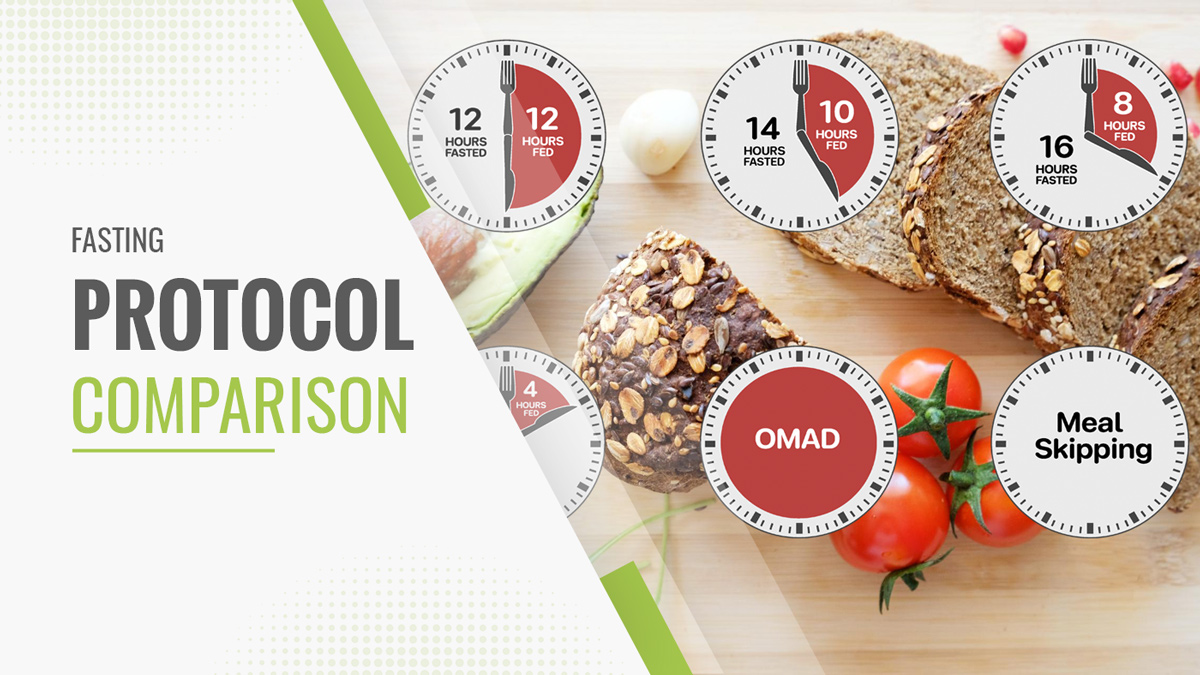
The fasting protocol comparison lines up two to four fasting methods side by side and recommends one for your goal and experience. Use it to narrow your options before you build a schedule. Its difficulty scores are the tool’s own rough ratings, not results from studies, and it does not replace a clinician’s advice on which protocol suits you.
Last verified 6 Oct 2026 against the comparison’s code and two one-year trials: Trepanowski and colleagues (2017) and Liu and colleagues (2022).
Compare Fasting Protocols
Find the perfect fasting method for your goals by comparing protocols side-by-side
Related Calculators
Medical Disclaimer: This calculator provides estimates for educational purposes only and does not constitute medical advice. Intermittent fasting is not appropriate for everyone. Do not fast if you are pregnant or breastfeeding, under 18 years of age, have a history of eating disorders, or have been diagnosed with Type 1 diabetes. If you take medications (especially insulin or blood pressure medication), have any chronic health conditions, or are recovering from surgery, consult your physician before beginning any fasting protocol. If you experience chest pain, fainting, persistent dizziness, or heart palpitations during a fast, stop immediately and seek medical attention.
How the comparison is worked out
The comparison reads from a fixed table of eight protocols, then scores the ones you picked against your goal and experience.
1. Pick two to four protocols
The comparison needs at least two protocols and takes no more than four. It starts with 16:8 and 20:4 ticked.
2. The fixed protocol table
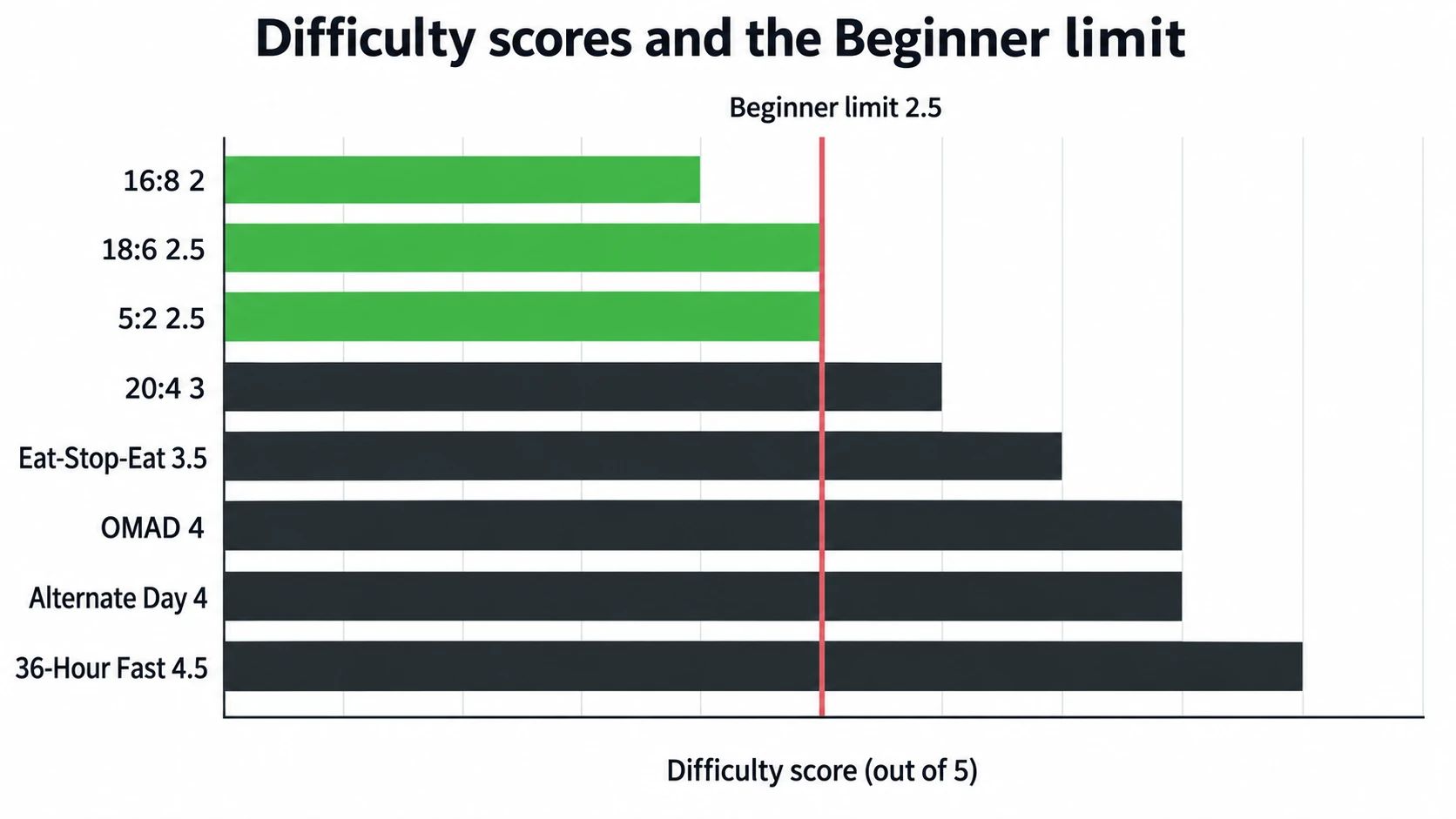
Every protocol carries a fasting window, an eating window and a difficulty score from 2 to 4.5. Your result shows the score as, for example, “2 of 5”. The difficulty scores are the tool’s own planning ratings.
| Protocol | Fasting window | Eating window | Difficulty score |
|---|---|---|---|
| Leangains (16:8) | 16 hours | 8 hours | 2 |
| 18:6 Method | 18 hours | 6 hours | 2.5 |
| Warrior Diet (20:4) | 20 hours | 4 hours | 3 |
| OMAD | 23 hours | 1 hour | 4 |
| 5:2 Diet | Varies | Varies | 2.5 |
| Alternate Day Fasting | 24 to 36 hours | 24 hours | 4 |
| 36-Hour Fast | 36 hours | 12 hours | 4.5 |
| Eat-Stop-Eat | 24 hours | Varies | 3.5 |
The comparison does not rate fat loss, autophagy, ketosis or muscle for each protocol. The trials under Sources found similar weight loss across eating patterns when people cut calories by about the same amount.
3. The recommendation
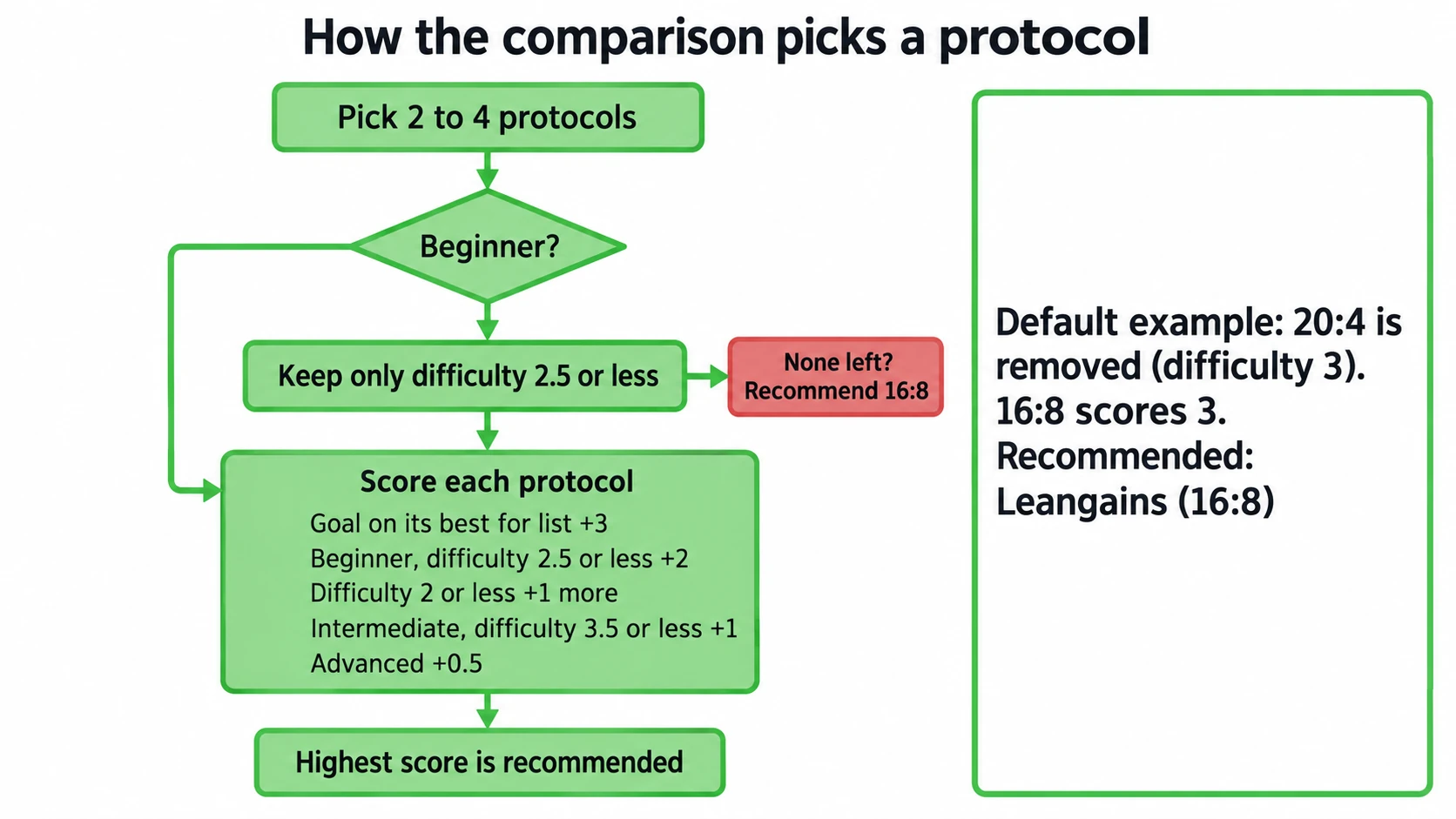
If you pick Beginner, the comparison only recommends a protocol with a difficulty score of 2.5 or less: 16:8, 18:6 or 5:2. If none of your picks qualifies, it recommends 16:8 and says why. It then scores each remaining protocol and recommends the one with the most points.
| Rule | Points |
|---|---|
| Your goal is on the protocol’s built-in “best for” list | +3 |
| Beginner, difficulty 2.5 or less | +2, plus 1 more at difficulty 2 or less |
| Intermediate, difficulty 3.5 or less | +1 |
| Advanced | +0.5 for every protocol |
Sources: Trepanowski and colleagues, JAMA Internal Medicine, 2017; Liu and colleagues, New England Journal of Medicine, 2022.
Worked example: the default inputs
16:8 and 20:4 ticked, goal Fat Loss, experience Beginner. These are the inputs the comparison starts with.
| Feature | Leangains (16:8) | Warrior Diet (20:4) |
|---|---|---|
| Fasting window | 16h | 20h |
| Eating window | 8h | 4h |
| Difficulty (tool rating) | 2 of 5 | 3 of 5 |
| Best for | Fast 16 hours, eat within 8. | Fast 20 hours, eat within a 4-hour window. |
20:4 has a difficulty score of 3, so the Beginner rule removes it. 16:8 scores 2 for a difficulty of 2.5 or less and 1 more for a difficulty of 2 or less, so the comparison recommends Leangains (16:8). The result adds that one-year trials found similar weight loss across eating patterns at the same calorie cut.
Fasting protocol questions
Which fasting protocol is best for fat loss?
Trials have not found a clear winner when the calorie cut is the same. In a one-year trial of 100 adults with obesity, alternate-day fasting and a daily calorie cut led to similar weight loss, and more people dropped out of the fasting group. In another one-year trial of 139 adults, an 8:00 AM to 4:00 PM eating window added no significant loss to the same calorie cut. Choose a protocol you can keep.
Can I switch between protocols?
Yes. Nothing in the comparison ties you to one protocol. If you are new to fasting, the result suggests starting with 16:8 and trying a longer protocol once it feels easy.
What is the hardest protocol to follow?
In the comparison’s own difficulty scores, the 36-hour fast rates hardest at 4.5, followed by OMAD and alternate-day fasting at 4. These scores are the tool’s ratings, not measured adherence.
How do I choose the right protocol for me?
Run the comparison with your real goal and experience, then test the winner against your week with the schedule generator. Ask a clinician before you start fasting if you take medicines for diabetes or blood pressure, are pregnant or breastfeeding, or have a history of eating disorders.
Sources
- Effect of alternate-day fasting on weight loss, weight maintenance, and cardioprotection among metabolically healthy obese adults: a randomized clinical trial. Trepanowski JF, Kroeger CM, Barnosky A, Klempel MC, et al. JAMA Internal Medicine, 2017; 177: 930-938.
- Calorie restriction with or without time-restricted eating in weight loss. Liu D, Huang Y, Huang C, Yang S, et al. New England Journal of Medicine, 2022; 386: 1495-1504.
More fasting tools
- Fasting schedule generator: set daily fasting and eating windows for the protocol you chose.
- Fasting weight loss calculator: estimate a goal date once the timing looks workable.
- OMAD calculator: calories and macros if you choose one meal a day.
- All fasting calculators: every fasting calculator in one list.