The OMAD calculator sets a calorie target and a protein, carbohydrate and fat split for one meal a day. It works from your weight, height, age, sex, activity level and goal, and for fat loss or muscle gain, the rate you pick. It also suggests how to build the meal. The targets are planning estimates; if you have diabetes, take medication or have a history of disordered eating, ask a clinician before you try OMAD.
Last verified 6 Oct 2026 against the revised Harris-Benedict equation (Roza and Shizgal, 1984), the calculator’s own goal and macro settings, and the one-meal-a-day trial reported by Stote and colleagues and Carlson and colleagues in 2007.
OMAD Calculator
Calculate your optimal calories and macros for One Meal a Day eating
Related Calculators
Medical Disclaimer: This calculator provides estimates for educational purposes only and does not constitute medical advice. Intermittent fasting is not appropriate for everyone. Do not fast if you are pregnant or breastfeeding, under 18 years of age, have a history of eating disorders, or have been diagnosed with Type 1 diabetes. If you take medications (especially insulin or blood pressure medication), have any chronic health conditions, or are recovering from surgery, consult your physician before beginning any fasting protocol. If you experience chest pain, fainting, persistent dizziness, or heart palpitations during a fast, stop immediately and seek medical attention.
How your result is worked out
The calculator works in four steps. The goal adjustments and macro shares are its own settings.
1. Calories at rest (BMR)
Your weight, height, age and sex go into the revised Harris-Benedict equation, which estimates the calories you burn at complete rest.
Men: 88.362 + (13.397 x weight in kg) + (4.799 x height in cm) – (5.677 x age)
Women: 447.593 + (9.247 x weight in kg) + (3.098 x height in cm) – (4.330 x age)
Roza and Shizgal found the equation estimates resting energy use to within about 14%, so your real needs can differ.
2. Calories in a normal day and your goal
The calculator multiplies your BMR by your activity factor to estimate your daily energy use (TDEE), then adjusts it for your goal. It never sets a target below 1,200 calories, and when your numbers fall below that line, the result says it used 1,200.
| Your answer | What the calculator does |
|---|---|
| Activity: Sedentary / Light / Moderate / Very Active | BMR x 1.2 / 1.375 / 1.55 / 1.725 |
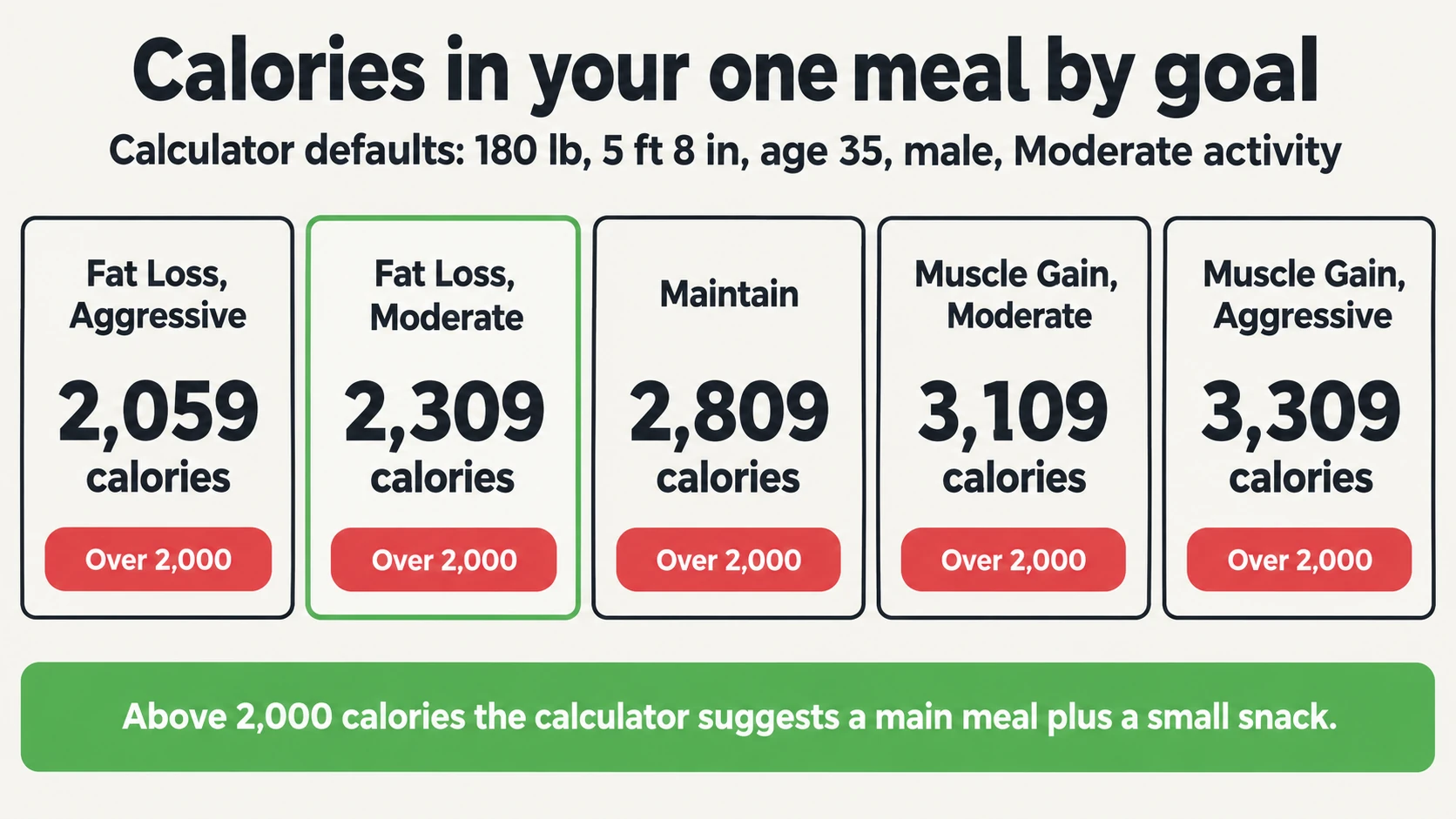
| Goal: Fat Loss, rate Moderate | TDEE minus 500 calories |
| Goal: Fat Loss, rate Aggressive | TDEE minus 750 calories |
| Goal: Maintain | TDEE, unchanged |
| Goal: Muscle Gain, rate Moderate | TDEE plus 300 calories |
| Goal: Muscle Gain, rate Aggressive | TDEE plus 500 calories |
3. Your macros
- Fat: 30% of your calories, divided by 9 calories per gram.
- Protein: 1.0 g per lb of body weight, or 1.2 g per lb for Muscle Gain. If that much protein would not fit in your calories once fat takes its 30%, the calculator lowers it to fit and shows a “Protein Target Reduced” note.
- Carbohydrate: the calories left after protein and fat, divided by 4 calories per gram.
4. Your meal
The schedule assumes a 23-hour fast and a 1-hour eating window. The result lists food ideas for protein, carbohydrate, fat and vegetables, and sample meals scaled to your calorie target. If your target is over 2,000 calories, the calculator notes that one meal that size may cause discomfort and suggests a main meal plus a small snack inside your window.
Worked example: the default inputs
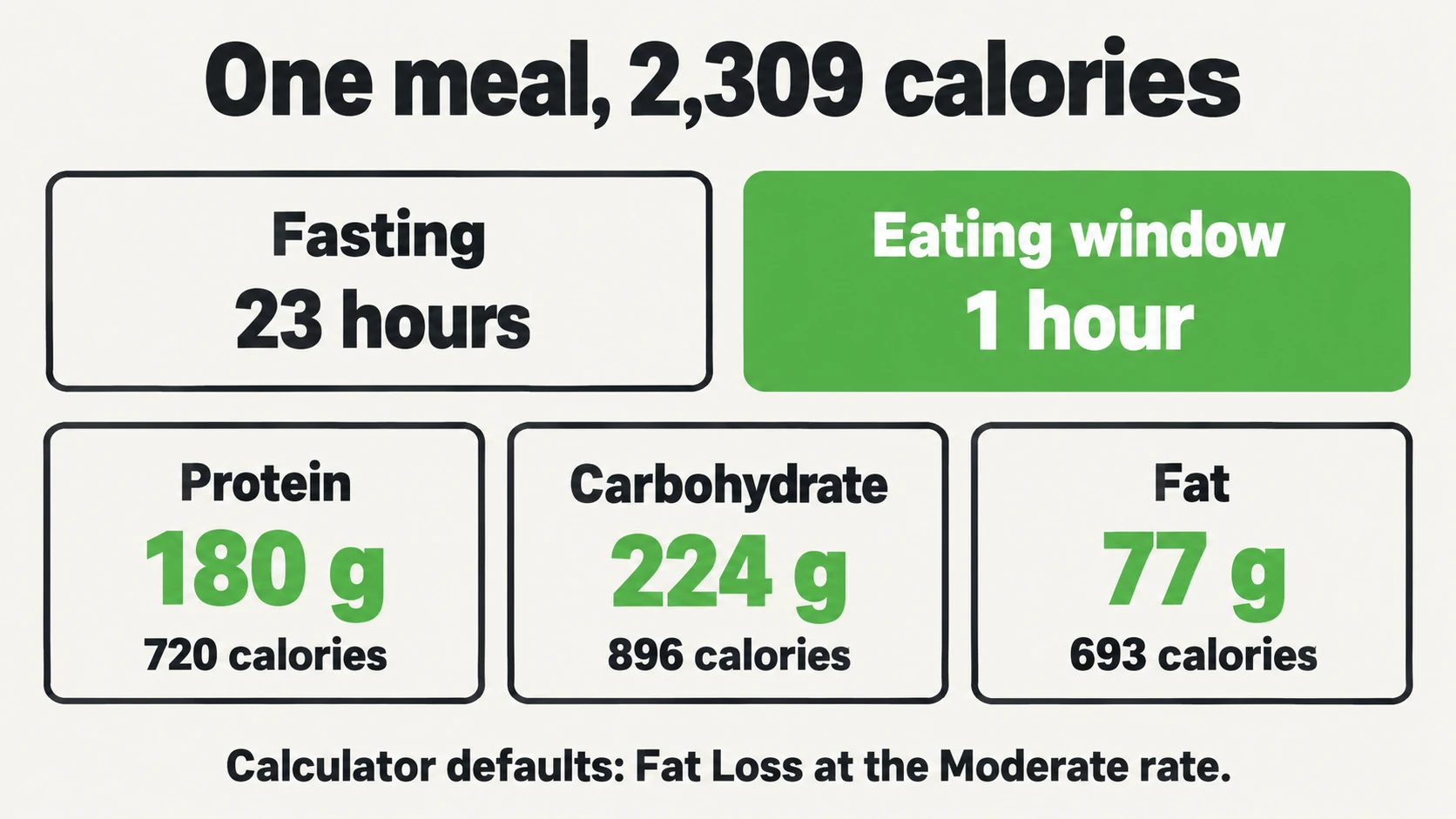
The calculator starts with a 35-year-old man, 180 lb, 5 ft 8 in, Moderate activity and Fat Loss at the Moderate rate. These are the numbers it shows before you change anything.
| Step | Result |
|---|---|
| BMR | 1,812 calories a day |
| TDEE (x 1.55) | 2,809 calories a day |
| Daily calories (2,809 – 500) | 2,309 calories |
| Fat (30% of 2,309, divided by 9) | 77 g (693 calories) |
| Protein (180 lb x 1.0) | 180 g (720 calories) |
| Carbohydrate (2,309 – 720 – 693, divided by 4) | 224 g (896 calories) |
| Schedule | 23 hours fasting, 1-hour eating window |
| Note shown | High Calorie OMAD, because 2,309 is over 2,000 |
The result panel adds that results may vary with your metabolism and activity.
OMAD questions
Is OMAD safe long-term?
The controlled trial below ran for 8 weeks per diet, so it cannot tell you what years on OMAD do. In that randomized crossover trial, healthy normal-weight middle-aged adults ate the same maintenance calories as either 3 meals or 1 meal a day for 8 weeks each. On one meal a day they reported more hunger and lost some fat mass, but their blood pressure and total, LDL and HDL cholesterol rose (Stote and colleagues, 2007). The same trial found higher morning fasting glucose and poorer morning glucose tolerance, and that change was reversible (Carlson and colleagues, 2007). Ask a clinician before you try OMAD if you have diabetes, high blood pressure or high cholesterol, or take medication.
Why was my protein target reduced?
At a low calorie target, 1.0 g per lb of body weight plus 30% of calories from fat can add up to more than your calories allow. The calculator then lowers protein to fit, sets carbohydrate to what is left, and hides the sample meals because they would no longer match. A smaller deficit or the Moderate rate brings back the full protein target.
Should I split a large meal?
The calculator suggests it for targets over 2,000 calories: a main meal and a small snack inside your eating window. That changes the plan from strict OMAD to a short eating window. The fasting schedule generator can set up a 20:4 or similar window instead.
Can I drink anything during the 23-hour fast?
The calculator’s tips say to drink water and zero-calorie drinks through the day. To check a specific drink, sweetener or supplement, use What Breaks a Fast.
Sources
- The Harris Benedict equation reevaluated: resting energy requirements and the body cell mass. Roza AM, Shizgal HM. American Journal of Clinical Nutrition, 1984; 40: 168-182.
- A controlled trial of reduced meal frequency without caloric restriction in healthy, normal-weight, middle-aged adults. Stote KS, Baer DJ, Spears K, Paul DR, et al. American Journal of Clinical Nutrition, 2007; 85: 981-988.
- Impact of reduced meal frequency without caloric restriction on glucose regulation in healthy, normal-weight middle-aged men and women. Carlson O, Martin B, Stote KS, Golden E, et al. Metabolism, 2007; 56: 1729-1734.
More fasting tools
- IF macro calculator: spread the same kind of daily targets across an eating window with more than one meal.
- Fasting schedule generator: pick a protocol and a start time to get your daily eating and fasting windows.
- Fasting weight loss calculator: estimate how many weeks your fasting plan takes to reach a goal weight.
- All fasting calculators: every fasting calculator in one list.