The ketosis calculator estimates how many hours into a fast you may reach nutritional ketosis. It works from four answers: how much carbohydrate you eat now, your usual diet, your activity level and how hard you exercise during the fast. You also get the hours for light and deep ketosis and the ketone range to expect at hour 24. The hours are planning estimates; only a ketone meter shows your real level.
Last verified 6 Oct 2026 against the calculator’s own hour tables and the nutritional ketosis range of 0.5 to 3 mmol/L of beta-hydroxybutyrate (Miller, Villamena and Volek, 2018), with the metabolic switch timing from Anton and colleagues’ 2018 review.
Ketosis Timeline Calculator
Find out when you'll enter ketosis and reach optimal ketone levels
Related Calculators
Medical Disclaimer: This calculator provides estimates for educational purposes only and does not constitute medical advice. Intermittent fasting is not appropriate for everyone. Do not fast if you are pregnant or breastfeeding, under 18 years of age, have a history of eating disorders, or have been diagnosed with Type 1 diabetes. If you take medications (especially insulin or blood pressure medication), have any chronic health conditions, or are recovering from surgery, consult your physician before beginning any fasting protocol. If you experience chest pain, fainting, persistent dizziness, or heart palpitations during a fast, stop immediately and seek medical attention.
How your result is worked out
The calculator works in three steps. The hours come from its own tables, so read them as its planning assumptions.
1. Hours to nutritional ketosis
Every estimate starts at 18 hours of fasting. The calculator adds or takes away hours for each answer, using the table below, and keeps the total between 16 and 36 hours.
| Your answer | Change to the 18-hour start |
|---|---|
| Current carb intake: High (200g+) | +8 hours |
| Current carb intake: Moderate (100-200g) | +4 hours |
| Current carb intake: Low (50-100g) | No change |
| Current carb intake: Very Low (under 50g) | -4 hours |
| Prior diet: High Carb | +6 hours |
| Prior diet: Moderate | +2 hours |
| Prior diet: Low Carb | -2 hours |
| Prior diet: Keto | -6 hours |
| Activity: Sedentary | +3 hours |
| Activity: Moderate | No change |
| Activity: Very Active | -2 hours |
| Exercise during the fast: None | No change |
| Exercise during the fast: Moderate | -1 hour |
| Exercise during the fast: High | -3 hours |
Carbohydrate counts twice: once for what you eat now and once for your usual diet. Between them they cover 24 hours of the table, more than any other answer.
The 16-hour floor follows the metabolic switch. Anton and colleagues put the switch at 12 to 36 hours after your last meal, and ketone production rises after it, so the calculator never shows light ketosis before hour 12 or nutritional ketosis before hour 16.
2. Light and deep ketosis
The other milestones sit a fixed number of hours from your nutritional ketosis hour, so they move with it.
| Milestone | How the calculator sets it |
|---|---|
| Light ketosis | Your nutritional ketosis hour minus 4, never before hour 12 |
| Nutritional ketosis | The estimate from step 1 |
| Deep ketosis | Your nutritional ketosis hour plus 12 |
The autophagy, metabolic switching and extended fasting calculators take their ketosis hour from this same model, so the pages agree for the same answers.
3. Ketones at 24 hours
The ketone tile checks where hour 24 falls on your timeline. If hour 24 is at or past your nutritional ketosis hour, it shows 1.0-3.0 mmol/L. If it falls between light and nutritional ketosis, it shows 0.5-1.0 mmol/L. Before light ketosis, it shows under 0.5 mmol/L.
Miller and colleagues define nutritional ketosis as blood beta-hydroxybutyrate of 0.5 to 3 mmol/L, up from the under 0.3 mmol/L you would usually see. The calculator splits that range in two, light ketosis from 0.5 and nutritional ketosis from 1.0. The split is its own.
Worked example: the default inputs
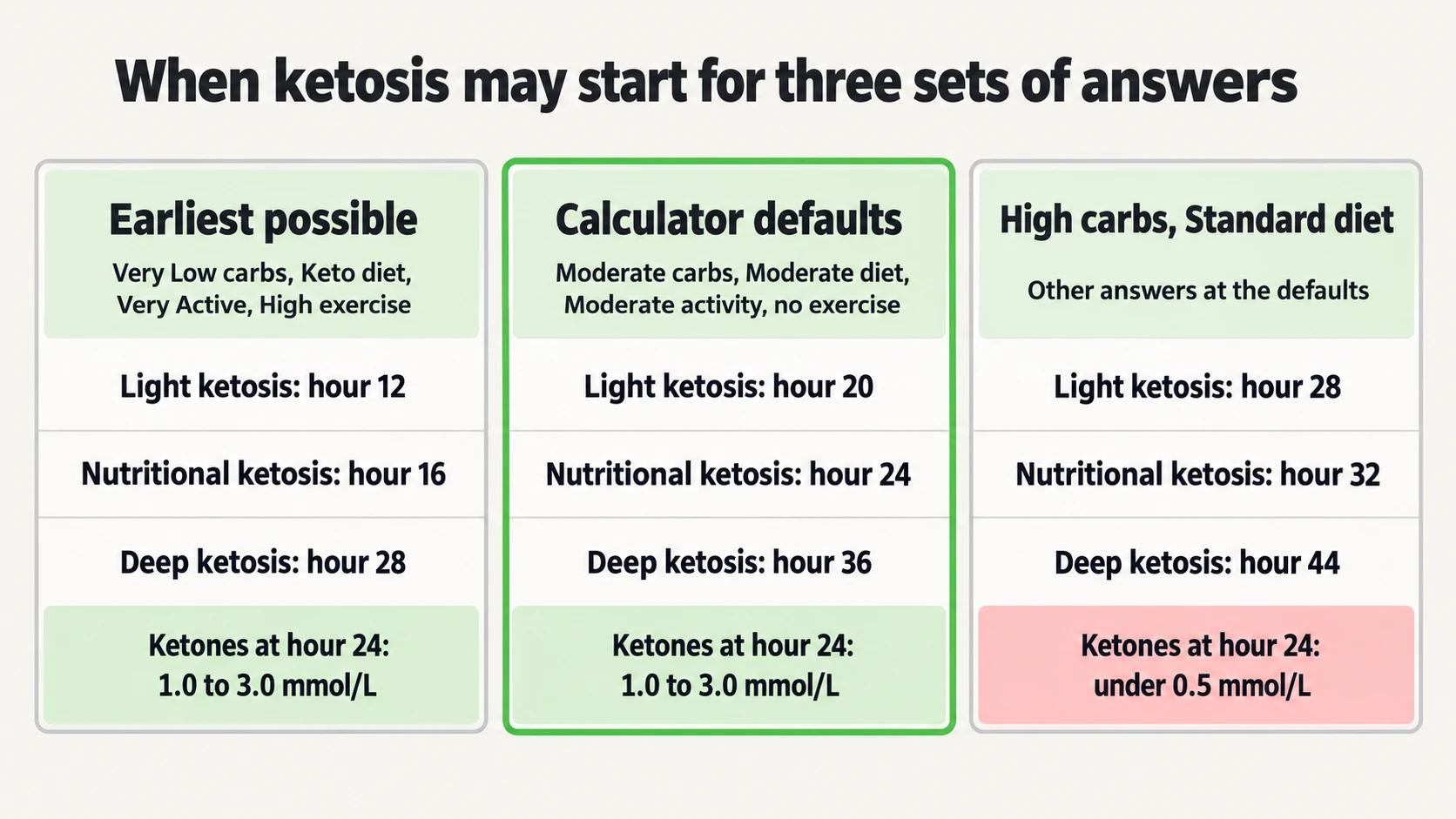
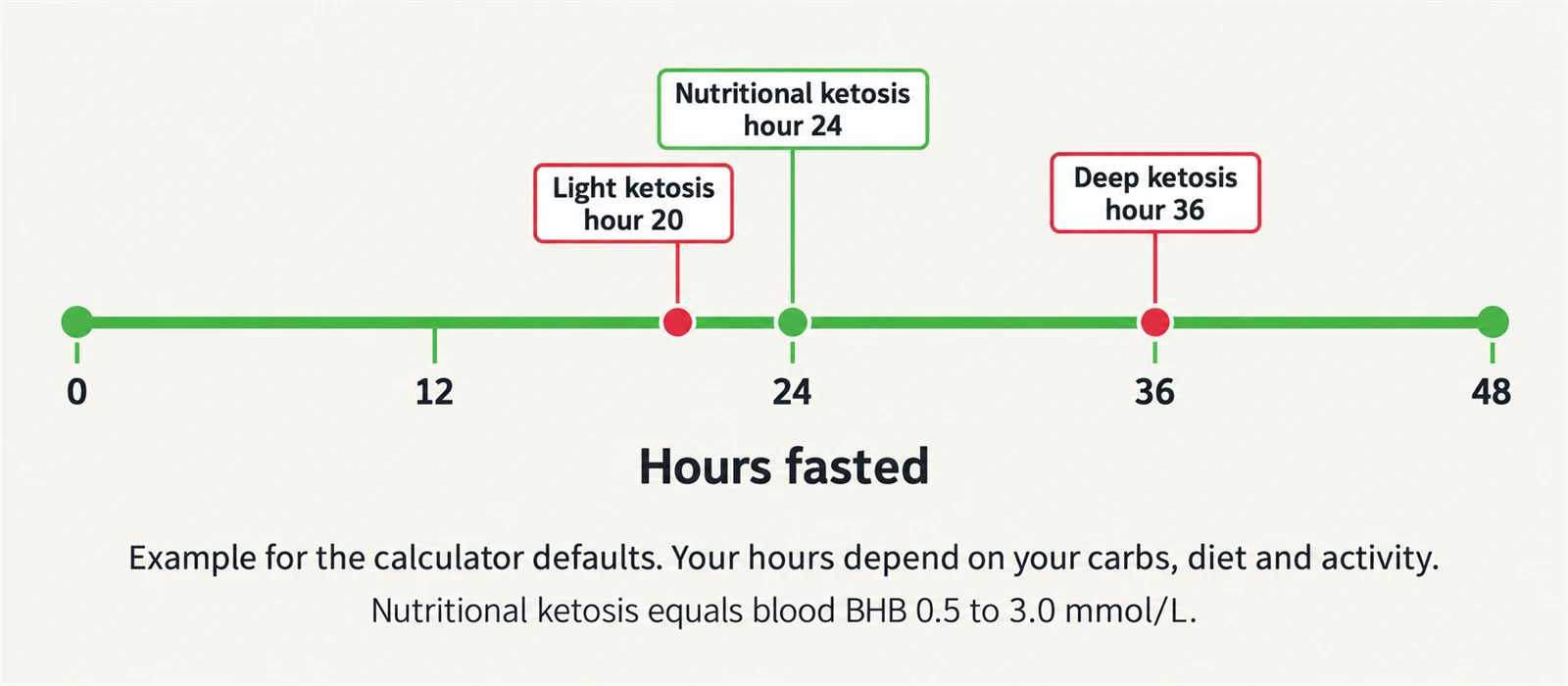
The calculator starts with Moderate (100-200g) carb intake, a Moderate prior diet, Moderate activity and no exercise during the fast. These are the numbers it shows before you change anything.
| Step | Result |
|---|---|
| Starting point | 18 hours |
| Current carb intake: Moderate | +4 hours |
| Prior diet: Moderate | +2 hours |
| Activity: Moderate | No change |
| Exercise during the fast: None | No change |
| Hours to nutritional ketosis | 24 hours |
| Light ketosis (24 – 4) | Hour 20 |
| Deep ketosis (24 + 12) | Hour 36 |
| Ketones at 24 hours | 1.0-3.0 mmol/L, because hour 24 is your nutritional ketosis hour |
The result panel adds that your own timing may differ from the estimate by 2 to 4 hours either way.
Ketosis questions
Is ketosis the same as ketoacidosis?
No. Nutritional ketosis sits at 0.5 to 3 mmol/L of beta-hydroxybutyrate, well below the levels seen in ketoacidosis (Miller and colleagues, 2018). Diabetic ketoacidosis happens when insulin runs low and ketones climb high, and diabetes is the most common medical cause of high blood ketones (Laffel, 1999). If you have diabetes or take medication that lowers blood sugar, ask a clinician before you fast.
How do I check whether I am in ketosis?
Urine strips use the nitroprusside test, which picks up only acetoacetate and gives a rough reading. Blood meters measure beta-hydroxybutyrate from a small drop of blood, and Laffel’s review calls beta-hydroxybutyrate the best indicator of ketone levels. The calculator measures nothing, so a meter reading beats its estimate.
What does “ketones at 24 hours” mean?
It is the range the calculator expects at hour 24 of your fast, read off your own timeline. A long timeline gives a lower range: with a High carb intake and a High Carb prior diet, for example, hour 24 falls before light ketosis and the tile shows under 0.5 mmol/L.
Why does exercise during the fast bring ketosis earlier?
Ketone levels rise during fasting and during prolonged exercise (Laffel, 1999). The calculator takes 1 hour off for Moderate exercise and 3 hours for High. Those sizes are its own settings.
How long until deep ketosis?
The calculator places deep ketosis 12 hours after your nutritional ketosis hour: hour 36 on the defaults. It shows no ketone level for that point. If you plan to fast past 24 hours, the extended fasting calculator covers longer fasts.
Sources
- Nutritional ketosis and mitohormesis: potential implications for mitochondrial function and human health. Miller VJ, Villamena FA, Volek JS. Journal of Nutrition and Metabolism, 2018; 2018: 5157645.
- Flipping the metabolic switch: understanding and applying the health benefits of fasting. Anton SD, Moehl K, Donahoo WT, Marosi K, et al. Obesity, 2018; 26: 254-268.
- Ketone bodies: a review of physiology, pathophysiology and application of monitoring to diabetes. Laffel L. Diabetes/Metabolism Research and Reviews, 1999; 15: 412-426.
More fasting tools
- Metabolic switching calculator: estimate when your body may switch from glucose to fat for fuel.
- Autophagy calculator: estimate when autophagy may begin during the same fast.
- Extended fasting calculator: plan a fast of 24 hours or more, with a weight projection and electrolyte reference ranges.
- All fasting calculators: every fasting calculator in one list.