
The autophagy calculator estimates the hour of a fast when autophagy may begin for you. It works from five answers: your body fat, activity level, usual diet, fasting experience and whether you exercise during a fast. You get one estimate in hours and four milestones placed around it. Nothing in the tool measures autophagy in your body, so treat the result as a planning estimate.
Last verified 6 Oct 2026 against the calculator’s own hour tables, shown in full below. The tool cites no study for these hours, so read every hour on this page as its planning assumption.
Autophagy Timeline Calculator
Discover when your body enters autophagy based on your unique profile
Related Calculators
Medical Disclaimer: This calculator provides estimates for educational purposes only and does not constitute medical advice. Intermittent fasting is not appropriate for everyone. Do not fast if you are pregnant or breastfeeding, under 18 years of age, have a history of eating disorders, or have been diagnosed with Type 1 diabetes. If you take medications (especially insulin or blood pressure medication), have any chronic health conditions, or are recovering from surgery, consult your physician before beginning any fasting protocol. If you experience chest pain, fainting, persistent dizziness, or heart palpitations during a fast, stop immediately and seek medical attention.
How your result is worked out
The calculator works in two steps. It first sets your autophagy estimate, then places four milestones around it.
1. Your autophagy estimate
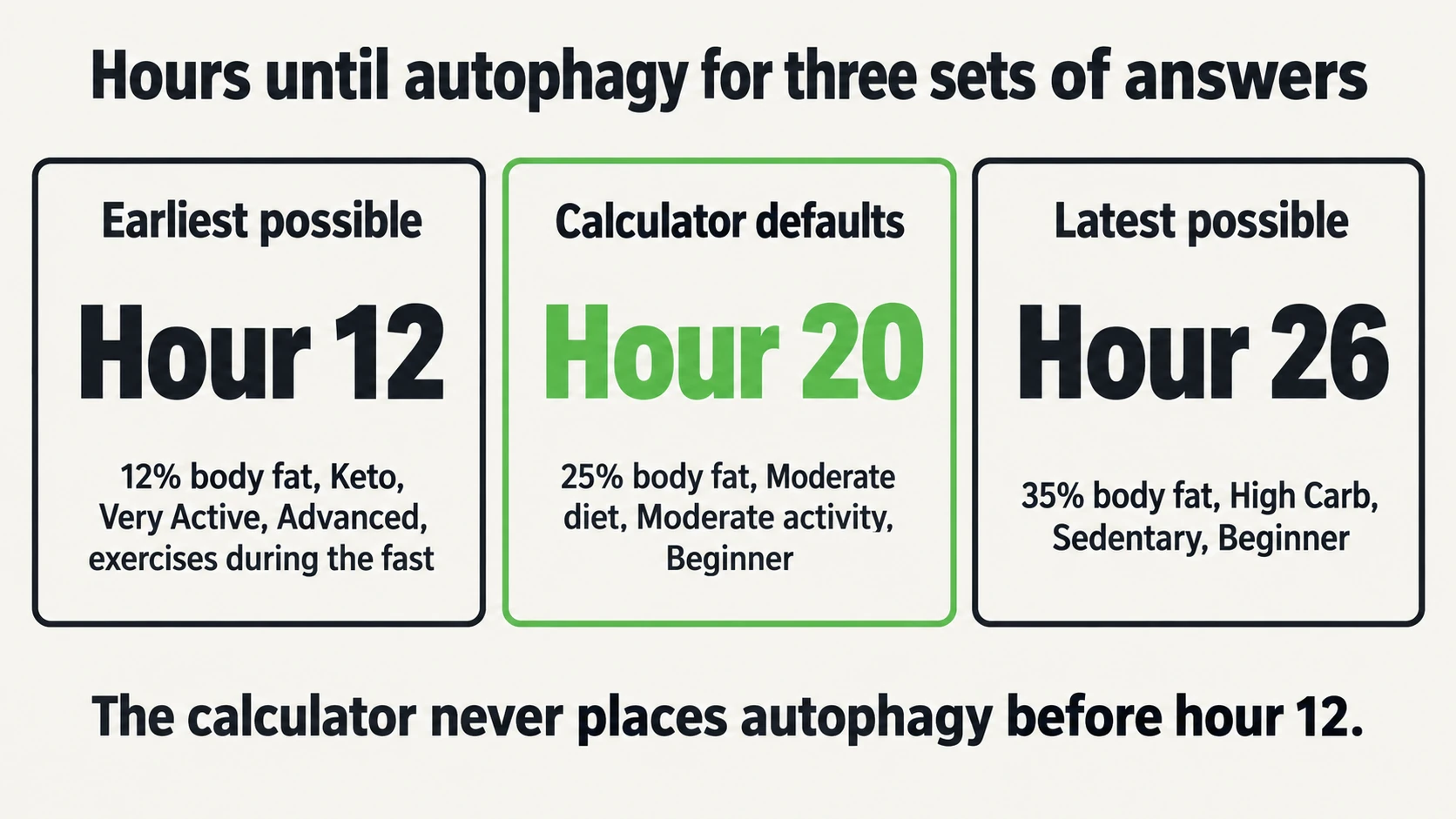
Every estimate starts at 18 hours of fasting. The calculator then adds or takes away hours for each answer you give, using the table below, and keeps the total between 12 and 30 hours.
| Your answer | Change to the 18-hour start |
|---|---|
| Body fat over 30% | +2 hours |
| Body fat over 25%, up to 30% | +1 hour |
| Body fat 15% to 25% | No change |
| Body fat under 15% | -1 hour |
| Prior diet: High Carb | +4 hours |
| Prior diet: Moderate | +2 hours |
| Prior diet: Low Carb | No change |
| Prior diet: Keto | -2 hours |
| Activity: Sedentary | +2 hours |
| Activity: Light | +1 hour |
| Activity: Moderate | No change |
| Activity: Very Active | -1 hour |
| Experience: Beginner | No change |
| Experience: Intermediate | -1 hour |
| Experience: Advanced | -2 hours |
| I exercise during my fasts (ticked) | -1 hour |
The calculator assumes that more carbohydrate before a fast, more body fat and less activity all push autophagy later, and that a keto diet, fasting experience and exercise bring it earlier. These hour values are its own settings.
2. The milestones around it
The result shows four milestones next to your estimate. Two sit a fixed number of hours from your estimate. The other two come from the site’s metabolic switching and ketosis calculators, run with your answers, so all three pages give the same hours for the same person.
| Milestone | How the calculator sets it |
|---|---|
| Glycogen depletion | The metabolic switching calculator’s switch point minus 2 hours, worked out from your body fat, activity and prior diet (your prior diet also stands in for your last meal) |
| Ketosis begins | The ketosis calculator’s light ketosis hour for your prior diet and activity (your prior diet also stands in for your current carb intake, and a ticked exercise box counts as Moderate exercise during the fast) |
| HGH boost | Your estimate minus 2 hours |
| Peak autophagy | Your estimate plus 30 hours |
Growth hormone output rises during a fast: in nine healthy men, Hartman and colleagues measured higher 24-hour growth hormone production on the second day of a fast than on a fed day. That study looked at day two, so the HGH marker at your estimate minus 2 hours is the calculator’s assumption.
Worked example: the default inputs
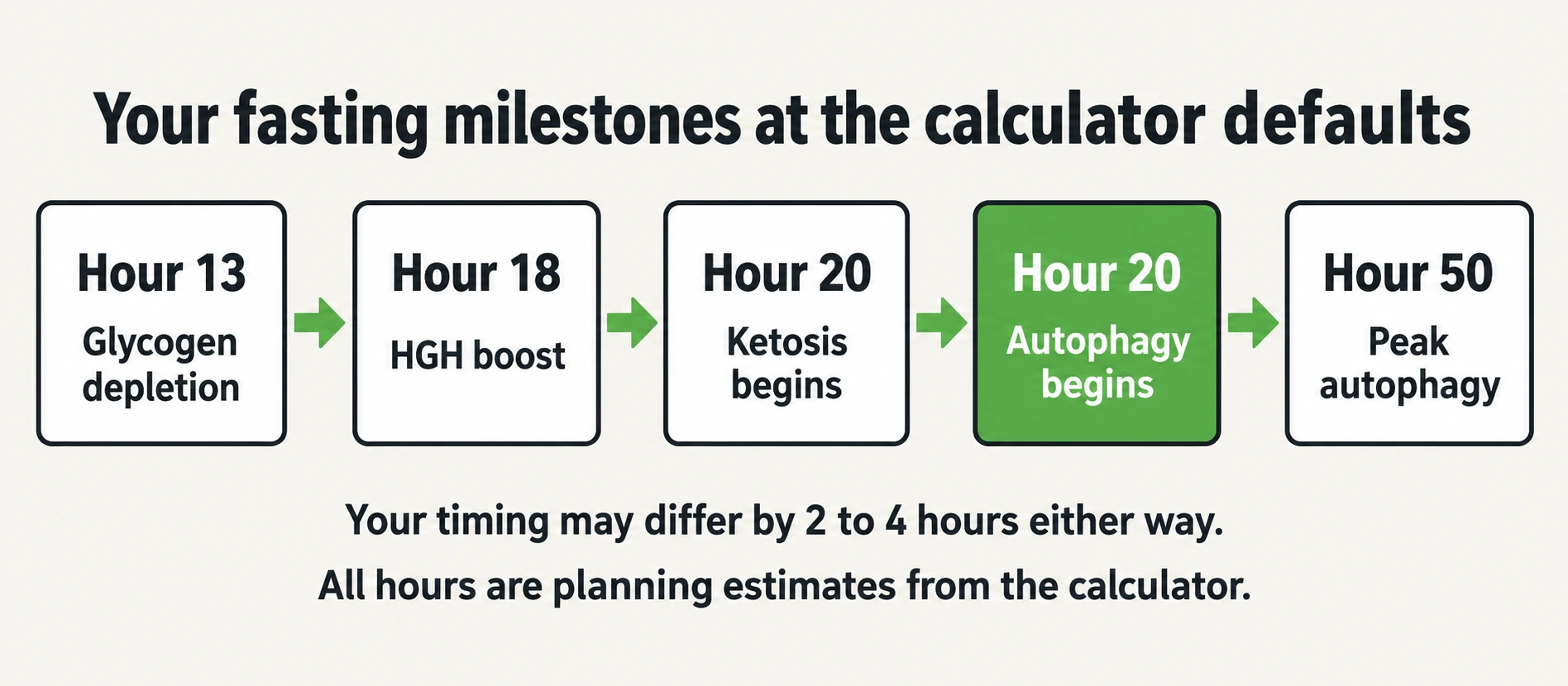
The calculator starts at 25% body fat, Moderate activity, a Moderate prior diet, Beginner experience and the exercise box unticked. These are the numbers it shows before you change anything.
| Step | Result |
|---|---|
| Starting point | 18 hours |
| Body fat 25% | No change |
| Prior diet: Moderate | +2 hours |
| Activity: Moderate | No change |
| Experience: Beginner | No change |
| Hours until autophagy | 20 hours |
| Glycogen depletion (switch point 15 – 2) | Hour 13 |
| Ketosis begins (light ketosis on the ketosis calculator) | Hour 20 |
| HGH boost (20 – 2) | Hour 18 |
| Peak autophagy (20 + 30) | Hour 50 |
The result panel adds that your own timing may differ from the estimate by 2 to 4 hours either way.
Autophagy questions
What is autophagy?
Autophagy is the process your cells use to break down damaged parts and recycle the building blocks. Yoshinori Ohsumi won the 2016 Nobel Prize in Physiology or Medicine “for his discoveries of mechanisms for autophagy”. A 2018 review by Bagherniya and colleagues concluded that fasting and calorie restriction both raise autophagy in a wide range of tissues and organs.
How do I know if autophagy is happening?
Researchers track autophagy with markers measured in tissue. In the coffee study below, for example, they measured two proteins, LC3B and p62, in the liver, muscle and heart of mice. You cannot check those markers at home, and the calculator measures nothing: it gives you an estimated hour from your answers.
Does coffee break autophagy?
Pietrocola and colleagues tested coffee in mice in 2014. Both regular and decaffeinated coffee raised autophagy markers in the liver, muscle and heart 1 to 4 hours after the mice drank it. The study did not include people, so it cannot tell you what coffee does during your own fast. The calculator does not ask about coffee and does not change your estimate for it.
Is a longer fast better for autophagy?
The calculator makes no claim either way. It places peak autophagy 30 hours after your estimate, hour 50 on the defaults, and gives no timeline past that point. If you plan a fast of 24 hours or more, use the extended fasting calculator, and ask a clinician first if you take medication or have a medical condition.
Why does my usual diet change the estimate so much?
Prior diet has the widest range of any answer in the calculator. High Carb adds 4 hours and Keto takes away 2, a 6-hour spread, because the tool assumes a lower-carbohydrate diet before the fast brings autophagy earlier. That spread is the calculator’s own setting.
Sources
- The effect of fasting or calorie restriction on autophagy induction: a review of the literature. Bagherniya M, Butler AE, Barreto GE, Sahebkar A. Ageing Research Reviews, 2018; 47: 183-197.
- Coffee induces autophagy in vivo. Pietrocola F, Malik SA, Mariño G, Vacchelli E, et al. Cell Cycle, 2014; 13: 1987-1994.
- Augmented growth hormone (GH) secretory burst frequency and amplitude mediate enhanced GH secretion during a two-day fast in normal men. Hartman ML, Veldhuis JD, Johnson ML, Lee MM, et al. Journal of Clinical Endocrinology and Metabolism, 1992; 74: 757-765.
- The Nobel Prize in Physiology or Medicine 2016: press release. The Nobel Assembly at Karolinska Institutet, 3 October 2016.
More fasting tools
- Ketosis calculator: check when ketone production may rise during the same fast.
- Metabolic switching calculator: estimate when your body may switch from glucose to fat for fuel.
- Extended fasting calculator: plan a fast of 24 hours or more, with a weight projection and electrolyte reference ranges.
- All fasting calculators: every fasting calculator in one list.