
The fasting habit score rates your fasting routine out of 100 from five answers: how often you fast, how long your fasts last, how many years you have fasted, your own rating of your lifestyle and how often you exercise. It shows which part of your routine scores well and which part has gaps. The score does not estimate biological age, and it cannot tell you whether fasting is safe for you.
Last verified 6 Oct 2026 against the calculator’s own point tables. The score follows no published formula, so every point value below is the calculator’s own setting.
Fasting Habit Score
Check whether your fasting routine looks consistent, sustainable, and balanced with exercise and daily habits
Related Calculators
Medical Disclaimer: This calculator provides estimates for educational purposes only and does not constitute medical advice. Intermittent fasting is not appropriate for everyone. Do not fast if you are pregnant or breastfeeding, under 18 years of age, have a history of eating disorders, or have been diagnosed with Type 1 diabetes. If you take medications (especially insulin or blood pressure medication), have any chronic health conditions, or are recovering from surgery, consult your physician before beginning any fasting protocol. If you experience chest pain, fainting, persistent dizziness, or heart palpitations during a fast, stop immediately and seek medical attention.
How your result is worked out
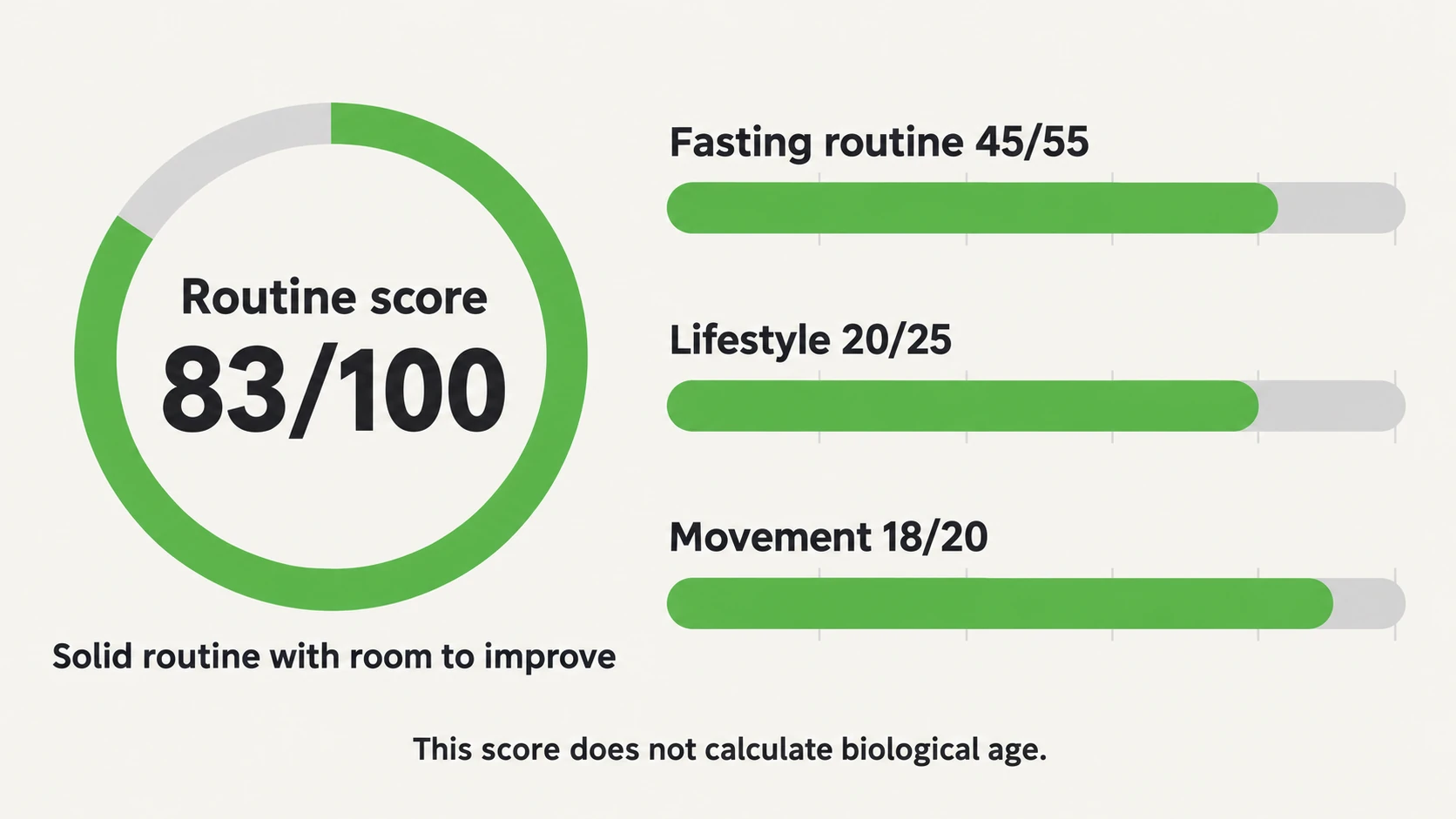
The calculator adds points from three parts: your fasting routine (up to 55), your lifestyle (up to 25) and your movement (up to 20). The total is your routine score out of 100.
1. Points for each answer
| Part | Your answer | Points |
|---|---|---|
| Fasting routine | Frequency: Daily | 22 |
| Fasting routine | Frequency: Few Times/Week | 20 |
| Fasting routine | Frequency: Weekly | 14 |
| Fasting routine | Frequency: Monthly | 8 |
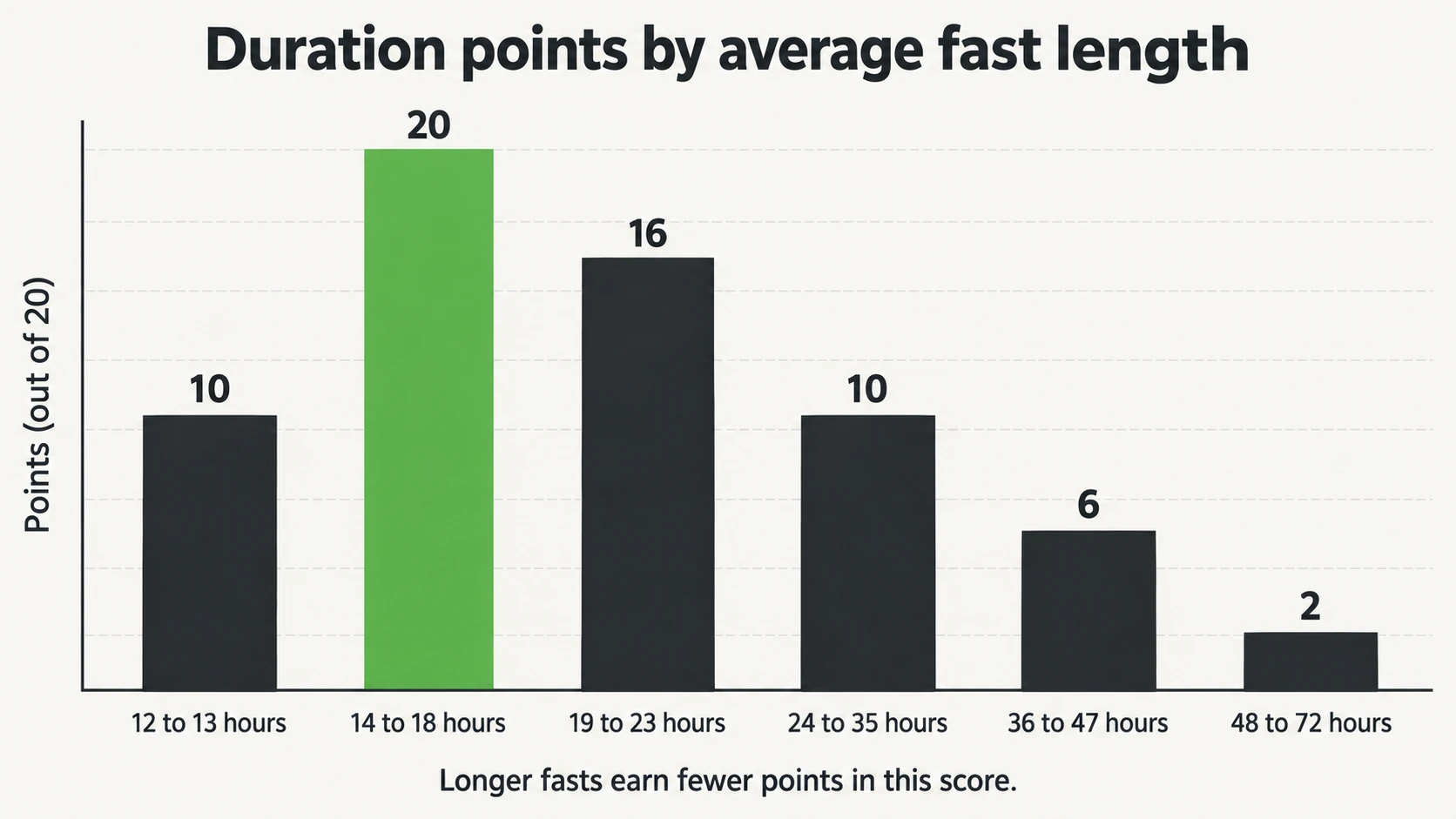
| Fasting routine | Average fast of 12 to 13 hours | 10 |
| Fasting routine | Average fast of 14 to 18 hours | 20 |
| Fasting routine | Average fast of 19 to 23 hours | 16 |
| Fasting routine | Average fast of 24 to 35 hours | 10 |
| Fasting routine | Average fast of 36 to 47 hours | 6 |
| Fasting routine | Average fast of 48 to 72 hours | 2 |
| Fasting routine | Years of fasting | Years x 2.6, rounded, up to 13 (5 years or more) |
| Lifestyle | Excellent / Good / Average / Poor | 25 / 20 / 12 / 5 |
| Movement | Daily / Regular (3-4x/week) / Occasional / Sedentary | 20 / 18 / 10 / 3 |
Average fasts of 14 to 18 hours earn the most duration points. From 24 hours up, the points drop, so a longer fast lowers your score.
2. Your rating
| Routine score | Rating the calculator shows |
|---|---|
| 85 to 100 | Strong, balanced routine |
| 70 to 84 | Solid routine with room to improve |
| 50 to 69 | Developing routine |
| Under 50 | Needs a safer foundation |
3. Your next step
Under “Next Best Step” the calculator adds a note for each of these answers:
- An average fast of 24 hours or more: longer fasts lower the routine score.
- Lifestyle rated Average or Poor: improve sleep, food quality, stress management and recovery before you extend fasts.
- Exercise rated Occasional or Sedentary: build a movement routine you can repeat.
- Under 1 year of fasting: keep the schedule simple while you learn how your body responds.
If none of these applies, it tells you the routine looks balanced.
This score comes from the calculator’s own point tables, not a published formula.
Worked example: the default inputs
The calculator starts with 1 year of fasting, a 16-hour average fast, Daily frequency, Good lifestyle and Regular exercise. These are the numbers it shows before you change anything.
| Step | Result |
|---|---|
| Frequency: Daily | 22 points |
| Average fast: 16 hours | 20 points |
| Years of fasting: 1 (1 x 2.6, rounded) | 3 points |
| Fasting routine | 45/55 |
| Lifestyle: Good | 20/25 |
| Movement: Regular | 18/20 |
| Routine score | 83/100 |
| Rating | Solid routine with room to improve |
| Next Best Step | Your routine looks balanced |
Fasting habit score questions
Is this a biological age test?
No. The form collects no biomarkers, so it has nothing to base a biological age on. The result panel says so: “This does not calculate biological age”.
Why can a longer fast lower the score?
The calculator scores routines you can repeat and recover from as more balanced. An average fast of 14 to 18 hours earns 20 points; 24 to 35 hours earns 10 and 48 hours or more earns 2. That scale is the calculator’s own choice.
How can I improve my score?
Start with the lowest of the three parts. Moving from Occasional to Regular exercise adds 8 points, and moving your lifestyle from Average to Good adds 8. Experience adds points on its own: about 2.6 a year, up to 13 at 5 years.
Does a low score mean fasting is unsafe for me?
No. The score cannot assess medical risk. If you have a health condition, take medication, are pregnant, or feel unwell again and again while fasting, talk the plan through with a clinician.
More fasting tools
- Fasting timer: track your next fast against a target duration.
- Fasting schedule generator: get daily eating and fasting windows for a protocol and a start time.
- What breaks a fast: check a drink, food or supplement against your fasting goal.
- All fasting calculators: every fasting calculator in one list.