The extended fasting calculator plans a fast of 24 hours or more. It estimates the fat you may lose, your daily energy use, and the hours when ketosis and autophagy may begin. It also shows daily reference ranges for sodium, potassium and magnesium, a guide to breaking the fast, and a refeeding warning for fasts of 48 hours or more. If you have a medical condition, take medication or are pregnant, ask a clinician before a fast this long.
Last verified 6 Oct 2026 against the revised Harris-Benedict equation (Roza and Shizgal, 1984), the 3,500-calories-per-pound rule (Wishnofsky, 1958), the site’s ketosis and autophagy models, the FDA sodium guidance and the NIH Office of Dietary Supplements fact sheets for potassium and magnesium.
Extended Fasting Calculator
Plan your 24-72+ hour fast with weight loss projections and electrolyte reference ranges
Related Calculators
Medical Disclaimer: This calculator provides estimates for educational purposes only and does not constitute medical advice. Intermittent fasting is not appropriate for everyone. Do not fast if you are pregnant or breastfeeding, under 18 years of age, have a history of eating disorders, or have been diagnosed with Type 1 diabetes. If you take medications (especially insulin or blood pressure medication), have any chronic health conditions, or are recovering from surgery, consult your physician before beginning any fasting protocol. If you experience chest pain, fainting, persistent dizziness, or heart palpitations during a fast, stop immediately and seek medical attention.
How your result is worked out
The calculator works in four parts. Every number it gives is an estimate, so treat the result as a plan to check against how you feel.
1. Estimated fat loss
Your weight, height, age and sex go into the revised Harris-Benedict equation, which estimates the calories you burn at rest (BMR).
Men: 88.362 + (13.397 x weight in kg) + (4.799 x height in cm) – (5.677 x age)
Women: 447.593 + (9.247 x weight in kg) + (3.098 x height in cm) – (4.330 x age)
The calculator multiplies your BMR by your activity factor to get your daily energy use. During the fast you eat none of it, so the calculator counts the whole amount, for every day of the fast, as fat at 3,500 calories per pound.
| Step | How the calculator sets it |
|---|---|
| Daily energy use | BMR x 1.2 for Sedentary, x 1.375 for Light, x 1.55 for Moderate |
| Estimated fat loss | Daily energy use x (fast hours divided by 24), divided by 3,500 |
With Metric selected, the calculator shows the same result in kilograms. Roza and Shizgal found the Harris-Benedict equation estimates resting energy use to within about 14%, and the 3,500-calorie rule ignores the way your energy use falls as you lose weight (Hall and colleagues, 2011), so read the fat figure as an estimate.
The scale usually drops more than the fat figure in the first days. Most of that early drop is water and glycogen: your body stores glycogen with three to four parts water (Kreitzman and colleagues, 1992).
2. When ketosis and autophagy may begin
The calculator takes both hours from the site’s own models, so they match the ketosis and autophagy calculators for the same answers.
- Ketosis begins: the ketosis calculator’s light ketosis hour for your prior diet and activity. Your prior diet also stands in for your current carb intake, and the calculator assumes no exercise during the fast.
- Autophagy begins: the autophagy calculator’s estimate for your body fat, prior diet, activity and fasting experience, with the exercise box unticked.
Body fat and fasting experience move only the autophagy hour. If you enter a start date and time, the calculator turns these hours into clock times on a dated timeline.
3. Daily electrolyte reference ranges
The three ranges are fixed reference intakes for adults. They are the same for every fast and every person, and the calculator gives no supplement dose.
| Mineral | Range shown | Where it comes from |
|---|---|---|
| Sodium | 2,300 mg a day or less | The FDA notes that the Dietary Guidelines for Americans advise adults to keep sodium under 2,300 mg a day |
| Potassium | 2,600 to 3,400 mg a day | NIH adequate intake for adults: 2,600 mg for women, 3,400 mg for men |
| Magnesium | 310 to 420 mg a day | NIH recommended intakes for adults, which run from 310 to 420 mg by age and sex |
These are total daily intakes from food and drink, not supplement doses. For adults, magnesium from supplements and medicines has an upper limit of 350 mg a day (NIH Office of Dietary Supplements). Ask a clinician before you take any electrolyte supplement during an extended fast. Your weight and activity do not change the ranges.
4. Warnings the calculator adds
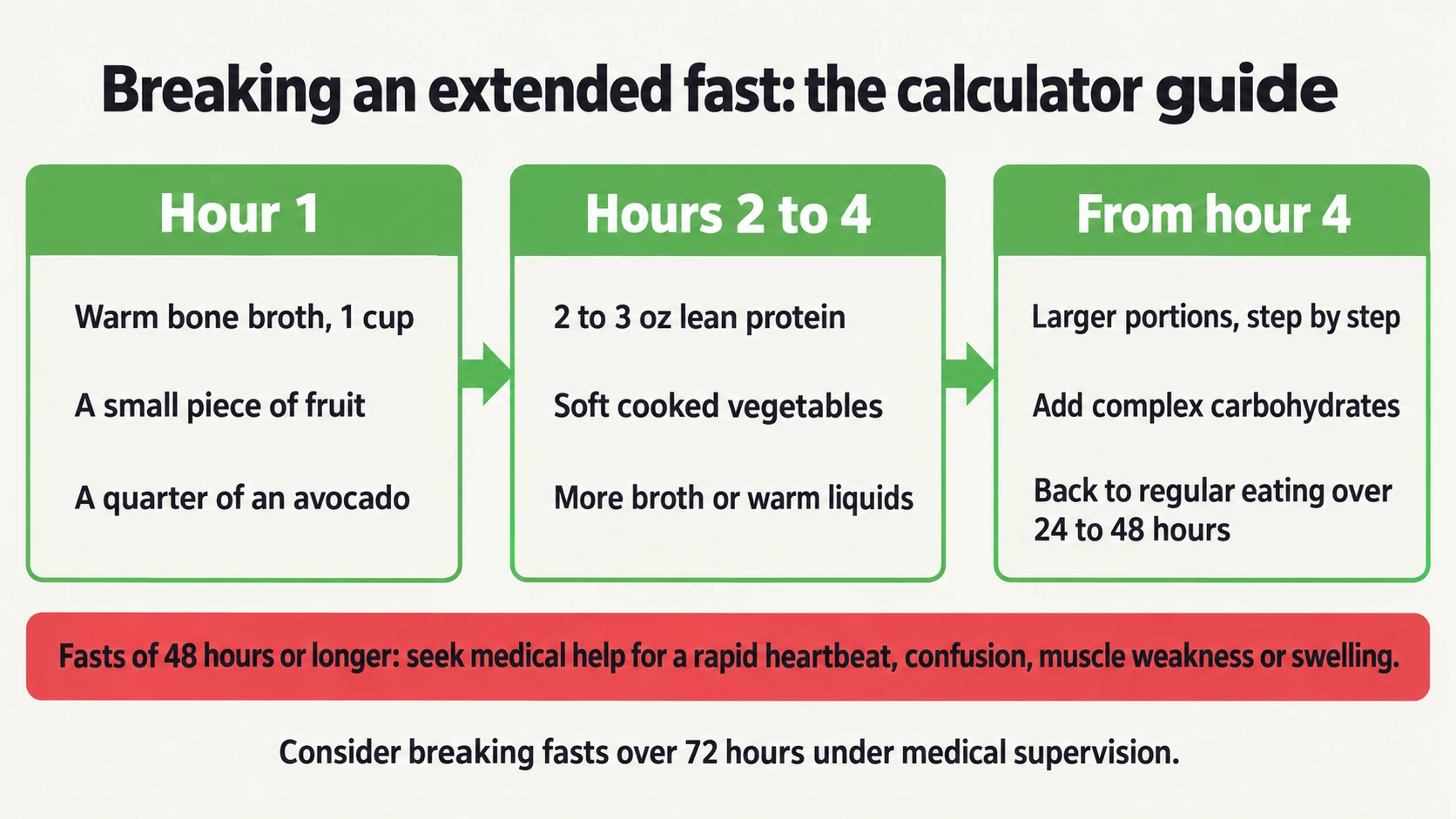
- Fasts of 48 hours or more: a refeeding warning. It tells you to break the fast with bone broth or diluted juice, to avoid large meals for the first 2 to 4 hours, to seek medical attention for a rapid heartbeat, confusion, muscle weakness or swelling, and to consider breaking fasts over 72 hours under medical supervision.
- Beginner experience: a caution that this is an advanced fast and a suggestion to start with 24-hour fasts and build up.
- Every fast: break your fast at once if you have severe dizziness, chest pain or confusion.
Worked example: the default inputs
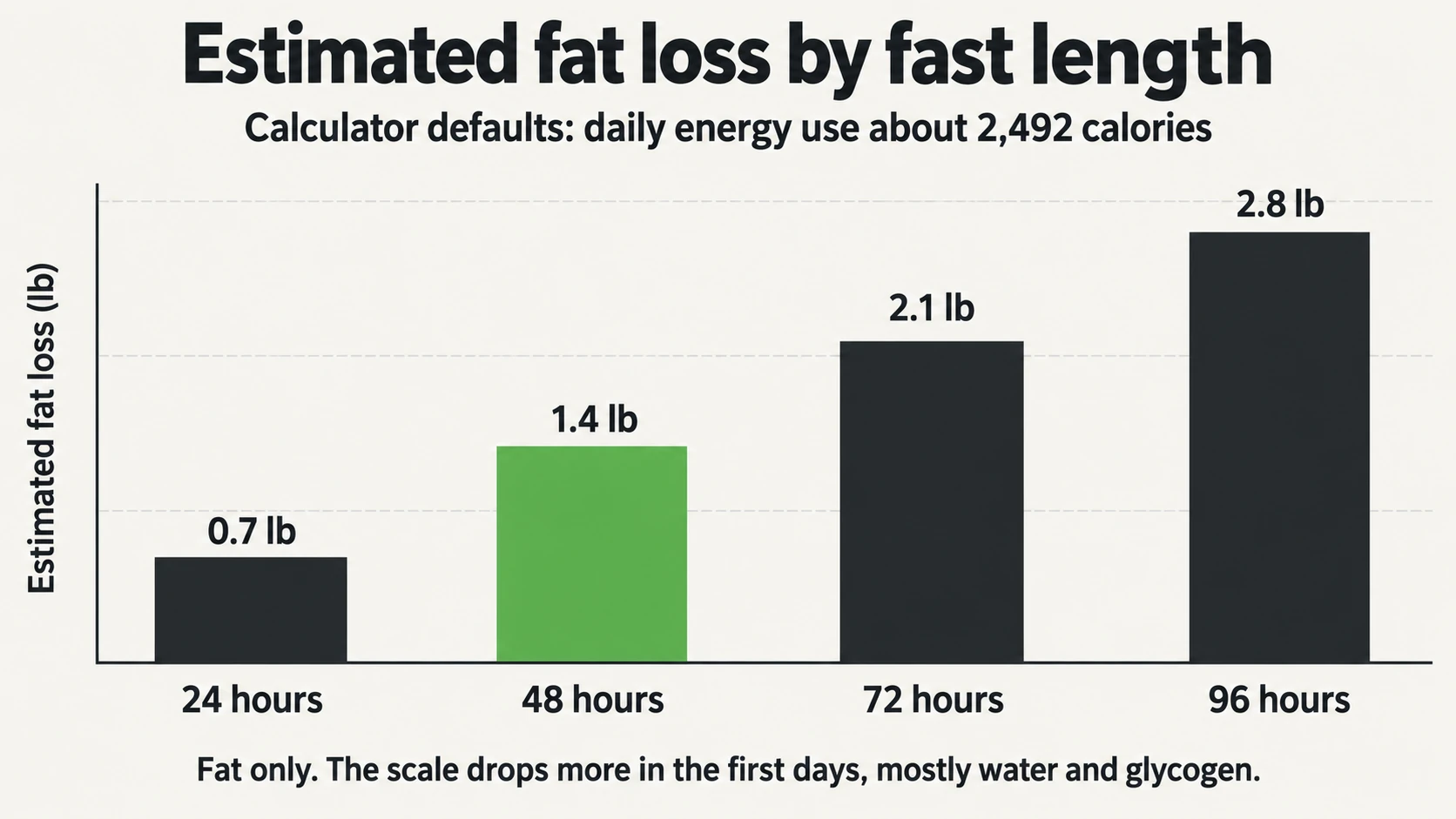
The calculator starts with a 48-hour fast and a 35-year-old man, 180 lb, 5 ft 8 in, 25% body fat, with a Moderate prior diet, Light activity and Beginner experience. These are the numbers it shows before you change anything.
| Step | Result |
|---|---|
| BMR | About 1,812 calories a day |
| Daily energy use (x 1.375) | 2,492 calories |
| Estimated fat loss (2,492 x 2 days / 3,500) | 1.4 lb |
| Ketosis begins | Hour 21 |
| Autophagy begins (18 + 2 for a Moderate diet + 1 for Light activity) | Hour 21 |
| Electrolytes | The three reference ranges, with the note that they are daily intakes, not supplement doses |
| Warnings shown | Refeeding (48 hours), Beginner Caution, the electrolyte note and when to stop |
The result panel adds that results may vary with your metabolism and hydration.
Extended fasting questions
How much weight will I lose on a 48-hour fast?
The calculator estimates the fat part only: 1.4 lb at its defaults. A bigger, younger or more active person burns more energy a day and gets a larger figure. Expect the scale to drop more than that, mostly from water and glycogen, and to rise again as you refill your glycogen after the fast.
Is a 72-hour fast safe?
The calculator does not judge that for you. At 72 hours it shows the refeeding warning and suggests breaking fasts over 72 hours under medical supervision, and for beginners it suggests starting with 24-hour fasts. Ask a clinician before a fast this long, and always if you have a medical condition, take medication or are pregnant.
How should I break an extended fast?
The calculator’s guide starts small. In hour 1: a cup of warm bone broth, a small piece of fruit and a quarter of an avocado. In hours 2 to 4: 2 to 3 oz of lean protein and soft cooked vegetables. From hour 4 on: larger portions and complex carbohydrates, with a return to regular eating over 24 to 48 hours.
Why does the calculator ask for body fat and experience?
Both feed the autophagy hour, through the autophagy calculator’s table: more body fat pushes the hour later, and more fasting experience brings it earlier. Neither changes the fat estimate, which comes from your weight, height, age, sex and activity.
Sources
- The Harris Benedict equation reevaluated: resting energy requirements and the body cell mass. Roza AM, Shizgal HM. American Journal of Clinical Nutrition, 1984; 40: 168-182.
- Caloric equivalents of gained or lost weight. Wishnofsky M. American Journal of Clinical Nutrition, 1958; 6: 542-546.
- Quantification of the effect of energy imbalance on bodyweight. Hall KD, Sacks G, Chandramohan D, Chow CC, et al. The Lancet, 2011; 378: 826-837.
- Glycogen storage: illusions of easy weight loss, excessive weight regain, and distortions in estimates of body composition. Kreitzman SN, Coxon AY, Szaz KF. American Journal of Clinical Nutrition, 1992; 56: 292S-293S.
- Sodium in Your Diet. US Food and Drug Administration, content current as of 5 March 2024.
- Potassium: Fact Sheet for Health Professionals. NIH Office of Dietary Supplements, updated 2 June 2022.
- Magnesium: Fact Sheet for Health Professionals. NIH Office of Dietary Supplements, updated 6 January 2026.
More fasting tools
- Fasting electrolyte calculator: see the reference ranges and the notes your fast length, activity and climate add.
- What breaks a fast: check a drink, food or supplement against your fasting goal.
- Autophagy calculator: estimate when autophagy may begin from five answers about you.
- All fasting calculators: every fasting calculator in one list.