
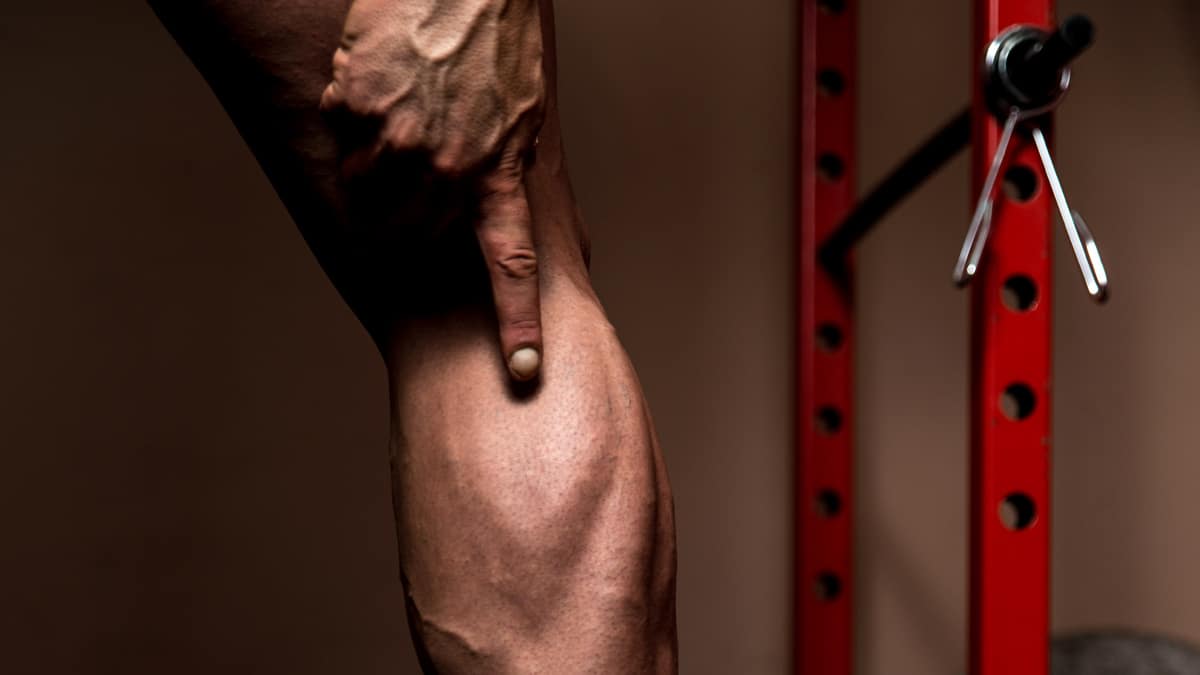
The average adult calf circumference in the U.S. NHANES 2003–2006 survey was 39.5 cm (15.6 inches) for men and 38.3 cm (15.1 inches) for women. Researchers measured the widest part of the calf while participants sat down. These historical averages describe the population they surveyed; they do not set a healthy or ideal calf size. [1]
A useful comparison starts with the same measurement method and age group. The charts below retain the survey’s centimeters and show inches rounded to one decimal place. If you want to track your training, record your own measurements under consistent conditions rather than treating an average as a target.
What is the average calf size for a man?
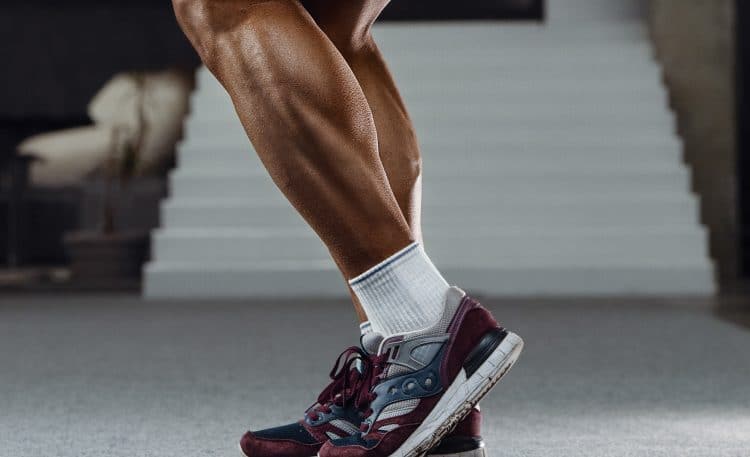
The men’s reference includes 4,303 participants aged 20 and older. Table 35 reports a weighted mean of 39.5 cm. The largest age-group mean was 40.3 cm among men aged 40–49. [1]
| Age (years) | Mean (cm) | Mean (inches) |
|---|---|---|
| 20 and older | 39.5 | 15.6 |
| 20–29 | 39.4 | 15.5 |
| 30–39 | 39.8 | 15.7 |
| 40–49 | 40.3 | 15.9 |
| 50–59 | 39.8 | 15.7 |
| 60–69 | 39.2 | 15.4 |
| 70–79 | 38.0 | 15.0 |
| 80 and older | 36.1 | 14.2 |
What is the average calf size for a woman?
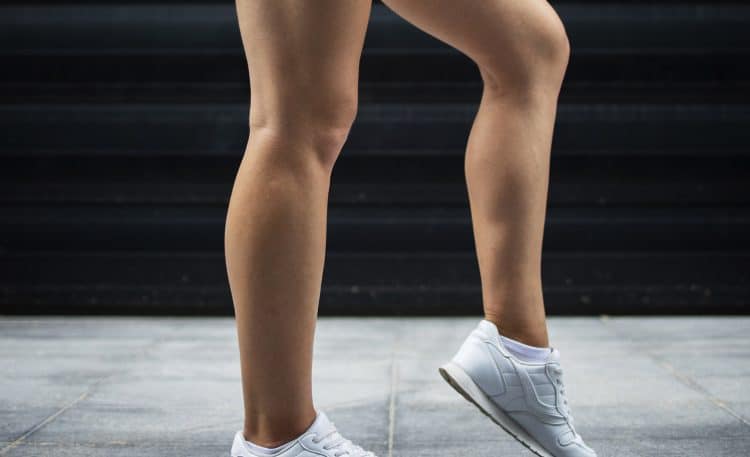
The women’s reference includes 4,133 participants aged 20 and older, excluding pregnant participants. Table 34 reports a weighted mean of 38.3 cm. Women aged 40–49 had the largest age-group mean at 39.2 cm. [1]
| Age (years) | Mean (cm) | Mean (inches) |
|---|---|---|
| 20 and older | 38.3 | 15.1 |
| 20–29 | 37.8 | 14.9 |
| 30–39 | 38.7 | 15.2 |
| 40–49 | 39.2 | 15.4 |
| 50–59 | 38.7 | 15.2 |
| 60–69 | 38.5 | 15.2 |
| 70–79 | 36.8 | 14.5 |
| 80 and older | 35.5 | 14.0 |
Researchers compared different people in each age group. They did not follow the same adults as they aged, so these rows cannot predict how your own calves will change.
How to measure your calf size
For comparison with these tables, use the seated, maximal-calf method. The NHANES manual specifies the right calf, a tape perpendicular to the lower leg, and a reading to the nearest 0.1 cm. [2]
- Sit on a stable chair with your right lower leg accessible. Keep the calf relaxed rather than lifting the heel to flex it.
- Wrap a non-stretch measuring tape around the calf. Move it up and down to find the largest circumference.
- Keep the tape at a right angle to the length of your lower leg. Hold it against the skin without pulling it tight.
- Read and record the measurement in centimeters. Divide by 2.54 if you also want inches.
- For your own tracking, record the date, side and position. If you measure the left calf too, keep its result separate.
A standing, flexed or post-workout measurement is a different comparison. For repeat checks, use the same tape, position and conditions. Do not change your method to obtain a larger number.
What an average or percentile tells you
The mean is an average that accounts for the survey’s population weights. The median, or 50th percentile, divides the distribution into two halves. The 25th and 75th percentiles mark the middle half of measurements.
For adults aged 20 and older, the survey’s middle half extended from 36.9 to 41.9 cm in men and 35.0 to 40.9 cm in women. The medians were 39.2 and 37.5 cm, respectively. These are descriptive comparisons, not diagnostic boundaries. The report does not define “normal” as within 0.3 inches of the mean. [1]
Does calf size indicate stroke risk?
Debette and colleagues studied 6,265 adults aged 65 and older from three French cities. In their cross-sectional analysis, people with larger calves had a lower prevalence of carotid plaques. These fatty deposits affect arteries that supply the brain. [3]
The researchers examined an association with plaques. They did not test a calf-training program or establish that increasing calf size prevents stroke. The paper cannot tell you how many inches to add to reduce your risk. Do not use the age charts to judge your cardiovascular health or change treatment.
Calf size for bodybuilding
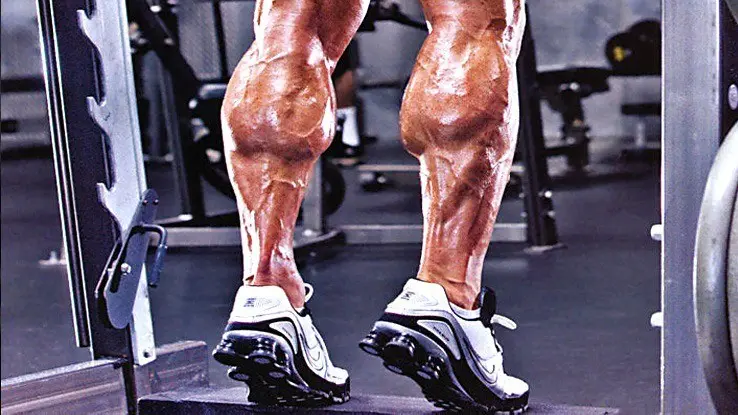
You can choose calf development as a physique goal without using a population average as your standard. The CDC tables do not establish a required calf-to-biceps ratio or a winning bodybuilding measurement. FitnessVolt’s bodybuilding leg-development retrospective covers physique examples rather than population norms.
Training if you want larger calves
Calf training can increase muscle size. In a 12-week study, Kinoshita and colleagues assigned 14 untrained adults to train one leg standing and the other seated. Standing calf raises produced greater gastrocnemius growth; soleus growth was similar between conditions. Researchers measured muscle volume with MRI, so the results do not predict an inch gain on a tape measure. [4]
The four-exercise example below preserves the session from this article’s earlier version. It totals 16 working sets and includes high-repetition work. Review its workload with a qualified coach before adding it to your program. A below-average measurement does not make this session necessary.
| Exercise | Sets | Repetitions |
|---|---|---|
| Donkey calf raise | 3 | 20 per set |
| Seated calf raise | 4 | 40, 30, 20, 20 |
| Leg-press calf press, single-leg variation | 4 | 10 per set |
| Standing calf raise | 5 | 50, 40, 30, 40, 50 |
Choose exercises that fit your equipment and training experience. The calf-raise machine alternatives guide covers other setups if your gym lacks these machines.
FAQs
My calves are a little bigger or smaller for my age. Is it normal?
A difference from the mean is common and does not establish a health problem. Use the same measurement method before comparing numbers. The survey does not supply a 0.3-inch pass/fail rule, and a smaller measurement alone is not a reason to start a high-volume workout. [1]
What size calves are considered big?
“Big” describes a comparison or appearance, not a medical category. A 16-inch calf measures 40.6 cm after rounding, which is above the all-adult means shown here. It does not establish muscle mass, fitness or an ideal size. For a population comparison, use the appropriate age group and percentiles rather than a universal cutoff. [1]
Conclusion
Use these historical calf measurements to understand the survey comparison. Take a seated measurement at the widest point and keep the conditions consistent if you track it over time. Choose training goals based on what you want to do, not on a requirement to match the average.
Sources
- McDowell MA, Fryar CD, Ogden CL, Flegal KM. (2008). Anthropometric Reference Data for Children and Adults: United States, 2003–2006. National Health Statistics Reports, no. 10. National Center for Health Statistics. Methods, page 2; Tables 34–35, pages 37–38.
- Centers for Disease Control and Prevention. (2005). NHANES Anthropometry and Physical Activity Monitor Procedures Manual. Section 3.3.1.4, Maximal Calf Circumference, page 3-8. Accessed September 8, 2026.
- Debette S, Leone N, Courbon D, et al. (2008). Calf circumference is inversely associated with carotid plaques. Stroke, 39(11), 2958–2965. DOI: 10.1161/STROKEAHA.108.520106. PMID: 18703804.
- Kinoshita M, Maeo S, Kobayashi Y, et al. (2023). Triceps surae muscle hypertrophy is greater after standing versus seated calf-raise training. Frontiers in Physiology, 14, 1272106. DOI: 10.3389/fphys.2023.1272106. PMID: 38156065.