
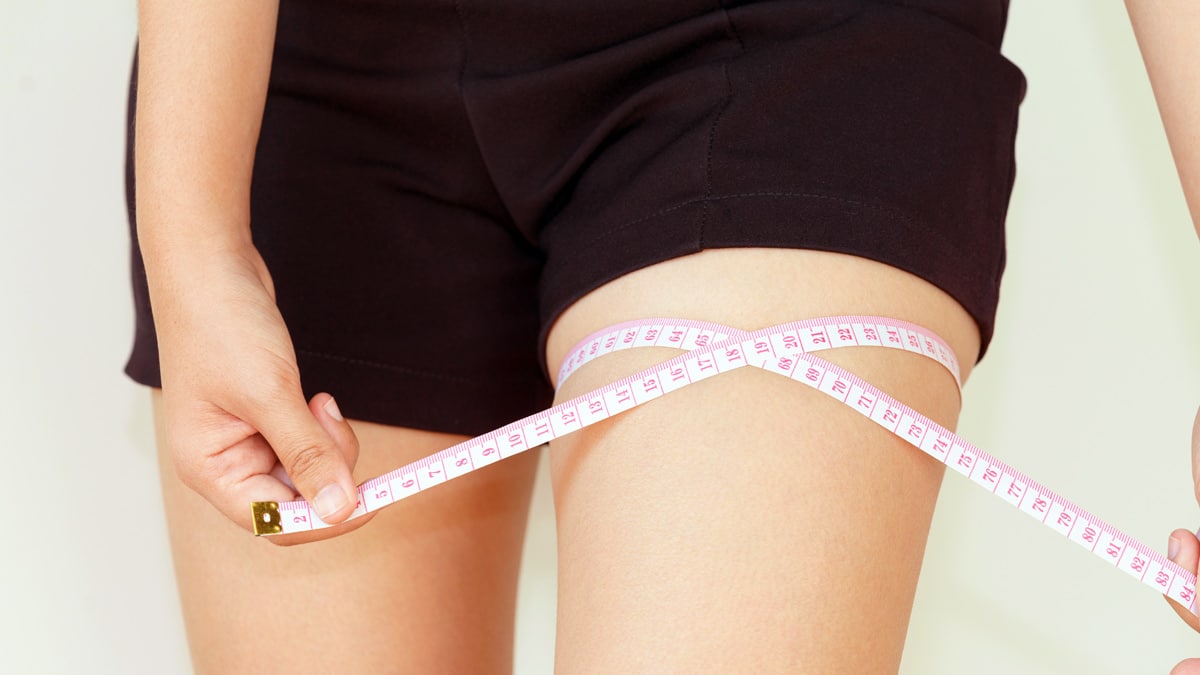
The average adult mid-thigh circumference in the U.S. NHANES 2003–2006 survey was 53.8 cm (21.2 inches) for men and 52.9 cm (20.8 inches) for women. These are historical population averages, not recommended sizes or measurements of the widest part of the thigh. [1]
A useful comparison starts with the tape position. A flexed measurement near the top of your leg measures something different from the mid-thigh measurement in these tables. Use the same location and stance before comparing your result with the survey or an earlier measurement of your own.
The charts below retain the survey’s age groups and show both centimeters and inches. They describe U.S. participants measured in 2003–2006; they do not establish current worldwide averages, bodybuilding targets or a health diagnosis.
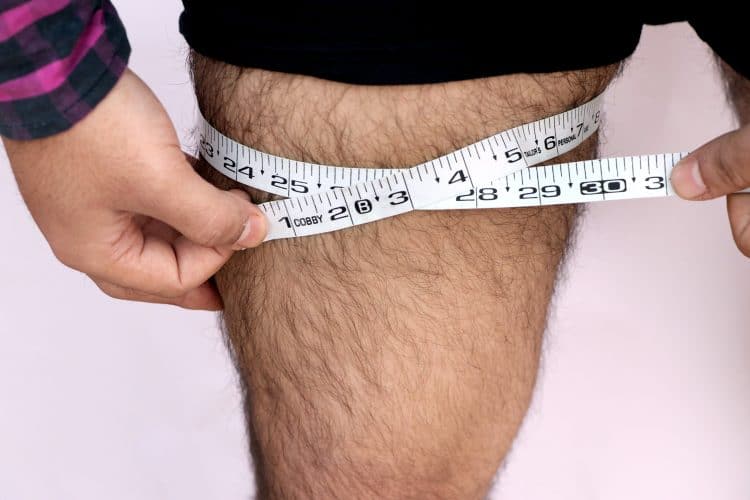
What is the average thigh circumference for a male?
The CDC report gives a mean of 53.8 cm (21.2 inches) for men aged 20 and older, based on 4,255 examined participants. The estimates use NHANES survey weights. [1]
| Age | Centimeters | Inches |
|---|---|---|
| 20–29 | 55.1 | 21.7 |
| 30–39 | 55.1 | 21.7 |
| 40–49 | 55.0 | 21.7 |
| 50–59 | 53.2 | 20.9 |
| 60–69 | 51.9 | 20.4 |
| 70–79 | 50.0 | 19.7 |
| 80 and older | 46.6 | 18.3 |
Men aged 20–39 had the largest mean in these age groups, at 55.1 cm. The 40–49 mean was 55.0 cm; both round to 21.7 inches. Keeping centimeters alongside inches makes that small difference visible.
The older groups had smaller means. The survey compared different people at different ages; it did not follow one man’s thigh size as he aged.
What is the average thigh size for boys aged 8–19?
| Age in years | Centimeters | Inches |
|---|---|---|
| 8 | 38.3 | 15.1 |
| 9 | 39.9 | 15.7 |
| 10 | 42.2 | 16.6 |
| 11 | 44.1 | 17.4 |
| 12 | 46.0 | 18.1 |
| 13 | 47.9 | 18.9 |
| 14 | 49.3 | 19.4 |
| 15 | 51.4 | 20.2 |
| 16 | 53.5 | 21.1 |
| 17 | 53.3 | 21.0 |
| 18 | 53.6 | 21.1 |
| 19 | 54.8 | 21.6 |
These are averages for separate age groups, not a growth schedule for an individual child. The small difference between ages 16 and 17 does not mean boys’ thighs should shrink at 17. Do not use the table to set a child’s dieting or muscle-gain target. Discuss concerns about growth with the child’s healthcare professional. [1]
What is the average thigh circumference for a female?
For women aged 20 and older, the same report gives a mean of 52.9 cm (20.8 inches), based on 4,065 examined participants. The published female reference tables exclude pregnant participants. [1]
| Age | Centimeters | Inches |
|---|---|---|
| 20–29 | 52.9 | 20.8 |
| 30–39 | 54.2 | 21.3 |
| 40–49 | 54.4 | 21.4 |
| 50–59 | 53.2 | 20.9 |
| 60–69 | 52.2 | 20.6 |
| 70–79 | 49.6 | 19.5 |
| 80 and older | 47.5 | 18.7 |
The mean was 52.9 cm at ages 20–29 and 54.4 cm at ages 40–49, the largest mean among the listed groups.

What is the average thigh size for girls aged 8–19?
| Age in years | Centimeters | Inches |
|---|---|---|
| 8 | 38.2 | 15.0 |
| 9 | 40.8 | 16.1 |
| 10 | 43.1 | 17.0 |
| 11 | 45.7 | 18.0 |
| 12 | 46.5 | 18.3 |
| 13 | 48.4 | 19.1 |
| 14 | 49.0 | 19.3 |
| 15 | 49.7 | 19.6 |
| 16 | 50.0 | 19.7 |
| 17 | 51.9 | 20.4 |
| 18 | 52.1 | 20.5 |
| 19 | 52.3 | 20.6 |
Girls had larger means than boys at ages 9–13 in this survey. Boys had larger means at age 8 and ages 14–19. These group comparisons do not determine how a particular child should develop. [1]
Comparing average thigh circumference in males and females
Men had the larger mean in the 20–49 age groups. At ages 50–59, both means were 53.2 cm. Women had larger means at ages 60–69 and 80 and older; men had the larger mean at ages 70–79.
A mean cannot tell you how much of an individual’s thigh is muscle or fat. Nor does being above or below it make someone fit or unfit. For example, among men aged 20 and older, the survey’s 25th and 75th percentiles were 49.8 and 57.2 cm. Among women, they were 47.4 and 57.2 cm. Those percentiles describe the middle half of the distribution, not a clinical healthy range. [1]
All inch values here equal the published centimeter value divided by 2.54, rounded to one decimal place. The original survey reports centimeters; rounding can make two different means look identical in inches.
How to measure your thigh circumference
To compare with these charts, use mid-thigh circumference. The NHANES examiners first marked a midpoint while the participant sat, then measured circumference while the participant stood. Their protocol used the right leg unless a condition prevented measuring that side. [2]
- Locate the measurement site. With the right knee bent at 90 degrees, NHANES examiners measured along the front of the thigh from the groin crease to a marked point just above the kneecap. They marked halfway along that distance.
- Stand with most of your weight on the left leg. Put your right leg forward, with its knee slightly bent and both feet flat. Use stable support if needed for balance.
- Wrap the tape around the marked midpoint, perpendicular to the length of the thigh. Keep it against bare skin without compressing the tissue.
- Check the tape position around the whole leg. Read and record the measurement in centimeters, with the side and measurement site.
The original examiners used a sliding caliper to locate the lower landmark. A home measurement without that equipment is an approximation, even if you follow the stance and tape placement. A widest-point measurement or a deliberate flex is a different comparison. The NHANES manual shows the full procedure in sections 3.3.1.3 and 3.3.1.8.
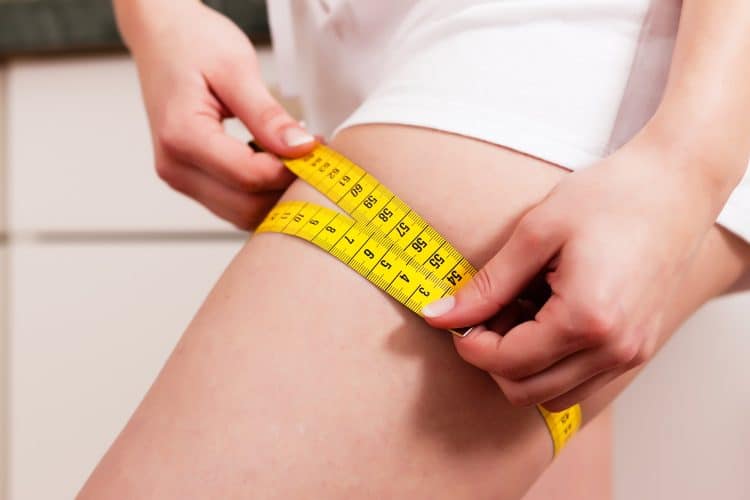
Measuring thigh circumference for bodybuilding
For your own training log, choose a repeatable method and label it. You can track the widest part of the thigh, but keep that series separate from measurements taken at mid-thigh. Do not compare a post-workout, flexed reading with an earlier relaxed reading and call the difference muscle gain.
Use the same side, location, stance and tape tension each time. Measure before training for a consistent baseline, and record both legs separately if you track both. Keep the tape perpendicular to the thigh rather than angling it to capture a larger number.
The tape goes around the whole thigh, including the quadriceps and hamstrings. Circumference is useful alongside a training log; it cannot isolate the size or strength of either muscle group.
How to increase your thigh circumference
For adults who want to build muscle, progressive resistance training can increase muscle size. The ACSM’s 2026 position stand supports training that matches your ability and goals. It does not require everyone to use one rep range or a separate quad day and hamstring day. [3]
Start with the principles in our muscle hypertrophy guide. The exercises below are options to select from, not a requirement to perform two five-exercise sessions.
Quad-focused options
- Front squat
- Leg extension
- Sissy squat
- Leg press
- Heels-elevated goblet squat
Hamstring and other posterior-chain options
- Lying leg curl
- Romanian deadlift
- Good morning
- Glute-ham raise on suitable equipment
- Hip thrust, as a glute-focused option rather than a replacement for hamstring work
Choose exercises you can perform with control and a workload you can recover from. A qualified coach can help adapt the selection. Your thigh circumference compared with a population mean does not determine your starting load, sets or repetitions.
Food and recovery
Build your eating plan around your training needs. Our TDEE calculator estimates daily energy needs, and the macronutrient calculator can help organize those estimates. They do not prescribe a thigh size or tell you that you need to gain weight.
Give yourself time to recover between demanding sessions. For sleep, the CDC recommends at least seven hours for adults aged 18–60, seven to nine hours at ages 61–64, and seven to eight hours from age 65. [4]
How to reduce your thigh circumference
A measurement above the average is not, by itself, a reason to lose weight or stop training your legs. First establish what you want to change and why. The tape cannot distinguish fat, muscle and other tissue.
A small 12-week study of 11 adults tested high-repetition leg-press training on one leg. It found no significant fat reduction in either leg, despite a reduction in total fat mass. This does not support promising that extra thigh exercises will remove fat from that location. [5]
If changing body composition is appropriate for your health and goals, consider your overall food intake and activity with a qualified professional. Avoid using these age averages as a reason to under-eat or deliberately lose useful muscle. The adult training discussion here is separate from the children’s reference tables.
Thigh circumference and health research
Jung and colleagues studied thigh circumference and diabetes in Korean adults aged 30–79. Their cross-sectional analysis found an association between smaller thigh circumference and diabetes after adjustment for factors including BMI and waist circumference. The relationship depended on those adjustments and on participants’ BMI. [6]
The researchers did not assign people to build larger thighs and test whether that prevented diabetes. Their findings cannot establish that increasing your tape measurement protects you, or that a small thigh means you have diabetes. Clinicians use blood tests, including A1C and glucose tests, to diagnose the condition. [7]
Where should you measure your thigh?
For the NHANES charts on this page, use the marked mid-thigh site and survey stance described above. For personal widest-thigh tracking, record that different location and use it again at the next measurement. Keep the two methods separate.
How do I find the thickest part of my upper leg?
Move the tape along the upper thigh to find the largest circumference while keeping it perpendicular to the leg. Record that location so you can repeat it. This gives you a widest-thigh measurement, which you should not compare directly with these mid-thigh averages.
What should my thigh size be for my height?
The CDC tables used here group measurements by sex and age, not height. They do not establish an ideal thigh size for your height. Avoid treating a physique proportion or a clothing-size chart as a health target.
Should I worry if my thighs are smaller or bigger than the average for my age?
The average alone cannot answer that. There is no one-inch pass/fail margin in these reference tables. If you are concerned about a change in size, weakness or other symptoms, discuss the change with a healthcare professional rather than trying to correct it to match the average.
Putting your measurement in context
Use the historical age table that matches your group, check the measurement method, and keep your own readings consistent. A tape measurement can document size; your health, strength and training needs require more context than whether you sit above or below a population average.
Sources
- McDowell, M. A., Fryar, C. D., Ogden, C. L., and Flegal, K. M. (2008). Anthropometric reference data for children and adults: United States, 2003–2006. National Health Statistics Reports, 10. National Center for Health Statistics. Tables 39–41 and measurement methods.
- Centers for Disease Control and Prevention. (2005). NHANES anthropometry and physical activity monitor procedures manual. Sections 3.2.1, 3.3.1.3 and 3.3.1.8.
- Currier, B. S., D’Souza, A. C., Fiatarone Singh, M. A., et al. (2026). American College of Sports Medicine Position Stand. Resistance Training Prescription for Muscle Function, Hypertrophy, and Physical Performance in Healthy Adults: An Overview of Reviews. Medicine & Science in Sports & Exercise, 58(4), 851–872. DOI: 10.1249/MSS.0000000000003897. PMID: 41843416.
- Centers for Disease Control and Prevention. (2024). About sleep. Accessed September 4, 2026.
- Ramírez-Campillo, R., Andrade, D. C., Campos-Jara, C., Henríquez-Olguín, C., Alvarez-Lepín, C., and Izquierdo, M. (2013). Regional fat changes induced by localized muscle endurance resistance training. Journal of Strength and Conditioning Research, 27(8), 2219–2224. DOI: 10.1519/JSC.0b013e31827e8681. PMID: 23222084.
- Jung, K. J., Kimm, H., Yun, J. E., and Jee, S. H. (2013). Thigh circumference and diabetes: obesity as a potential effect modifier. Journal of Epidemiology, 23(5), 329–336. DOI: 10.2188/jea.je20120174.
- National Institute of Diabetes and Digestive and Kidney Diseases. (2022). Diabetes tests & diagnosis. Last reviewed July 2022. Accessed September 4, 2026.