

Peak week refers to the 7-10 days before a powerlifting competition. The goals during this period are: arrive at competition weight, maximize freshness and recovery, maintain sharpness, and prepare mentally for the meet.
Peak week is not the time to make fitness gains. The work is done. Your entire focus is on showing up fully recovered, at the right weight, with your technique grooved and your mind clear. Any training done in peak week is about maintaining readiness, not building capacity.
Many lifters - especially beginners - make the mistake of treating peak week as an opportunity to do extra work, squeeze in one more PR attempt, or make dramatic changes to their routine. This almost always backfires.
Peak Week and Weight Cutting for Powerlifting
How to approach the final week before a powerlifting meet - managing weight, tapering training, and peaking performance. Includes safe weight cutting strategies and what to avoid.
Updated March 15, 2024What Is Peak Week?
Training Volume and Intensity in Peak Week
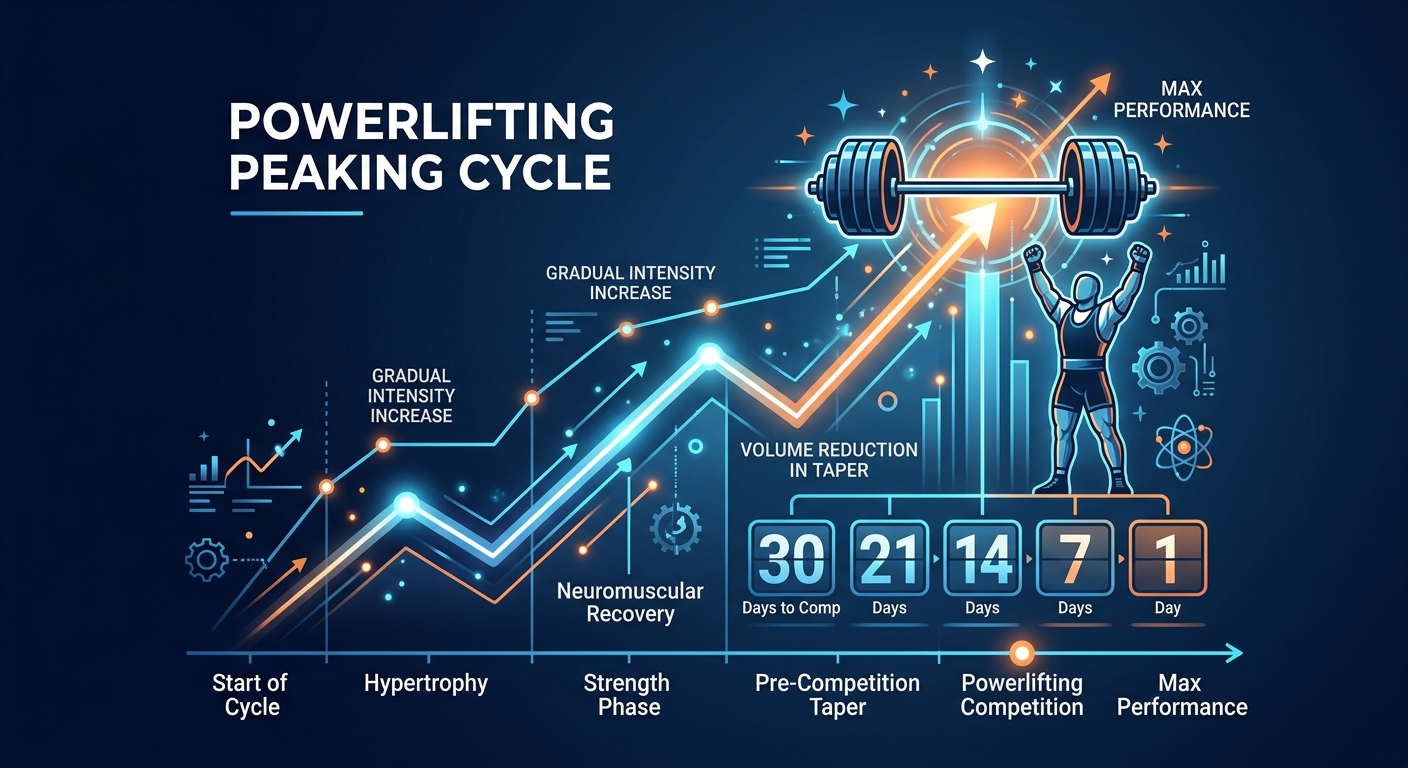
The standard approach is to significantly reduce volume while maintaining some intensity to preserve neural readiness.
General framework (7 days out to meet day):
- 7-10 days out: Last heavy training session. May include a final test at near-competition intensities.
- 5-6 days out: Reduced volume session. 50-60% of normal weekly volume. Moderate intensity (70-85%).
- 3-4 days out: Light movement session. 20-30% of normal volume. Focus on technique at 50-60% of max.
- 1-2 days out: Optional very light movement or rest. Many lifters prefer complete rest the day before.
The exact protocol depends on the training system you follow. SHEIKO-based programs, for example, use a gentle taper over 2 weeks. Juggernaut and Conjugate approaches may taper more aggressively. Follow your program's prescribed peak week rather than improvising.
Never attempt a new maximum in peak week. Your PRs happen on the platform, not in the gym the week before.
Understanding Weight Classes and Cutting
Powerlifting uses weight classes to create fair competition. Weigh-ins confirm that a lifter's body weight falls within their declared class limit.
There are two fundamentally different approaches:
Competing at your natural weight: You train at a weight that falls comfortably within your weight class. You may slightly reduce food and water in the final 1-2 days to make weight, but no dramatic manipulation. This is the recommended approach for beginners and the healthiest long-term strategy.
Cutting weight: Deliberately reducing body weight - sometimes by 5-10%+ - through water restriction, sweat sessions, and caloric reduction in the days before weigh-ins. The intent is to weigh in lighter (and therefore compete against smaller opponents), then rehydrate and eat before competing. This is common in combat sports and increasingly common in powerlifting.
The feasibility of cutting depends critically on whether your federation uses same-day weigh-ins (1-2 hours before competition - very limited recovery time) or 24-hour weigh-ins (IPF at higher levels - full day to recover). The same cut that is manageable with 24 hours recovery may devastate performance with only 2 hours.
Safe Water Manipulation (Same-Day Weigh-Ins)
If your federation uses same-day weigh-ins, large cuts are inadvisable. A modest water cut of 1-2% bodyweight (0.7-1.4 kg for a 70 kg lifter) is generally safe and recoverable within 2 hours.
Simple same-day protocol:
- Reduce dietary fiber and high-residue foods 2-3 days out to reduce gut content (not stool weight - just food in transit).
- Slightly reduce sodium intake 2 days out to reduce water retention.
- Avoid excess carbohydrates (which cause water retention) in the final day.
- Morning of weigh-in: minimal water until after you step on the scale.
After weighing in: Immediately begin rehydrating with water and electrolyte-containing beverages. Eat a moderate meal - carbohydrates and protein, not fat-heavy foods that sit in the stomach. Most lifters feel normal within 90 minutes of a modest cut.
Weight Cutting With 24-Hour Weigh-Ins
Twenty-four hour weigh-ins allow more aggressive cuts because there is full time for rehydration and glycogen restoration. At the elite level, cuts of 5-8% bodyweight are common in IPF competitions.
Structured 24-hour cut approach (not recommended for beginners):
- 7-10 days out: Begin a low-carbohydrate phase to deplete muscle glycogen and associated water (each gram of glycogen is stored with approximately 3 grams of water).
- 3-5 days out: Reduce sodium intake.
- 1-2 days out: Reduce fluid intake gradually. Some elite lifters use a sauna session 18-24 hours before weigh-in.
- Day of weigh-in: Complete the cut, step on the scale, then immediately begin refeed protocol.
Refeed protocol after 24-hour weigh-in:
- First 30 minutes: 500-750 ml electrolyte drink (sodium, potassium, magnesium).
- First 2 hours: 1-1.5 L additional fluid. High-carbohydrate meal (rice, pasta, potatoes) with moderate protein.
- 2-24 hours: Continue eating and drinking to restore glycogen. Most lifters consume 8-12 g of carbohydrates per kg of bodyweight during this window.
Warning: Aggressive weight cutting is not without risk. Dehydration impairs cognitive function, reduces reaction time, and can cause dangerous electrolyte imbalances. If you have no experience with weight manipulation, consult an experienced coach before attempting a cut greater than 3% bodyweight.
Nutrition in Peak Week (No Cut)
If you are not cutting weight, peak week nutrition should be straightforward:
Carbohydrate loading: In the 2-3 days before the meet, increase carbohydrate intake to 6-8 g per kg bodyweight. This tops off muscle glycogen stores, which improves strength and endurance during the meet. You may notice a slight increase in body weight - this is normal and represents stored glycogen plus associated water.
Protein: Maintain normal protein intake (1.8-2.5 g/kg bodyweight).
Fat: Reduce slightly to leave room for carbohydrate increases without excessive total calories.
Meet day nutrition: Eat a familiar, easily digested breakfast 2-3 hours before the meet. Between flights, consume carbohydrate-rich snacks (rice cakes, fruit, gummy bears) and protein. Avoid high-fiber, high-fat foods that cause gastric distress. Many experienced lifters have a meet day food routine they repeat at every competition.
Sleep and Recovery
Sleep is the most powerful recovery tool available and is often disrupted the night before competition by anxiety and unfamiliar environments. A few evidence-based strategies:
Sleep banking: In the week before the meet, prioritize extra sleep - going to bed 30-60 minutes earlier than usual. Research shows that sleep banking attenuates the performance effects of one poor night of sleep. You cannot fully compensate for the night before the meet, but a well-rested base helps.
Hotel environment: Bring familiar items (your own pillow, eye mask, earplugs) to improve sleep quality in unfamiliar environments. Set two alarms. Keep your routine as normal as possible.
The night before: Some pre-competition anxiety is normal and does not necessarily prevent adequate sleep. If you sleep only 5-6 hours the night before the meet, this is not ideal but also not catastrophic. Most people perform reasonably well on poor sleep when adrenaline and motivation are high. The sleep two nights before the meet often matters more than the night immediately before.
Mental Preparation in Peak Week
The final week is also the time to consolidate your mental preparation:
- Finalize your attempt selection. Use your planned openers (90-92% of target third attempt). Have your second and third attempts mapped out but be willing to adjust based on how your opener feels.
- Review your plan. Know the meet schedule, where to warm up, when your flight starts, and who your handler is.
- Visualize the day. Spend 10-15 minutes each evening running through the meet in your mind. See successful lifts, feel the bar, hear the commands.
- Reduce decision fatigue. Pack your bag the night before. Know what you are eating. Have your music playlist ready. The more automatic the logistics, the more mental energy is available for lifting.
Peak week anxiety is normal. The goal is not to eliminate it but to channel it. By the time you are walking to the platform, you want to feel ready - not calm, necessarily, but ready.