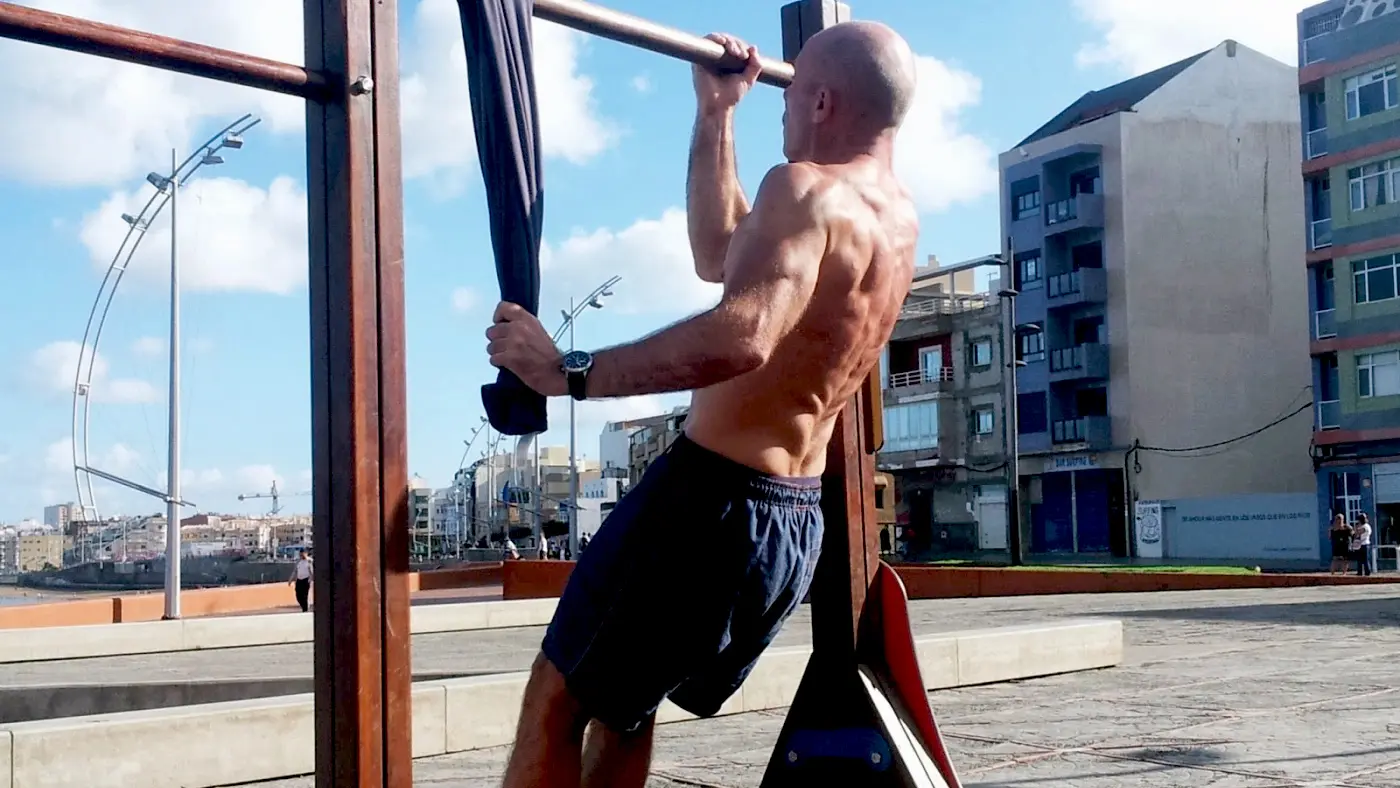
A one-arm pull-up lifts your chin over the bar with a single arm, from a still dead hang. It is one of the hardest pulling skills in calisthenics, and it can take years. This page shows you which step of the progression you are on, from strict pull-ups through archer and assisted one-arm reps to the full rep, and how to do each one.
The one-arm pull-up progression, step by step
Pass each step before you spend time on the next. The pass mark is the number to hit with strict form.
-
1

Strict pull-ups
Pass: 12 strict pull-ups
Start every rep from straight arms. Half reps hide the weak bottom range you need for one arm.
-
2
Archer pull-ups
Pass: 5 archer pull-ups each side and 15 strict pull-ups
Keep the straight arm straight. As you get stronger, let it help less.
-
3
Assisted one-arm pull-ups
Pass: 3 towel-assisted one-arm pull-ups each side, towel hand at eye level or lower
Hang a towel over the bar. One hand holds the bar, the other holds the towel no higher than eye level. Lower the towel hand as you get stronger.
-
4
One-arm negatives
Pass: 10 s one-arm negative on each arm
End the set before you lose control. Dropping fast into a one-arm hang is hard on the elbow.
-
5
One-arm pull-up
Pass: 1 strict one-arm pull-up from a still hang, each arm
Step 4 gives you one clean negative. Steven Low finds the first rep usually comes at 3 sets of 3 negatives of 7 to 10 s, so build to that before you test often.


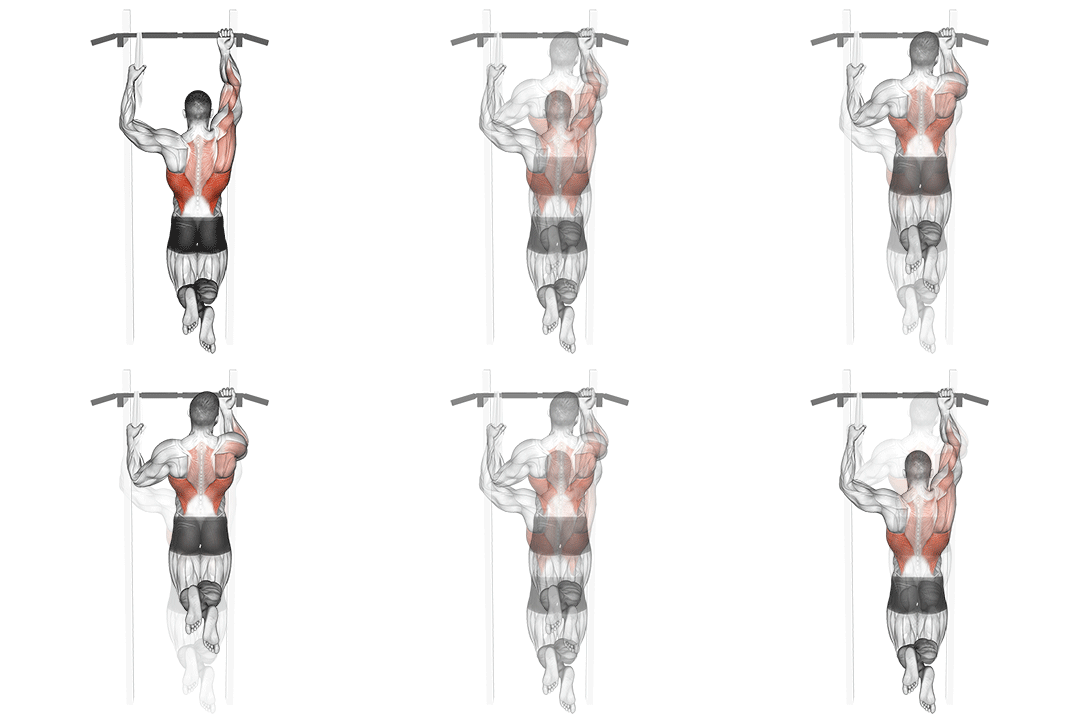
How to do a one-arm pull-up
- Hang from the bar with one hand, using any grip: palm away, palm toward you or neutral. Keep the body straight and the core braced, with the free arm down by your side or out to the side.
- Pull the shoulder of the working arm down, away from the ear. This switches on the lats before the elbow bends.
- Bend the arm and pull your chin up to the bar, keeping the upper arm close to your body.
- Lower yourself back to a straight arm slowly. Dropping fast shock-loads the elbow and shoulder.
People turn their body in different ways on the way up: some stay square to the bar, others turn side-on. Use the position where you feel strongest, as long as the rep starts from a still hang. Expect one arm to be stronger than the other, and train both.
Common one-arm pull-up mistakes
Dropping out of negatives
Losing control and falling into a one-arm hang jolts the elbow. Finish the rep with both hands or step down as soon as control goes.
Never cutting the help
The assisting hand should give enough help for a controlled rep, and a little less each week. If the help never shrinks, the one-arm strength does not grow.
Kicking or twisting up
A swing or a kick hides the weak range. Start every rep from a still hang.
Adding volume too fast
One-arm work is hard on the fingers, elbows and shoulders. Add sets slowly and keep a rest day between sessions.
Train the one-arm pull-up safely
- Warm up the shoulders, elbows and grip before one-arm work.
- Learn to control the lowering before you test a full rep.
- Gripping a towel works the fingers hard. Ease off if they get sore.
- Stop for elbow or shoulder pain and go back a step. See a doctor if pain persists.
Assisted one-arm pull-ups: towel and band
An assisted one-arm pull-up is a one-arm rep where the free hand takes a little of the load, through a towel, a band or the other wrist. It lets you train the full movement before you can do it alone, and it is step 3 of the ladder above.
- Towel-assisted: hang a towel or rope over the bar. Hold the bar with one hand and the towel with the other, about 30 to 45 cm below the bar. Pull mainly with the bar hand and let the towel hand help only as much as it must. The lower you hold the towel, the less it can help.
- Band-assisted: loop a strong resistance band over the bar and stand or kneel in it, then pull with one hand. The band helps most at the bottom, where you are weakest, and less near the top.
- Hand-on-wrist pull-ups: one hand holds the bar and the other holds that wrist. Both arms pull, but only one hand grips, which builds the grip for one-arm work.
Muscles worked in the one-arm pull-up
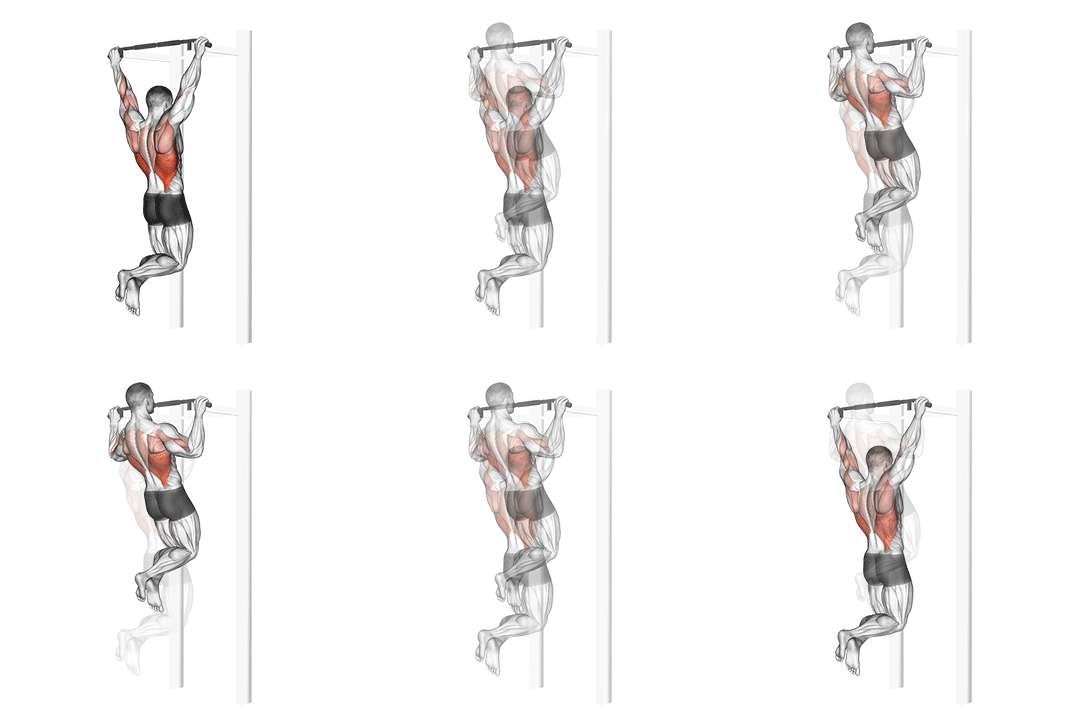
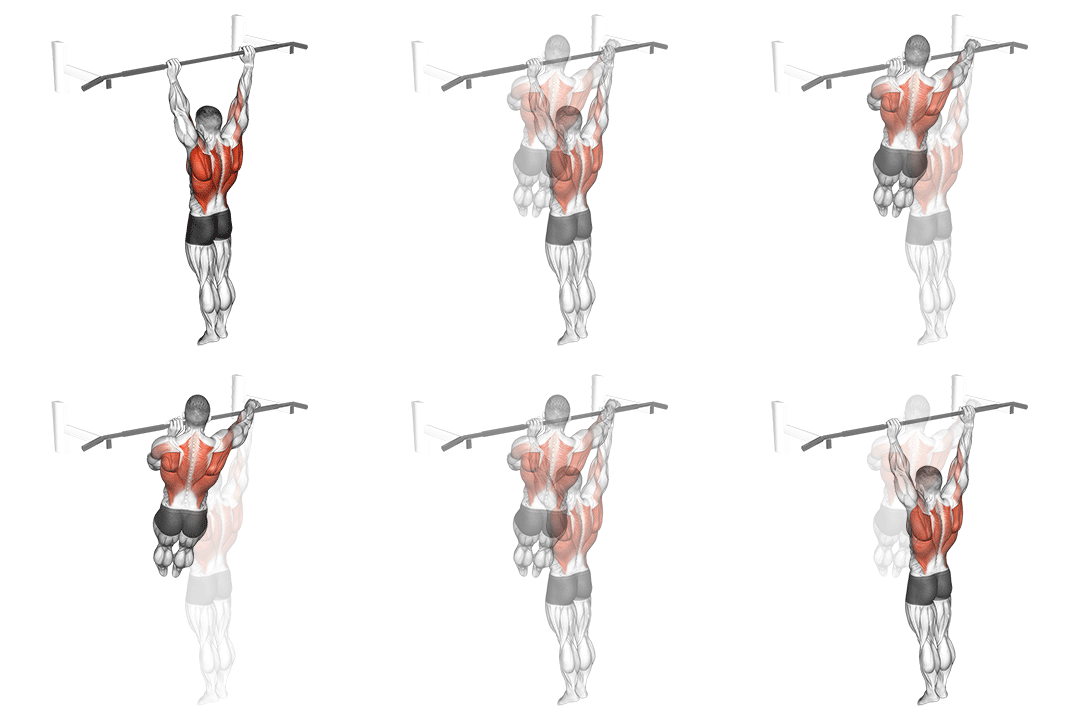
The one-arm pull-up works the lats most, with the biceps, the lower and middle traps, the forearms and the core helping.
- Lats: the main movers. They pull the arm down and back to lift your body.
- Biceps: bend the elbow and turn the forearm.
- Lower and middle traps: hold the shoulder down and back so the other muscles have a stable base.
- Forearms: one hand holds your whole body weight, so the grip works very hard.
- Core: stops the body from twisting and the legs from swinging.
Exercises that help the one-arm pull-up
- One-arm dead hang: hang from one hand for 20 to 30 s. It builds the grip and shoulder control. See our dead hang guide.
- Weighted pull-ups: pull-ups with extra weight build the raw strength. See our weighted pull-up guide.
- Archer pull-ups: step 2 of the ladder. See our archer pull-up guide for the full technique.
- One-arm flex hang: hold yourself with one bent arm at the top, then at one third and two thirds of the way down.
- One-arm lat pulldown and single-arm rows: easier one-arm pulling work for the early weeks. See our one-arm lat pulldown guide.
- Front lever raises: train the lats with straight arms. They still load the elbows, so count them as part of your pulling work. See our front lever raises guide.
Body weight matters: the lighter you are, the less each arm has to lift. To see how your one-arm pull-up compares with other lifters, see the one-arm pull-up strength standards.
How long does it take to learn the one-arm pull-up?
No reliable source gives a timeline. Judge progress by your negatives: longer, slower lowers come before the first rep.
Where the one-arm pull-up pass marks come from
- Steven Low (author of Overcoming Gravity), Prilepin tables for bodyweight strength isometric and eccentric exercises
- Steven Low (author of Overcoming Gravity), The Fundamentals of Bodyweight Strength Training
- GMB Fitness, How To Build Up To Pull-Ups: A 3-Step Bodyweight Progression
- r/bodyweightfitness wiki, Pull-up Progression
Pass marks are FitnessVolt coaching standard v1, based on these sources. They show readiness to practise the next step, not a guarantee.
Interested in measuring your progress? Check out our strength standards for Bench Press, Squat, Deadlift, and more exercises.