The lats are arguably the most important back muscles from an aesthetic standpoint. When developed properly, they give your back width and thickness. In fact, big lats are even visible from the front and look a little like wings.
Because of their size and function, it’ll take more than a couple of sets of lat pulldowns or seated rows to build the back of your dreams. To sculpt strong, muscular lats, you’ll need to target them from multiple angles with various exercises.
As a personal trainer with over 35 years of experience, I’ve helped numerous lifters transform their backs. In this article, I reveal the 13 best exercises for building bigger lats.
Recent Updates: On June 15, 2024, Fitness Volt’s Senior Editor, Vidur Saini (American Council on Exercise-CPT), updated the article and added actionable expert tips throughout the piece to improve the reader experience.
Level Up Your Fitness: Join our 💪 strong community in Fitness Volt Newsletter. Get daily inspiration, expert-backed workouts, nutrition tips, the latest in strength sports, and the support you need to reach your goals. Subscribe for free!
13 Best Latissimus Dorsi Exercises
Add the following exercises to your arsenal:
- Lat Pulldowns
- Pull-Ups
- Chin-Ups
- Straight-Arm Pulldown
- Dumbbell Pullover
- Deadlift
- Bent-Over Row
- T-Bar Row
- Pendlay Row
- Single-Arm Row
- Chest-Supported Dumbbell Row
- Seated Cable Row
- Inverted Rows
5 Best Latissimus Dorsi Exercises: Vertical Pulls
Vertical pulling exercises mainly involve shoulder adduction and will help you build a wider upper back. If you want a broader lat spread, these are the exercises you need to do!
1. Lat pulldowns
| Sets & Reps | Equipment Needed | Target Muscles |
| 3-4 x 8-12 | Lat pulldown machine | Lats, biceps, posterior deltoids |
Lat pulldowns are an excellent upper back exercise. Using a lat pulldown machine means you can easily adjust the weight and even do pump-inducing drop sets. Lat pulldowns are very straightforward, and you can use several different handles and hand positions to train your lats from various angles. Lat pulldown options include:
- Wide overhand grip
- Medium overhand grip
- Neutral medium grip
- Neutral narrow grip
- Medium underhand grip
- Narrow underhand grip
How to do it:
- Sit on the lat pulldown machine, so your feet are flat on the floor. Adjust the leg pad so that it holds you securely in position.
- Stand up and grab the handle with your chosen grip. Sit back down and place your legs under the pads. Lean back slightly and lift your chest up toward the bar.
- Bend your arms and pull the bar down to the top of your chest. Think about leading with your elbows. Keep your wrists straight. Pause at the bottom of each rep for 1-2 seconds.
- Slowly extend your arms and repeat.
Pro Tip: Avoid shoulder injuries by only doing lat pulldowns to the front. Behind the neck lat pulldowns put a lot of extra stress on your shoulder joints and do not increase lat activation. Instead, you’ll get a better, safer workout by pulling the bar down to your front.
| Difficulty | Progression | Regression |
| Beginner | Weighted pull-ups | Assisted pull-ups, negative pull-ups |
2. Pull-ups
| Sets & Reps | Equipment Needed | Target Muscles |
| 3 x As many reps as possible (AMRAP) | Pull-up bar | Lats, biceps, forearms, lower trapezius |
You don’t need fancy exercise machines to build bigger, wider lats. In fact, all you really need is a suitable place to hang and the strength to lift your body weight with just your arms.
Pull-ups are an excellent lat exercise and a good indicator of a healthy weight for your height. If you can’t do pull-ups, it could be because you are overweight.
How to do it:
- Hang from an overhead bar using a slightly wider than shoulder-width, overhand grip. Pull your shoulders down and back and brace your core.
- Without kicking your legs or swinging, bend your elbows and pull your chin up and over the bar. Squeeze your shoulders together and avoid craning your neck.
- Lower yourself back down smoothly and repeat.
- You can also do pull-ups with a wider than shoulder-width grip.
Pro Tip: Actively depress your scapulae (pull your shoulder blades down and together) at the movement’s top to maximize lat engagement and prevent compensatory shrugging.
| Difficulty | Progression | Regression |
| Intermediate | Weighted pull-ups, increased reps | Assisted pull-ups, negative pull-ups, lat pulldowns |
3. Chin-ups
| Sets & Reps | Equipment Needed | Target Muscles |
| 3 x AMRAP | Pull-up bar | Lats, biceps brachii, brachialis, chest (to a lesser extent) |
Where pull-ups are performed using an overhand grip, chin-ups are done using an underhand grip. This puts your biceps in a mechanically advantageous position, which may mean you can do more reps or lift heavier weights. It also means your biceps get a good workout as you train your lats.
How to do it:
- Hang from an overhead bar using a slightly narrower than shoulder-width, underhand grip. Pull your shoulders down and back and brace your core.
- Without kicking your legs or swinging, bend your elbows and pull your chin up and over the bar.
- Lower yourself back down smoothly and repeat.
- You can also do chin-ups with a neutral/parallel grip.
Pro Tip: As you pull up, try to touch your chest to the bar, not just your chin. This emphasizes the contraction in the lats and lower chest for greater muscle recruitment.
| Difficulty | Progression | Regression |
| Intermediate | Weighted chin-ups, increased reps | Assisted chin-ups, negative chin-ups, lat pulldowns (close grip) |
4. Straight-arm pulldown
| Sets & Reps | Equipment Needed | Target Muscles |
| 3 x 10-15 | Cable machine with rope attachment | Lats, triceps, teres major |
Most lat exercises are compound, which means they involve not only the shoulder joint and lats but other joints and muscles, especially the elbows and biceps. Straight-arm pulldowns are an isolation exercise that only involves the shoulder joint. This is a useful exercise for when you want to train your lats without taxing your biceps.
How to do it:
- Stand in front of a lat pulldown machine fitted with a straight bar. Hold the bar with a shoulder-width, overhand grip.
- Keeping your arms straight but not locked, push the bar down to your upper thighs.
- Raise the bar to above head height to stretch your lats and repeat.
Pro Tip: Maintain slight elbow flexion throughout the movement to reduce joint strain and emphasize lat engagement over triceps.
| Difficulty | Progression | Regression |
| Beginner | Increase weight, single-arm variations | Pull-ups |
5. Dumbbell pullover
| Sets & Reps | Equipment Needed | Target Muscles |
| 3 x 10-15 | Dumbbell, bench | Lats, triceps, pectoralis major, serratus anterior |
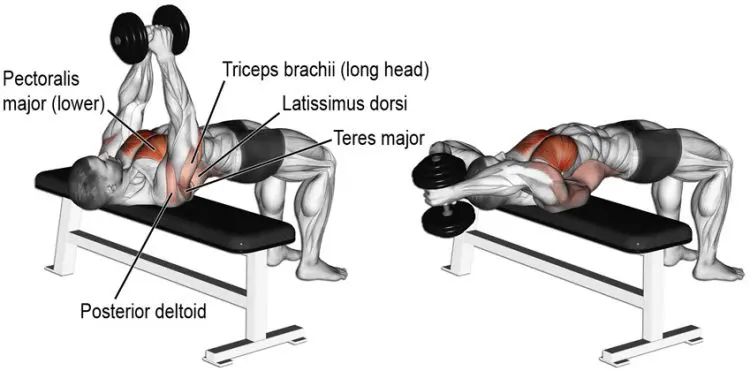
Dumbbell and machine pullovers are a great way to isolate your lats, and they involve your pecs too. Pullovers are a single joint exercise, so all the movement happens at the shoulder. Unlike all pull-ups, pulldowns, and row variations, pullovers do not use your biceps. They are great for finishing off your lats at the end of your back workout.
How to do it:
- Set an adjustable bench to a 10 to 15-degree decline. Grab a single dumbbell and hold it in both hands. Place the palms of your hands against the inside of the weight plates.
- Lie on the bench with your head lower than your hips. Press the dumbbell up to arms’ length and hold it over your chest. Bend your elbows slightly, and then keep them rigid.
- Lower the weight back over your head so your biceps brush your ears. Extend your arms as far as you can without arching your lower back excessively.
- Pull the dumbbell back over your chest and repeat.
Pro Tip: You can also do this exercise with a barbell or with a dumbbell in each hand. If your gym has a pullover machine, use it according to the manufacturer’s instructions, as each one is different.
| Difficulty | Progression | Regression |
| Beginner | Decline dumbbell pullover | Straight-arm lat pulldown |
8 Best Latissimus Dorsi Exercises: Horizontal Pulls
Horizontal pulling exercises mainly involve shoulder extension and will help build thicker lats. If you want a back that’s as deep as it is wide, these are the exercises to use:
1. Deadlift
| Sets & Reps | Equipment Needed | Target Muscles |
| 3-5 x 4-6 | Barbell, weights | Glutes, hamstrings, quads, spinal erectors, lats, traps |
The barbell deadlift is arguably the king of back exercises. When you do deadlifts, you must forcibly extend your shoulders to keep the weight close to your legs. This creates an intense contraction in your lats. Besides the lats, deadlifts work all your other posterior chain muscles, including the glutes and hamstrings.

How to do it:
- Place a loaded barbell on the floor. The bar should be about mid-shin height. Stand with your toes under the bar, feet hip-width apart.
- Lean forward and hold the bar with an overhand or mixed grip, where one hand faces forward and the other faces backward.
- Straighten your arms, lift your chest, and drop your hips. Your lower back should be slightly arched, and your abs tightly braced.
- Drive your feet into the floor and stand up straight. Do not round your back or bend your arms. Use your lats to keep the bar close to your legs at all times.
- Push your hips back, bend your legs, and lower the weight to the floor. Get set for another rep and repeat.
Pro Tip: As you lift, drive your hips forward explosively while keeping your back flat. This generates maximum power from the glutes and hamstrings, protecting the spine from excessive load.
| Difficulty | Progression | Regression |
| Advanced | Sumo deadlift, deficit deadlift | Trap bar deadlift, Romanian deadlift, rack pulls |
2. Bent-over row
| Sets & Reps | Equipment Needed | Target Muscles |
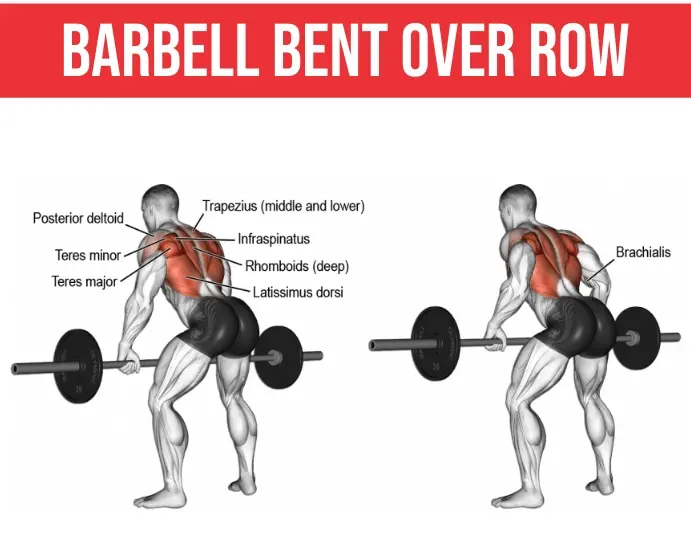
| 3-4 x 8-12 | Barbell, dumbbells | Lats, traps, rhomboids, rear deltoids, biceps |
Bent-over rows are a classic back-builder. Performed with a barbell, this exercise works your lower and upper back along with your lats. However, the bent-over row can be hard on your lower back, so avoid this exercise if you have a history of back pain.
How to do it:
- Hold a barbell with a wider than shoulder-width overhand grip. Bend your knees slightly and then bend forward from your hips until your torso is angled to between 45-90 degrees. Do not round your lower back.
- Without using your legs or lower back to lift the weight, bend your arms and pull the bar up to touch your abdomen.
- Slowly extend your arms and repeat.
Pro Tip: Pause at the top of each rep, squeezing your shoulder blades and back muscles. This intensifies the peak contraction and deepens the mind-muscle connection.
Level Up Your Fitness: Join our 💪 strong community in Fitness Volt Newsletter. Get daily inspiration, expert-backed workouts, nutrition tips, the latest in strength sports, and the support you need to reach your goals. Subscribe for free!
| Difficulty | Progression | Regression |
| Intermediate | Pendlay row, Yates row | Supported bent-over row (with bench), inverted row |
3. T-bar row
| Sets & Reps | Equipment Needed | Target Muscles |
| 3-4 x 8-12 | T-bar machine | Lats, traps, rhomboids, rear deltoids, biceps |
The T-bar row is an old-school back exercise that’s still popular today. It’s a little more lower back-friendly than regular bent-over rows, which is good news if you find the barbell version awkward or uncomfortable. However, to avoid injury, you still need to do T-bar rows with a slightly arched and not rounded lower back.

How to do it:
- Step onto the T-bar row platform and stand with one foot on either side of the bar.
- With your feet flat, bend your knees slightly and hinge forward from your hips. Keep your back slightly arched.
- Grasp the handles with both hands. With your arms straight, lift the weight up until your torso is between 45 degrees and parallel to the floor.
- Bend your arms and pull the handle into your chest. Lead with your elbows and keep your wrists straight.
- Fully extend your arms and repeat.
Pro Tip: Lean back slightly as you row, allowing for a greater range of motion and a deeper stretch in the lats. This can enhance muscle activation and growth potential.
| Difficulty | Progression | Regression |
| Intermediate | Landmine T-bar row | Single-arm dumbbell row, inverted row |
4. Pendlay row
| Sets & Reps | Equipment Needed | Target Muscles |
| 3-4 x 6-8 | Barbell, weights | Lats, traps, rhomboids, rear deltoids, biceps |
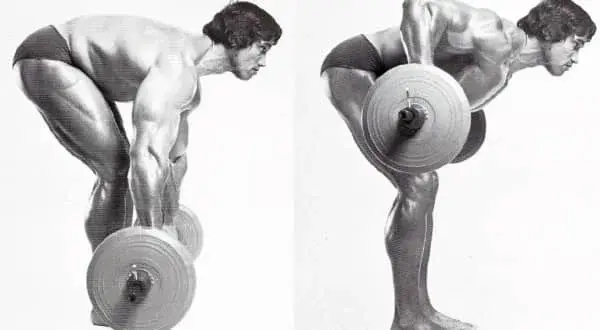
Pendlay rows were invented by USA weightlifting and powerlifting coach Glen Pendlay. This exercise is basically a bent-over row where each rep starts with the weight resting on the floor. This momentary pause between reps takes stress off your lower back, gives your grip a brief rest, and provides an opportunity to reset your core. This should mean you can use more weight or do more reps than with regular bent-over rows.
How to do it:
- Place a loaded barbell on the floor. Stand with your toes beneath the bar, feet roughly shoulder-width apart.
- Lean forward and hold the bar with an overhand, shoulder-width grip. Straighten your arms, lift your chest, and slightly arch your back. Your knees should be partially bent. This is your starting position.
- Without jerking with your back, pull the bar off the floor and into your abdomen. Lower the bar back to the floor and repeat.
- Each rep should start from a dead stop, so no bouncing!
Pro Tip: Slowly lower the bar to the floor until it comes to a dead stop. This eliminates momentum, forcing your muscles to work harder and build greater strength from a disadvantageous position.
| Difficulty | Progression | Regression |
| Advanced | Increase weight, deficit Pendlay row | Bent-over row, barbell row with controlled eccentric |
5. Single-arm row
| Sets & Reps | Equipment Needed | Target Muscles |
| 3 x 8-12 (per arm) | Dumbbell, bench | Lats, rhomboids, traps, rear deltoids, biceps |
Because you have one arm free to use for support, single-arm dumbbell rows are much easier on your lower back than barbell bent-over rows. They also allow you to work one side at a time, which is an excellent way to identify and fix strength imbalances. Finally, single-arm rows allow you to stretch your lats at the bottom of each rep, which can help increase hypertrophy or muscle building.
How to do it:
- Hold a dumbbell in one hand. Lean forward and place your free hand on a knee-high bench. Your upper body should be perpendicular to the floor, and your back should be straight and not rounded. Place your feet shoulder-width apart, knees slightly bent for stability.
- Bend your arm and pull the dumbbell up and into the side of your chest. Lower the weight and extend your arm, getting a good stretch in your lats as you do so.
- Do the same number of reps on each side.
Pro Tip: Some people like to do this exercise with one knee resting on the bench. This can work, but you may feel more stable with both feet on the floor. This more balanced stance should allow you to lift more weight.
| Difficulty | Progression | Regression |
| Intermediate | Kroc rows | Chest-supported row (using a bench), inverted row |
6. Chest-supported dumbbell row
| Sets & Reps | Equipment Needed | Target Muscles |
| 3 x 8-12 (per arm) | Dumbbell, incline bench | Lats, rhomboids, traps, rear deltoids, biceps |
Most horizontal pulling exercises work your lats and your lower back. However, this one is different as your upper body is supported, which removes your lower back from the movement. This can be useful if you have a tired or injured lower back or just want to concentrate 100 percent on your lats.
How to do it:
- Lie face down on an incline bench, so your feet are still touching the ground.
- With a dumbbell in each hand, extend your arms and let them hang down from your shoulders. Rotate your wrists, so your palms are facing inward.
- Bend your arms and pull the weights up and into your lower ribs. Think about driving your elbows back and together to maximize lat engagement.
- Lower the weights back down by extending your arms toward and floor and try to stretch out your lats at the bottom.
- Continue for the desired number of reps.
Pro Tip: Instead of rowing straight up, angle the dumbbell slightly towards your hip. This mimics the lats’ natural movement and reduces shoulder joint stress.
| Difficulty | Progression | Regression |
| Beginner | Elevate incline, single-arm variations | Inverted row |
7. Seated cable row
| Sets & Reps | Equipment Needed | Target Muscles |
| 3-4 x 8-12 | Cable machine, various attachments | Lats, rhomboids, traps, rear deltoids, biceps |
Seated cable rows allow you to do a horizontal pulling exercise in a seated position, which takes some stress off your lower back. As this is a machine exercise, you can adjust the weights quickly and easily, making it ideal for pyramids and drop sets.

How to do it:
- Attach a straight bar or parallel grip handle to a low pulley machine. Sit on the machine with your knees slightly bent.
- Grab the handles and sit up straight. Do not round your lower back.
- Without leaning forward or backward, pull the handle into your abdomen and then straighten your arms.
- If you have to lean forward and backward to complete your reps, the weight is probably too heavy!
Pro Tip: After pulling the handle towards your abdomen, slowly return to the starting position with a controlled eccentric (3-4 seconds). This maximizes time under tension, stimulating greater muscle growth.
| Difficulty | Progression | Regression |
| Beginner | Single-arm variations, change grip (wide, close, neutral) | Inverted row |
8. Inverted rows
| Sets & Reps | Equipment Needed | Target Muscles |
| 3 x AMRAP | Smith machine, suspension trainer | Lats, biceps, traps, rhomboids, rear deltoid |
This rowing variation puts very little stress on your spine. It’s perfect for anyone with lower back pain or those who prefer to include more bodyweight exercises in their workouts. You can make this exercise easier or harder just by moving your feet or changing the angle of your body.
How to do it:
- Using a Smith machine or squat rack, set the bar to about waist height. You can also use a suspension trainer, such as a TRX. Sit under the bar and hold it with a wider than shoulder-width overhand grip or a narrower underhand grip.
- Lean back so your arms are straight. Lift your hips off the floor so that your weight is supported by your arms and legs only.
- Bend your arms and pull your body up to the bar.
- Extend your arms and repeat.
Pro Tip: Don’t just pull yourself up; actively drive your elbows down towards your ribs. This cue better engages the lats and helps you avoid over-reliance on biceps and traps.
| Difficulty | Progression | Regression |
| Beginner | Elevate feet, weighted inverted row | Use a higher bar/surface, assist with bands |
Best Lat-Focused Workout For Hypertrophy
Use the following workout to build the coveted V-taper:
| Exercise | Sets | Reps | Rest |
| Deadlift | 3 | 4-6 | 2-3 min |
| Pendlay Row | 4 | 6-8 | 1-2 min |
| Lat Pulldown | 3 | 8-12 | 1 min |
| Single-Arm Dumbbell Row | 3 | 8-12/arm | 1 min |
| Inverted Row | 3 | As Many Reps as Possible (AMRAP) | 1 min |
Latissimus Dorsi Anatomy
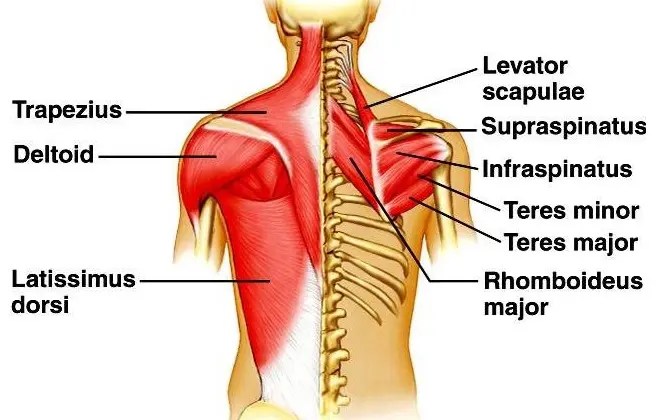
While you don’t need a degree in functional anatomy to build bigger lats, it may be helpful to know a little more about this massive muscle so you can choose the best exercises to train it.
Latissimus dorsi means side back muscle, which tells you (in Latin!) where your lats are. The lats basically connect your arms to your torso and, as such, they control several upper arm movements.
The functions of the lats are:
Adduction of the shoulder joint
Adduction means to draw a limb into the midline of your body. The lats adduct the shoulder joint, meaning they pull your upper arms down and into your sides, such as during lat pulldowns or wide-grip pull-ups.
Extension of the shoulder joint
Besides adducting your shoulder, the lats are also responsible for shoulder extension. This means drawing your upper arms backward. Exercises that involve this movement include seated and bent-over rows.
Medial rotation of the shoulder joint
Medial or internal rotation means turning inward. The lats are a back muscle, but they attach to the front of your humerus. As such, when they contract, they turn your upper arms inward. Doing a front lat spread pose is an example of this movement.
To develop your lats fully, you need to perform exercises that involve shoulder adduction and shoulder extension. This means your workout needs to include vertical AND horizontal pulling exercises.
More on Latissimus Dorsi:
- Inverted Row Exercise Guide and Videos
- Cable Incline Pushdown Exercise Guide and Videos
- Cable Straight Arm Pulldown Exercise Guide and Videos
- Cable Pulldown Exercise Guide
- Train For Full Body Gains And Function With The Renegade Row
- How To Do Seated Cable Row (Back)
- How To Do Decline Bent-Arm Barbell Pullover (Lats, Chest)
- How To Do Incline Straight-Arm Pull-Down (Lats)
- How To Do Cable Straight Arm Pulldown (Lats)
- How To Do Barbell Rack Pull (Back)
- Machine One-Arm Row (Back)
- One-Arm Lat Pull-Down (Lats)
- Standing Twisting Cable Row (Back)
- Weighted Inverted Row (Back)
- Bent-Over One-Arm Cable Pull (Lats)
- Seated One-Arm Cable Row (Back)
- Standing Twisting Cable High Row (Back)
- How To Do The Landmine Row
Wrapping Up
Bodybuilders have a saying; if you want to grow, you’ve got to row! And while rowing exercises are crucial for building a bigger, more muscular back, so too are vertical pulling exercises like chin-ups and pulldowns.
So, if you are serious about building the best back possible, make sure you attack it from both angles with vertical and horizontal pulling exercises. That way, you’ll sculpt a back that’s wide and thick.
Interested in measuring your progress? Check out our strength standards for Chest Supported Dumbbell Row, Dumbbell Pullover, Pendlay Row, and more.
 You can also follow us on Twitter, Facebook, Instagram, and
YouTube for even more content.
You can also follow us on Twitter, Facebook, Instagram, and
YouTube for even more content.